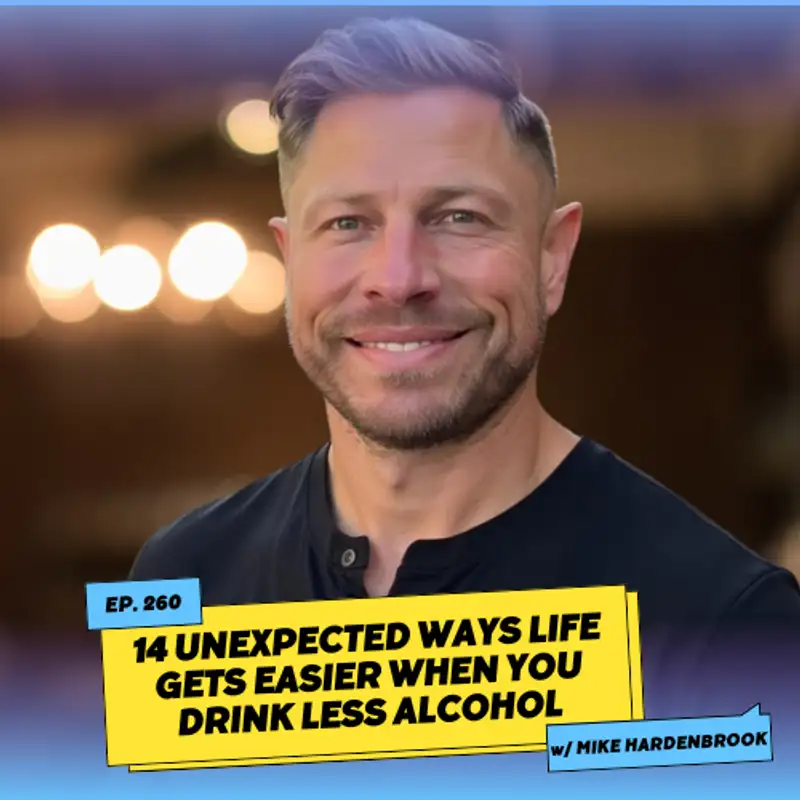
14 Unexpected Ways Life Gets Easier When You Drink Less (Part 1)
Welcome to Journey to the Sunnyside, the podcast that helps you build a better relationship with alcohol and uncover the secrets to mindful living. Each episode brings you real stories, expert insights and practical tools to support your goals. Whether you're cutting back, taking a break or thinking about quitting for good. I'm your host, Mike Hardenbrook, bestselling author, neuroscience enthusiast and habit change expert. This show is brought to you by Sunnyside, a personalized science backed program that helps you to drink less through habit change, coaching, and community.
Speaker 1:And for added support, we now have Sunnyside Med, a clinical option offering access to compounded Naltrexone, a prescription medication that reduces cravings and helps prevent binge drinking. Ready to start your journey? Get your free fifteen day trial at sunnyside.co. Hey, everybody. Welcome back to another one of these ten minute Mondays.
Speaker 1:Today, I wanna talk about the benefits of drinking less. This is all about motivation, but I wanted to do it in the not normal way because most people already know the obvious ones. We already know our sleep gets better. We already know that we're going to have less hangovers. Maybe we might lose some weight.
Speaker 1:Maybe you'll feel a little bit more in control. And while that's all true and it is motivating, I don't think it's the only thing that's motivating. The more interesting part is what happens underneath those benefits, the stuff kind of nobody really talks about because it's not the obvious thing until you're looking at it. So today is not the obvious benefits of drinking less. It's more of the hidden ones that you haven't heard of or maybe you didn't think about.
Speaker 1:Just the little things where you can go, Oh, I didn't realize alcohol was actually connected to that. I've got 14 of these and we're going to break this up into a two part series. We're going to do seven today, seven in the next one. Let's get into it. Number one, you stop outsourcing your off switch.
Speaker 1:This one is obviously one of my favorites because it's tied to my history, but it's also pure Sunnyside. A lot of us use alcohol as that off switch. It's the thing that ends the workday. It's how we stop thinking. It's how we go from on to off, especially at night.
Speaker 1:And it works. And that's also the problem because if alcohol is what usually you use to get your off switch, then you never really practice doing it on your own. So that ability to wind down, it gets rusty. You can still do it, you just haven't been doing it in a while. So when people drink less or take a break, it's not really removing the alcohol, it's actually what they do at the end of the day to really come down from it because they feel maybe stuck in this on position.
Speaker 1:Now here's the good news. It comes back. Now you practice the end of the day in a different way and within a couple of weeks, your body learns how to downshift on its own. Now you've got that off switch that you can go anywhere with. It can work on a Tuesday.
Speaker 1:It can work on your vacation. It can work on nights when you're stressed out. And the benefit is that when you change your drinking, you're not gritting through all of this. You have relearned to use this skill and you've got that ability back that the drink had been handling for you for quite a while. Number two is the drink is the first domino.
Speaker 1:So I'm gonna skip the whole boring calorie angle. We already know that alcohol has calories, and if you drink less, you have less calories. But the more interesting thing is how alcohol becomes the first decision in a chain of decisions. It's rarely the drink itself. It's the drink, then the chips.
Speaker 1:It's the drink, then, hey, pick up the phone. Let's order something. But it's more than that. Then there's the drink and then tomorrow you're tired, so your workout gets skipped. Or there's having drinks and then you want comfort food the next day because you feel like crap and your sleep was off and your mood is low.
Speaker 1:So the drink is just one domino, but it quietly knocks over maybe five more. And there's even research suggesting that alcohol can nudge people towards more savory, ultra processed foods, which we know are not good. So number two is the benefit of drinking less really isn't just fewer calories, which a lot of people will cite. It's actually cleaner decision making. It doesn't have to be perfect.
Speaker 1:It's never gonna be perfect. And in fact, sometimes when I'm not drinking, I tend to cheat a little bit more because, hey, I deserved it. But nonetheless, I'm not making these downline decisions on a regular basis because of alcohol. Number three is coffee stops doing cleanup duty. Now this one sounds small, but I actually think it's big.
Speaker 1:A lot of people are not just in an alcohol habit. They're actually in an alcohol and caffeine loop. So alcohol at night obviously helps you shut down, but you end up sleeping lighter, you wake up tired, then coffee has to basically drag you through the morning. And then that caffeine over the day can make you feel more wired. It can also make you crash in the afternoon.
Speaker 1:So then by evening, you want something to take that edge off. And guess what? Alcohol is right there again. So it's not just, I want some wine tonight. The actual reality might be more like, I'm using alcohol to come down from a day.
Speaker 1:That caffeine helped me to survive because alcohol made my sleep worse the night before. And as you can see, that's a loop. And when you drink less, sometimes you'll even notice by default that that coffee habit, if you have one, is starting to shift on its own because the morning, it doesn't feel like you need to rescue yourself from a hard night's sleep and a full day ahead. Number four is you stop blaming your stomach. Here's another one that people rarely connect to drinking.
Speaker 1:A lot of people deal with stomach stuff. Maybe it's low grade, and they assume it's food or stress or, you know, that spicy dinner or maybe just part of getting older. But there's actually a connection to alcohol. It relaxes the valve on top of your stomach that's supposed to keep the acid down and it bumps up acid production at the same time, which is why reflux can show up for some people, especially in the middle of the night, which then also contributes to poor sleep. And this isn't just something for people that drink heavily.
Speaker 1:This is for even moderate amounts. And wine, guess what? My favorite is the biggest offender. So when you drink less, a lot of people will notice that their stomach settles down. They can eat better.
Speaker 1:I know for me, I felt less bloated. And you can spend years, maybe even your entire adult life, thinking that you have this sensitive stomach. And then when you make these changes, all of a sudden you realize that there's one culprit. Alright. Number five is going to sound a little counterintuitive.
Speaker 1:The drinks start working again. Here's one almost nobody really frames as a benefit because it kind of sounds backwards, to be honest. When you drink on a regular basis, we already know that your tolerance will go up. So the same thing, let's say two drinks used to do, now take three or four or maybe even more. And a lot of people miss this as part of the whole process that runs in reverse as well.
Speaker 1:When you cut back, even just for a couple of weeks, your tolerance starts to come back and your body gets more sensitive to alcohol again. So the drinks you do have are actually working. One glass does what two used to. You still get that chill out, end of the day feeling. People assume drinking less means giving up the entire payoff, but you might be surprised that over time, you're not actually losing much.
Speaker 1:You're getting that sensitivity back. You're not having the downsides from having a couple drinks or one drink. But overall, less is more. You have less. You can enjoy it when you have it more.
Speaker 1:Number six is you remember tomorrow better. Now this isn't what you're thinking, and it might sound a little bit strange at first. But when people think about alcohol and memory, of course, they think about remembering last night. Did I remember this conversation right? Did I get home right?
Speaker 1:Hopefully that doesn't happen often, but that's usually how we associate alcohol. But there's actually another kind of memory that matters more in our daily life, and it doesn't have to be this big amount of alcohol. It's called perspective memory, and that's basically remembering the things that you intend to do later. Maybe it's send an email. Maybe it's a call person back.
Speaker 1:Maybe it's to follow through on what you said you'd do. That's not memory from the past. That's memory for the future. And alcohol has actually been studied here. And I'm going to set aside a heavy drinking night.
Speaker 1:We're just talking about normal moderate levels of drinking can make it harder to follow through on those future intentions. And, of course, heavier drinkers report more of these in everyday life. But this matters because most people don't experience the cost of drinking as one big disaster. We experience it more in these small, unreliable ways. So if we can't rely on ourselves and we're not getting back to people, we're forgetting things, we're starting the day behind, Maybe we're breaking little promises.
Speaker 1:Those things, they add up, and you might not even notice them. So you remember tomorrow better. And then number seven, a big one, confidence starts to transfer. This is where I wanna leave part one because it is one of those big ones, and it also bridges to next week. A lot of people use alcohol for confidence, and I get that.
Speaker 1:It can make you feel more social. It can make you feel more relaxed and open. And maybe even the version of you that doesn't overthink things and feels confident. But alcohol confidence has one problem. It only works when the alcohol is there.
Speaker 1:So every time you use it, you get through that moment, but you don't really build any evidence to yourself that you could have done this without the drink. Now let's flip it the other way. Let's say you go to dinner and drink less and it's fine. That's evidence. Let's say you go to a party and you drink less and you're still connected to people.
Speaker 1:That's more evidence. Let's say you make it through an awkward conversation that you've been avoiding without needing three drinks first. That's evidence. Now there's research backing this up. People who take a break from drinking report more confidence handling situations without having the alcohol.
Speaker 1:That is real confidence, the kind of confidence you can actually carry to the next situation. We all know at first, drinking less starts to change your mornings, right? Well, it also slowly starts changing what you believe about yourself. So next week in part two, I got seven more. Things like why the first drink is the only one really doing anything, what alcohol does to a hard conversation, why the hardest hour of your day is also wine o'clock, and the big one, what all of this does to whether you trust yourself.
Speaker 1:Because the real benefit of drinking less isn't just feeling better the next day, it's slowly becoming someone that you can count on. Okay. Thanks for hanging out with me this week. If you got anything out of this, please rate and review. Send me an email, mikesunnyside dot co.
Speaker 1:And until next time, cheers to your mindful drinking journey. Journey to the Sunnyside is brought to you by Sunnyside, a personalized science backed program that's already helped over 500,000 people cut out more than 24,000,000 drinks. No matter where you are on your journey to build healthier drinking habits, Sunnyside meets you where you are. And now with Sunnyside Med, you can access compounded naltrexone, a doctor prescribed medication proven to reduce cravings and prevent binge drinking, giving you the peace of mind you need to make lasting change. If you could benefit drinking a bit less, head on over to sunnyside.co for a free fifteen day trial.
Creators and Guests