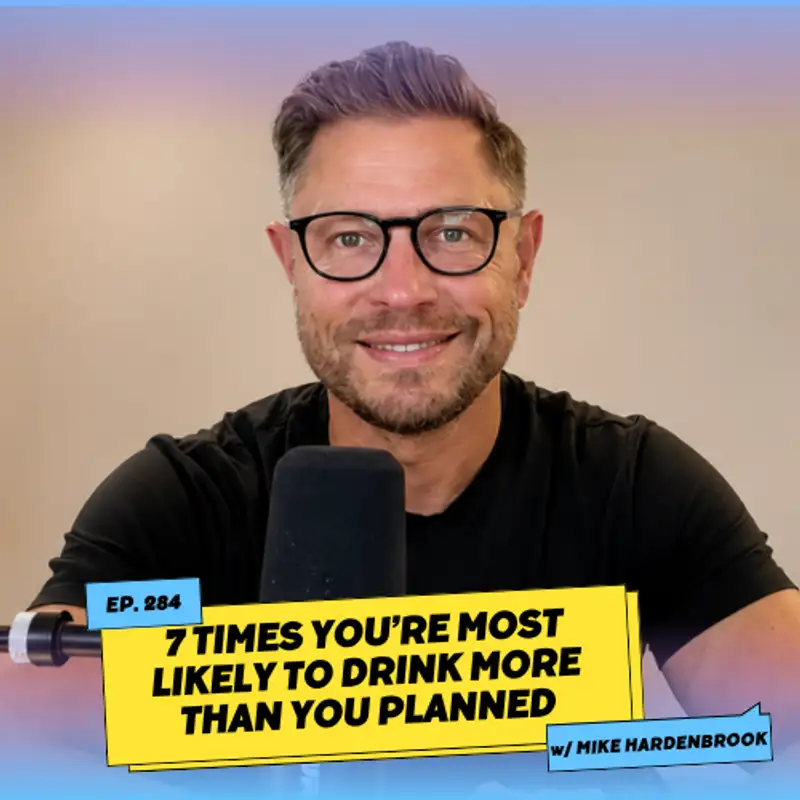
7 Times You’re Most Likely to Drink More Than You Planned
Hey everybody. Welcome back to another one of these ten Minute Mondays. Now most of you have had a night where you drank more than you planned. Otherwise we probably wouldn't be listening to this podcast. Now I've been there because, Hey, I wrote a whole book on that.
Speaker 1:You might not have been trying to have a big night and maybe you were just thinking, Hey, I'm going to have two, but you had four or more, or you were just going to have a glass of wine and then somehow that whole bottle disappeared. I've always been interested in why that happens because when you look across enough of those nights, it's not always random. And there are actually certain situations where it's just easier to end up drinking more than you intended. So in this episode, I came up with seven for us to cover. And you might not relate to every single one of them, but I bet you're going to recognize a couple of these with yourself.
Speaker 1:Number one is drinking wasn't the original plan. Let's say you weren't even going to drink tonight. Then 06:00 rolls around and you start to change your mind. You actually think, you know what? I do want to have a drink tonight.
Speaker 1:And there's nothing wrong with that. Plans can change. But here's the part I think that is easy to miss. Your plan was to not drink. Now it is to drink.
Speaker 1:So your plan is essentially zero. Once zero becomes one, what's the new plan? I've had nights where the answer was basically, I don't know. I'm just having drinks now. And I never really replaced the original plan with another one.
Speaker 1:And that's a very different situation from deciding ahead of time. You know what? I'm going to have two tonight. Changing your mind doesn't have to mean that you're throwing the plan out completely. So if zero was the plan and it's no longer the plan, it's really useful to decide beforehand when that plan changes what you want before the night starts making those decisions for you.
Speaker 1:Number two is nobody really knows how much is in the glass. And this happens all the time, especially with wine and mixed drinks at home. We tend to count drinks as if a glass is the measurement. I only had two glasses of wine. Okay, but how much wine was in each one of those?
Speaker 1:And researchers have actually tested this. Even experienced bartenders poured substantially different amounts depending on the shape of the glass that they were using. And things like wine that can be even harder to track. You pour some, maybe later you top it off. Maybe you top it off again before it's empty.
Speaker 1:And at the end of the night you say, Hey, I just had three glasses. Maybe. I'm not suggesting that you pull out the measuring cup every single time that you have a drink. Just remember that sometimes that number that you think that you're keeping track of isn't actually as precise as it might feel. Number three is the drink ends before the activity does.
Speaker 1:And I notice this when I'm watching a movie. I'll sit down with a drink and then thirty, forty minutes go by and the drink's gone. But guess what? The movie is not over. And there's this subtle feeling that those two things, they're supposed to go together.
Speaker 1:I'm still watching the movie. So I'm going to go pour another one. It's not necessarily that I stopped and thought, I really want another drink. The thing that I associated the drink with just isn't over yet. The drink and the activity are actually running on different clocks.
Speaker 1:And you see this all the time. Things like watching a football game, sitting outside with friends, or having a long dinner. Sometimes the activity, rather than how much you actually want to drink, ends up determining when you're done. Number four is someone else is setting the pace. And this really isn't about peer pressure.
Speaker 1:Nobody is really trying to get you to drink. You're with somebody who's drinking faster than you. They finish theirs. They get another. They ask if you want one while they're up.
Speaker 1:Hey, sure. Now you have another drink. There's quite a bit of research showing that people tend to adjust their drinking to the people around them. And in these experiments, when someone else drinks more or faster, people often increase their own drinking too. Now this can be obvious when we're talking in this capacity, but I think it's almost invisible when it's happening.
Speaker 1:You aren't copying somebody on purpose. Their drink just creates another opportunity for you to have one too. So for example, if I'm drinking with somebody that has three drinks in the time that I'd normally have two, I can end up moving closer to their pace without even deciding that's what I'm going to do. Number five is tomorrow doesn't need much from you. Friday night obviously feels different than a Tuesday night.
Speaker 1:And apparently we're not imagining that. Researchers have tested what happens to people's desire for alcohol when they have responsibilities the next morning. When people imagined having meaningful things that they needed to do the next day, big surprise, they generally chose less alcohol than when nothing was waiting for them. And that includes things like work and caregiving responsibilities, which of course makes sense. If I know I have to be up early tomorrow, that matters when I'm thinking about, am I going to have another drink?
Speaker 1:If I can sleep in until ten, well, the reason to stop, that's going to carry less weight. Now that doesn't mean the Friday needs to look just like Tuesday, but if the nights where you consistently drink more than you planned are also the nights where tomorrow is pretty much wide open, there's probably something there. Number six is the first drink really works. Sometimes that first drink does exactly what you wanted it to. You feel that immediate shift.
Speaker 1:Maybe you've been looking forward to it even for a few hours and now you're finally sitting down with a drink and it feels good. The interesting thing is what your brain does with that experience. It doesn't necessarily say, Great, we got what we wanted. We came. We're done.
Speaker 1:No, it actually can make you want another one. The research on this is something called alcohol priming. Across experimental studies, an initial dose of alcohol has been shown to increase motivation for more alcohol, including cravings and subsequent drinking. So the fact that that first drink worked can actually be part of what makes the second one more appealing. But here's the weird part: you can't have that first drink twice.
Speaker 1:The biggest change has already happened. So going from no alcohol to that first drink isn't necessarily the same as going to the second or the third. And I know that I've had nights where I'm still pouring another drink even though, if I really think about it, I've already got what I originally wanted. And that's also worth noticing. And then number seven, you already went over the number that you planned.
Speaker 1:This is the biggest pitfall. Let's say you planned two, you had three and then comes the thought that I've definitely had before. Well, I already blew it. Once you would think this way, having four or five or more can suddenly feel very different. And psychologists have studied a related idea called the abstinence violation effect.
Speaker 1:And it originally came from research around abstinence and relapse. So I'm not saying that having three drinks instead of two is really the same thing, but there's something useful in the psychology. Once we decide that we've failed at the thing that we're trying to do, it can become easier to stop trying altogether. There's even researchers with drinkers showing that feeling bad after breaking your own drinking limit can be associated with worse self regulation afterwards. For me, the useful part is much simpler.
Speaker 1:Three isn't two. But three isn't six either. Having one more than you planned doesn't mean the rest of your night no longer counts. Now when you look at this whole list, that's really what I find useful about it. You don't need all seven.
Speaker 1:There are a few here that I recognize immediately in myself and you probably have two on your own. Maybe it's changing your mind around drinking without deciding what that new plan is. Maybe it's the nights when you have absolutely nothing to do the next morning. Just find one or two that keep showing up. Because if you consistently drink more than you planned under the same circumstances, then that's useful information for us to move forward.
Speaker 1:So the next time that you're in one of those situations, you're going to know where your original plan tends to get a little bit harder to follow. And sometimes just knowing ahead of time gives you a better shot at ending the night where you actually wanted to, or at least close to it. Okay. Thanks for hanging out with me this week. If you got anything out of this rate and review.
Speaker 1:Until next time, cheers to your mindful drinking journey.
Creators and Guests