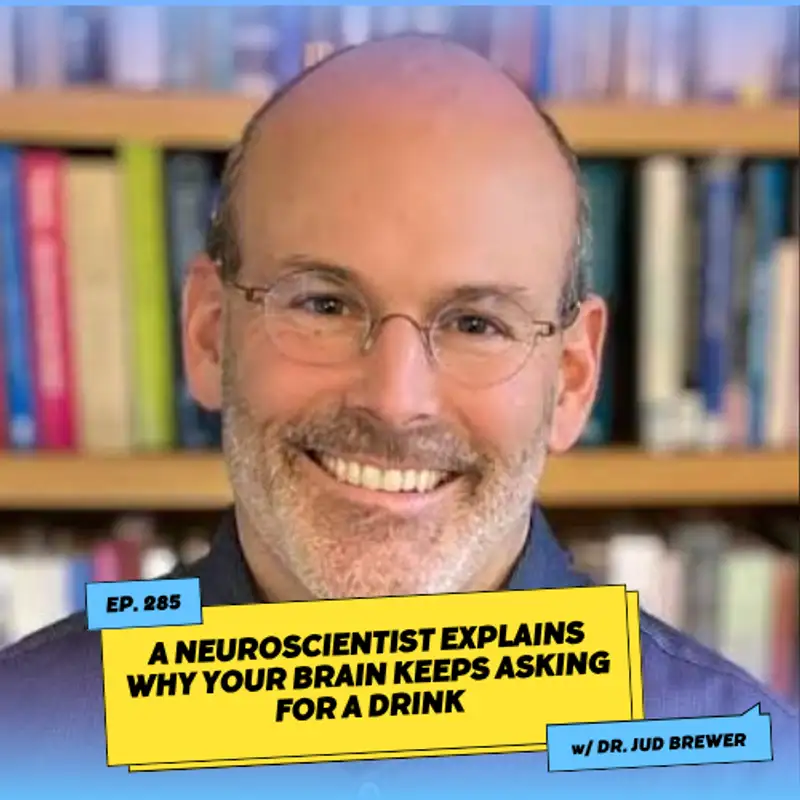
A Neuroscientist Explains Why Your Brain Keeps Asking for a Drink w/ Dr. Jud Brewer
Have you ever looked forward to a drink, then started drinking it, and realized you weren't actually enjoying it that much, and yet, the next evening, looked forward to it all over again? That's something I wanted to ask today's guest, Doctor. Judd Brewer. He's a neuroscientist and psychiatrist, a professor at Brown University, and the New York Times bestselling author of Unwinding Anxiety. I wanted to understand what keeps that desire going, and what actually helps us change it.
Speaker 1:Judd explains why getting curious about your drinking can do more than just telling yourself to drink less. And I gotta ask him something I've wondered about for a while. Do we really love the taste of wine or whiskey, or do we love what we've learned to associate with it? Let's get into it. Judd, thanks for coming on today.
Speaker 2:Thanks for having me.
Speaker 1:That's gonna be a great conversation, and we're gonna jump right into it because I'm gonna ask you this. What do most people under... Misunderstand about their own habits?
Speaker 2:Well, I would start by saying most people don't understand how habits work at all. You know, they kinda say I have a habit. I don't know what to do about it. So I would say that misunderstanding starts with really not knowing how their own minds work.
Speaker 1:Yeah. Do you think that understanding habits helps you to change them?
Speaker 2:A 100%. You know, that's usually where I started my clinic is just helping my patients understand how habit loops form.
Speaker 1:Yeah. So what is that? What is the beginning start where you try to explain to somebody that has less than basic knowledge around habits? What do you want them to understand when you first talk to them?
Speaker 2:Yeah, I usually start with a behavior that they might have and then I help them trace it out. So for example, a lot of my patients in my clinic, whether they struggle with addiction or anxiety, let's take anxiety as an example, because I don't know anybody that doesn't have some level of anxiety. Most people can relate to this. So I will ask people to just describe what they're struggling with. And usually, they'll say something like, well, I feel anxious.
Speaker 2:I can't stop it. And then we start to trace it out and say, well, what do you do when you're anxious? And usually, they do some related behavior. The most common one is worrying. They'll worry about the future, they'll worry about keeping a family member safe or whatever.
Speaker 2:It might be a derivative of that, like stress eating or something like that. But let's just take worrying as an example. Once we can identify the anxiety and the worry, then the only other thing we need to identify to get the full loop is figure out what's happening, like what the result of that behavior is. So any habit gets formed through three elements, a trigger, a behavior and a result. So in this case, anxiety is the trigger for the mental behavior of worrying, and the result is typically people, you know, gives them the illusion of control or feeling like they're doing something.
Speaker 2:And because doing something feels better than doing nothing, that worry as a behavior gets reinforced. So the next time they feel anxious, they start to worry again, and it sets up that loop.
Speaker 1:One thing I'd like to think about is... And I think a lot of people aren't sure about these habits become something that we actually just do. But at one point, does it stop being something that we're choosing to do and starts to become something that we're automatically doing?
Speaker 2:Most habits form pretty quickly, actually. And so by definition, a habit is is a behavior that we're performing automatically. And most habits that we have are actually very helpful for survival. Imagine waking up in the morning and then having to relearn everything from walking to putting on your clothes to eating to making coffee. I don't think anybody would make it past breakfast before being exhausted because they'd have to be learning all of this stuff over and over.
Speaker 2:So we set up these habits early in life. You probably remember, that kids, they're learning to eat, first, they get the food near their mouth, then they get the food in their mouth. And as adults, most of us can get our food in our mouth at the first try now. Right? So there's an example of a habit that we just take for granted.
Speaker 2:So we set these habits up relatively quickly, and then we forget about all the details. I think of it as set and forget.
Speaker 1:Yeah. Well, we get into these habits. Some of them are great habits. Some of them are ones that we continue doing, and we don't know why we keep doing them without changing it. So what actually makes us want something and why we keep wanting it even if the reward isn't there anymore for us.
Speaker 2:Well, as you're getting at any habit that gets set up as a habit has to be rewarding at first. Otherwise, we won't set it up as a habit. If we slam our hand in the door and it hurts, we're not gonna set that up as a habit. So there has to be some rewarding quality. As we just talked about, habits can get set up pretty quickly to the point where we're not even noticing whether they're rewarding or not anymore.
Speaker 2:Let's use an example. Smoking, for example, is an interesting one because most people that smoke start to smoke in their teenage years. I think all the patients in my clinic that I've worked with, they've started smoking around the age of 12 or 13, and that's even the case for the clinical studies that we've done. So at the time, they typically describe it as they smoke a cigarette, but cigarettes don't taste very good. They feel nauseated because nicotine's a toxin.
Speaker 2:But there's something rewarding about that experience, and the reward is usually being rebellious or being cool at school or having some social reward that is higher or more rewarding than all the nasty stuff that comes from smoking a cigarette. So here, this is the case for any habit, is that we might do something early on where it feels rewarding at first, smoking a cigarette to be cool, worrying or whatnot, but then once it becomes habitual, we're not actually paying attention to how rewarding it is. And in fact, it can become so familiar that changing the habit feels uncomfortable because it's doing something different. So in this case, there are a lot of behaviors that we do that are not rewarding, but we don't feel like we can stop. Overeating, not rewarding.
Speaker 2:It's bad for our health. Worrying, in particular, bad for our mental and physical health.
Speaker 1:Yeah. I think specifically around alcohol, like, it did provide a a reward at one time. And then some people age out of that when they're younger. Most of that experimentation and the habits grow when you're younger. And then some of us carried it on into adulthood, and yet we carry it on, yet the reward versus the pain is probably lopsided.
Speaker 1:It went from a lot of reward to a little bit of pain. Now it's more like an automatic behavior with a lot more pain. I think the brain understands that the reward is outweighed now by the pain, but that doesn't necessarily give us the answer. How do you approach that?
Speaker 2:Right. So one, often there's this term denial, right? Often people are not paying attention to the pain that's actually part of the experience. So it could be personal pain, the hangover, and they'll say, oh, try to forget it or take some aspirin, drink, do all the things to try to minimize the hangover so that it doesn't feel so bad. And then by the afternoon, they forget that it was it was that throbbing headache in the morning and the anxiety to go with it.
Speaker 2:That's just one example. All the social pains, we tend to minimize those types of things, ignore a lot of the problems that come, say, with alcohol in particular, but any type of drug use or something that we're doing despite adverse consequences, right? That's the definition of addiction is continued use despite adverse consequences. So first, there's gotta be that sobering up and really looking very, I would, yeah, I think soberly is the right word. Like seeing the results very clearly, and that's something that we often don't see.
Speaker 2:Some of that has to do with delayed effects where we might not see effects immediately, or we might be intoxicated. And so the things that we're doing, we're not paying attention to. So that stuff has to get registered as a composite reward value or lack of a reward before people can really see this clearly. At the extreme end, this is where rock bottom comes in. Often people say, Oh, you have to hit rock bottom.
Speaker 2:You don't have to hit rock bottom. A lot of people do, and it's really unfortunate that's how they change their life around. But we don't have to do that. We can really start to pay attention and even pay careful attention when we compare, say, drinking to not drinking. Often, if people have had the regular habit of even drinking a couple of drinks a night, they might not notice that it's actually affecting small parts of their life, like sleep, like anxiety, and things like that, until they've actually stopped doing that for a little while.
Speaker 2:And so here, it can be important to have that contrast where it's like, well, what's it like when I drink? And what's it like when I don't drink, say, a week, and then check my sleep, check my mental health, check all these other things to see how I'm doing? This is, of course, if somebody is somewhat dependent, this is after they've gone through the withdrawal and all this stuff and and are at some level of baseline at that point.
Speaker 1:Yeah. I totally agree. For a lot of people, rock bottom will never come, and yet it's still negatively affecting them. And it's not, if and when necessarily. It might not come at all.
Speaker 1:And I've been doing a lot of thinking around this and what happens what I call between the promise and the poor. Now the promise in the morning that I'm not gonna drink tonight or next weekend the same way I did and trying to figure out, like, why there's two personalities there. And I take it down to another level related to rock bottom in that we always wanna look at the milestones. The milestones that are taken away, the career, the marriage, all the things associated with rock bottom, yet we overlook what I call the margins, which is the patience when somebody snaps at you that you might have if you weren't drinking the day before or the enthusiasm that you wake up to have a podcast together here or just all these little things. So I think that, like, getting to that understanding is a big part of habit change.
Speaker 1:Now what I'd like to do though is I wanna go back to your smoking example because I know that you get into actually looking at the habit itself and the the taste and the smell. You talk a little bit about how that sort of changes somebody's perception with their current habits?
Speaker 2:Yes. So we can use smoking as an example and then even get into some more nuanced ones like stress eating or anxiety or using social media. Smoking's an interesting one because it's so habitual for most people. I'd say somebody smokes a pack a day. There's probably 15 out of 20 times they're really not paying attention as they're smoking the cigarette.
Speaker 2:Some of them, they're not paying attention at all. Had a patient. He'd been smoking like forty years, and I told him to pay attention as he smoked. And he came back to the next visit incredulous. He said, how did I not notice this before?
Speaker 2:And what he was pointing out was that cigarettes taste like crap. And he, for forty years, he'd been ignoring that. So that's the first step in any habit changes to really pay attention to the direct results right now. How rewarding is this for me right now? With cigarettes, I have my patients pay attention to what the taste is, what it feels like going into their lungs, what the smoke smells like, all of that.
Speaker 2:And pretty quickly, they learn that cigarettes are not very rewarding at all. What that does is updates the reward value in our brain so that we can see, oh, this isn't as rewarding as I thought. Now smoking's a relatively clear example because it's not something that we need to do to survive. In fact, it's an anti survival strategy. It affects our health in many, many ways and not in a good way.
Speaker 2:Let's take eating as a more subtle example. We all have to eat to survive, but we don't have to stress eat, we don't have to overeat, and those are things that are actually detrimental for us. So here I have people pay attention. For example, if they tend to overeat, I have them pay attention with each bite to see if it's more rewarding, the same or less rewarding than the last bite. And what they can do is map out what I call the pleasure plateau as they're eating.
Speaker 2:You know, if somebody's hungry, food's gonna taste really good with that first bite, but when they start to reach satiety where they're nearing fullness, it actually changes. Same type of food, same exact food, in fact. It's just that their body's registering that they don't need so much. So what I have them do is pay attention so they can coast to a stop at that pleasure plateau where they've had enough to eat, but they haven't overindulged before they go off that cliff of overindulgence. So those are two physical examples.
Speaker 2:Mental example, we've already touched on a little bit, is worrying. And worrying's challenging because a lot of people just feel like that's who they are. They just worry all the time. But in fact, it's a habit that we develop. And so I have them ask themselves, what am I getting from this when they're worrying to see what the direct results are right now.
Speaker 2:And typically, they feel more anxious when they worry, and it's using up a lot of energy. Mentally exhausting to worry, and it doesn't solve any problems. And in fact, it gets them stuck in the same perceptive loops over and over and over.
Speaker 1:Yeah. I think that worry, if you get stuck in that loop, you actually feel like you're problem solving and you mistake the two together. And some people literally find things to worry about so that they feel like they're being proactive.
Speaker 2:Yes. Unfortunately, it's a fool's errand because by definition, worrying is going over the same thoughts over and over and over. So that is not solving a problem because if they'd solved the problem, they wouldn't need to think about it anymore.
Speaker 1:She wanted to get into this this taste and sensory perception when it came to the... You drew the line with overeating and also with with smoking, but I actually wanted to get your feedback on this related to alcohol because alcohol, you give it to kids, tastes terrible. Right? And yet adults will say, oh, I love my wine. I love my whiskey.
Speaker 1:And I I actually have a whole theory on IPAs that nobody actually likes a IPAs. They just like the I a b b on them because I I like beer and I don't like them. But do you think how closely linked is that statement of people saying, oh, I love a good Cabernet? Do they actually love it, or are they... Is that reward so attached to that that they're bullying themselves?
Speaker 2:Mhmm. That's a great question. So I can't speak for everyone. And there are certainly people that really seem to appreciate the taste of certain drinks. Red wine connoisseur.
Speaker 2:Great. You know? Game on. But for a lot of people, and you're highlighting this, for example, with hard alcohols where the feeling of the burning, you know, going down somebody's So they... Typically, learn to associate that with something pleasurable.
Speaker 2:So when people are first introduced to alcohol, often it's in their teenage years, and it's through something, usually a party or something, where it's some festive occasion. And then adults, one of the most common reasons that people drink is for social reasons and to relax. Let's let's go out for happy hour. Let's go have a relaxing drink before dinner or after a long week at work or whatever. And so they're associating that with relaxation.
Speaker 2:And of course, for a lot of people, it is that social lubricant, it can feel like it helps them wind down a little bit. And so the alcohol itself, regardless of the taste, but the alcohol itself is having certain effects. So there are these physiologic effects that people have, and then they associate that taste with, oh, yeah, because it's all that good stuff that came with it that they're bringing in as compared to, you know, like, oh, I love the taste of burning, which doesn't... When you say it, it's just... It's funny.
Speaker 2:It's like, who loves the taste of burning?
Speaker 1:Yeah.
Speaker 2:Oh, it's that that feeling of burning that's associated with something else that is pleasant. Burning is generally not pleasant. It's burning.
Speaker 1:Yeah. I see people drink scotch on, you know, TV or whatever, and it's got a great color. It's sitting in an ice cube, but at the same time, I'm not a scotch guy. I'm like, that's disgusting. I know what that tastes like, and I don't know.
Speaker 1:I just don't... I guess I can't... I do like a red wine, but I also put myself into before those years. Would I pick... If I had grape juice and red wine when I was a kid, which one would I pick up for taste?
Speaker 1:Obviously, the grape juice, you know. Alright. So I wanted to get into anxiety because, you know, you may have written a book about that, but you also wanted to bring it up in this conversation. Tell me why.
Speaker 2:It was probably the most important thing that I never learned in medical school.
Speaker 1:Mhmm.
Speaker 2:So I was taught in medical school and residency to prescribe medications for anxiety. And unfortunately, when you look at the data, it's only about one in seven people that shows a significant reduction in symptoms when they take the best medications out there. So there's a class of medications called the selective serotonin reuptake inhibitors first line treatment for anxiety, one in seven. So I'm basically playing the anxiety or the medication lottery when somebody comes to me and they need help with anxiety. I don't know which one of those seven people is going to benefit, and more importantly, what to do with the other six.
Speaker 2:So I was struggling with this in my own clinic. At the time, we had developed an app based training for eating, and we're getting some pretty good results from it. And folks in that program were saying that anxiety was driving their stress eating, and it asked me to develop a program for anxiety. But at the time, thinking, well, I prescribe medications. But that prompted me to go back and look at the literature.
Speaker 2:And back in the 1980s, there was a guy, Thomas Borkovic, who suggested that anxiety could be driven through negative reinforcement. So basically, it could be driven like a habit. And I had this huge light bulb moment where, because my lab had been studying habit change for years at that point, and we were getting at the basic mechanisms and how to change it. We'd done a study where we'd gotten five times the quit rate of gold standard treatment for smoking. So we were seeing some pretty good results.
Speaker 2:So I said, well, what if we develop a program to treat and help people with anxiety? And the idea was to first help them map out these anxiety habit loops. You and I talked about that a little bit earlier so that they could see what was actually happening. I'll give an example from a patient just to make this clear. I had a patient who came in who was about 40 years of age when he first came to see me, and I came in, he looked pretty anxious.
Speaker 2:He had basically developed panic disorder over the last few years where he couldn't drive on the highway, barely was driving on local roads. He'd been panicking since he was about in fifth grade. So he met all the criteria for panic disorder, all the criteria for generalized anxiety disorder. He had no idea what to do. And so we first mapped out his habit loop around anxiety, and I sent him home just a map just to see how often it came up.
Speaker 2:And so what we started, so there's this example of somebody who's really struggling. The first idea is just to see that it's a habit, so that in itself provides a lot of relief, and that's what this patient even showed. He was like, Oh, I didn't have an idea that this could be a habit. It gave him a lot of hope because a lot of people have tried everything for anxiety, and nothing has worked, often because most treatments don't actually get at the root cause. So he comes back two weeks later.
Speaker 2:First thing he says, Oh, and by the way, he was four hundred pounds when he came to see me. So very unhealthy weight. He had he had high blood pressure. He had basically pickled his liver. He had obstructive sleep apnea, basically this physical condition related to his weight that was making him not sleep well and have problems.
Speaker 2:And so he comes back two weeks later, and the first thing he says is, Hey, doc, I lost 14 pounds. And I looked at him because I didn't think, I didn't remember that we had talked
Speaker 1:about weight loss at that point. We were just going to
Speaker 2:focus on this anxiety. And he said, yeah, I was mapping out these anxiety habit loops, and this anxiety was leading me to eat fast food. I'd been doing this for decades. And I realized that the fast food was actually not helping my anxiety. It was making it worse because I had all this health anxiety on top of my regular anxiety.
Speaker 2:And he said, so I stopped doing it. So that's the key for anxiety is seeing how unrewarding the worrying is, how unrewarding the other coping mechanisms are, whether they are stress eating or going to social media or whatever, and then becoming disenchanted with those behaviors. In fact, we did a study with one of our programs where we got a sixty seven percent reduction in anxiety in people with generalized anxiety disorder, and this is relative to only fourteen percent in people who are getting usual clinical care like medications, psychotherapy, things like that. So approaching anxiety as a habit and getting at that root cause actually worked very, very well. This patient went on to lose over 100 pounds.
Speaker 2:He's kept that weight off. He didn't do any yo yo dieting as part of this because he'd really gotten at the cause, the heart of it. And he said it was the easiest weight loss he'd ever had. On top of that, about six months into treatment, I was walking out of our School of Public Health at Brown University. It's on Main Street, so pretty busy street.
Speaker 2:This guy pulls up in his car, rolls down his window, it's my patient. I'm thinking this is great. And he goes, yeah, hey, doc, I'm an Uber driver now. I'm headed to the airport to pick someone up. And so there's an example of when we can really treat anxiety at its root cause.
Speaker 2:And the key to this is really learning to be curious and bring awareness so that we can see these loops, see that they're not serving us, and then they die off. It can be tremendously helpful for people to move from disabling panic disorder to going back out and even driving cars to make a living or at least make some money. We've actually boxed this up, so to speak, into a program now so that we... So anybody out there can use it. It's called Going Beyond Anxiety, where people can actually learn these habit loops and learn how to work with them.
Speaker 2:But the program is called Going Beyond Anxiety because we don't stop there, and this is the best part, is people can use this same mechanism to learn to thrive and flourish. And I have to say, the last five years in my clinic, as I've been really focusing on these things, has been so fun. Because first, I can help somebody get back to baseline pretty quickly, but then I get to be part of them shifting into thriving and flourishing. And it's it's really rewarding for all involved.
Speaker 1:Such a great story, and I'm always so enthusiastic about stories where there's real change that kinda came... It came directly, but indirectly in a way. The weight loss was not something he tackled. But there's so many things that, like, for example, with alcohol, like, if I... We wanna go head on.
Speaker 1:If I just change alcohol, then this will happen. And a lot of times, if you go and change this, the other thing will start to shift as well. But I do wanna talk about anxiety as it relates directly to alcohol here because they're so linked. Right? Because Yeah.
Speaker 1:Many people will drink because of anxiety. It helps my anxiety at the same time. It also causes the anxiety to be multiplied in many ways or or exist when it wouldn't exist. In my case, I actually... It went away.
Speaker 1:I... I'm not an anxious person by default, but when I was in that state, I was, and I used it in a way to help calm it. And so how do you tend to kinda work with people when they're in this specific loop?
Speaker 2:Yeah. I see this all the time in my clinic, and I'm thinking of a patient in particular who was referred to me for alcohol use disorder, and he'd been... He was drinking six to eight hard drinks a day, and it turns out that he would... He's worked for... He was self employed.
Speaker 2:He'd wake up in the morning, have this huge to do list, get anxious about it, procrastinate, then get more anxious because he hadn't gotten any work done, start drinking, and then drink to numb himself and avoid all the anxiety from not doing anything and then repeat the process the next day. So we actually started by addressing his anxiety. And when we helped him really work with the anxiety, I think similar to what you're talking about, for a lot of people, the things that they're using as coping mechanisms like alcohol are not needed anymore. So he didn't, it was much easier for him to stop drinking because he didn't need it to help him try to avoid or numb himself from the anxiety. I see other effects.
Speaker 2:So I had another patient, she was about 50 when she came to see me. She'd been a lot of anxiety where she would drink for her anxiety, but on top of it, she'd get that hangxiety, the hangover coupled with the anxiety. So she'd wake up in the morning and feel really anxious, and that would be coupled or exacerbated by the hangover. And so she started, when she was able to get sober, she realized a lot of the anxiety would go away and also a lot of the related anxiety. So she had three kids.
Speaker 2:She was really embarrassed because she would do all these things that would really embarrass her kids. And when she stopped drinking, she... Her relationship really improved with her teenage kids. And the anxiety around, oh, I embarrassed myself again, or what are my kids gonna think? All of that went away because she wasn't embarrassing herself.
Speaker 1:Yeah. Very much for for me, it was anxiety would drive okay. I need this relief at this time. So that would fuel the drinking, but then the drinking the next day, things like public speaking would become all of a sudden this big thing that I was very anxious about. Or I would start to be concerned about my health, obviously doing things that
Speaker 2:are
Speaker 1:unhealthy, then add in the chemical aspect of it that would magnify it, and then it would just spill over into that evening again, and yet that you repeat this thing. So let me ask you. How important is understanding what's actually driving the habit when you're trying to change it?
Speaker 2:I would say it's important to see what the behavior is, most importantly. So what is the habit that I'm trying to work with? The triggers are not that important because they are the things that just set the process in motion. The most important thing is looking at the cause and effect relationship between the behavior and the reward. So what driving it in terms of it being rewarding?
Speaker 2:Is it helping somebody feel less anxious? Is it their drinking? Is it are they stress eating to numb themselves from anxiety? Are they procrastinating? What's the behavior and what are they getting from that behavior?
Speaker 1:Where is the interrupt there? So let's say they understand what's driving this. Mhmm. Right? And there's a toolkit of different things that people can do to try.
Speaker 1:And so many people will say, oh, well, you know, I tried meditation. It didn't work. I tried breath work. It didn't work. And this is something that I've been thinking about is why does it work for some people and doesn't work for others?
Speaker 1:And is there something in there specific to that pattern that they're trying to change and what's driving it?
Speaker 2:That's a really good question. And I would say often, and I'll include myself in this category, often people don't know what the purpose of meditation is. There... It can be hyped as helping people calm down, helping people clear their minds. There's also sorts of things that you name it and meditation will help it, at least according to the Internet.
Speaker 2:What meditation's really designed to do is help familiarize ourselves with our minds so that we can know our minds, know how our minds work. And the idea is to be able to see the patterns of the mind. So if somebody is meditating and it's helping them see these patterns, then they're going to be more likely to benefit from it because they'll be able to see what the cause and effect relationship is between the behavior and what they're getting from it. But if they're just meditating to try to calm themselves or something else, it's probably not gonna help with that habit. The other thing that meditation can help with is that it helps people, it can, because you don't have to meditate to do this, but meditation can help people really foster different attitudinal qualities of the mind.
Speaker 2:One attitude that is really helpful, and we've found that this is important in some of our clinical studies, is that attitude of curiosity. So for example, if somebody has a craving for alcohol, let's say, they can fight it, they can try to go meditate it away, they can try to do all these things, but in that sense, they are either resisting it or they're avoiding it. And then it's just gonna come back around. More critically, what people can do in that moment is get curious about what that craving feels like. And what that does is help people kind of defang or help them see that the feeling of a craving itself is not terrible.
Speaker 2:I'll give an example. I had a patient who came in, he was trying to quit smoking, but I think this will work, came into my office and he said, Hey doc, I feel like my head's going to explode if I don't smoke, right? So he felt like that craving is really strong. He'd resisted cravings, he'd tried everything, nothing worked. So instead of resisting it, I encouraged him to get curious about it and just describe what that craving felt like.
Speaker 2:And so he described things like tension, tightness, burning, and we also asked him to describe the intensity, and it went up and up and up, and then it peaked and started going down. And as it peaked and started tailing off, he had this big look in his eye like, oh, wow, this realization. And I asked him what he noticed. And he said, I've always smoked before the thing started going away because he felt like his head was going to explode, and he didn't want his head to explode. But he realized all he had to do was just get curious about the physical sensations of that craving, and he could be with them without having to do anything to make them go away because they would tail off on their own.
Speaker 2:And that's a critical insight and a great way to help empower people to see that all they need is just to learn some... You can think of it as distress tolerance, but the distress tolerance really comes from running toward our experience as compared to bracing ourselves against it.
Speaker 1:I fully believe in that. I talk a lot about urge surfing, which is a a different approach with curiosity and to observe the craving or the urge in the moment and not be reactive. Let me ask you this because it came up to mind. How much of, let's say, meditation, for example, how useful is it in a proactive preemptive stage? Let's say you wake up every morning, you're trying to change, you do it in the morning knowing that your craving will probably come in the afternoon.
Speaker 1:And how much of these are... Or how important is it to be reactive in that actual state?
Speaker 2:Mhmm. It's a good question. So we've actually done some studies where we've measured the effects of formal meditation practices, for example, and then also in the moment practices. And we found that both useful, but the in the moment practices, and this was a study with smoking, but I imagine it could extrapolate to others as well. But the in the moment practices were the most important piece where people were learning to get curious, know, like the urge surfing.
Speaker 2:There are also good studies on urge surfing showing that that's helpful. So really the end of the moment practices are the critical pieces to help people work with the cravings in the moment.
Speaker 1:Yeah. You know, that's that's part of the thing that I've been really concentrating on is, as I said, like, kind of between that promise and the poor. Let's say you have a habit that you know is not good, but you might not necessarily wanna give it up fully. So we'll use the example of a lot of people listening. They are not happy with their current habit around alcohol, but it might not be...
Speaker 1:It's not gonna be a rock bottom issue. They might wanna go from good to great. They might not be happy, but there's something in there that they don't wanna fully give it up. But can somebody change a habit that doesn't actually wanna give it up?
Speaker 2:So if there... So in short, if there is something that is still rewarding about the behavior that doesn't have more negative outcomes than the reward, it's going to be hard to give it up. So net net, there has to be a negative reward value for somebody to give something up. Now, often and we can use food, but we can also use alcohol as an example With eating, we have to eat to survive, but we don't have to overeat. And so there can be a way to find that plateau where we're doing what's serving us, but we're stopping before it goes into disservice territory.
Speaker 2:For some people, a single drink can do that. For a lot of people, they actually realize that even a single drink's affecting their sleep at night when they're really paying close attention, and they realize that no level of alcohol is helpful for them. So the bigger, better offer for them is the not drinking or maybe having a non alcoholic spritzer or having some soda water. There are so many alternatives to alcohol these days that actually taste good and are socially acceptable. It's much easier for people not to feel like they're a pariah when they decide not to drink at all.
Speaker 1:Definitely gotten easier even just in the last few years for it to publicly justify why I'm making this choice and not have to have a bunch of excuses behind it or even lies. Is there somebody that... Is there a personality type to... This is a loaded question, but is there a personality type to some people that can say moderate? It could be in an alcohol or or it could be referring to to other habits that might be, like, in excess, unhealthy.
Speaker 1:Is there some... Because everybody asks, am I the type of person that can moderate or not? Is there something that you come across that kinda helps paint the picture for somebody?
Speaker 2:Yeah. There's a... When I was at Yale, there was a researcher,, who was studying different alcohol phenotypes or genotypes more specifically, I think she had found three different categories where it affects people different ways. And so I would say there's a genetic predisposition where some people, they drink and it's just nasty. Like, they just don't drink at all.
Speaker 2:So those aren't the people that run into problems. But then there are some folks where the pleasant qualities to it, the buzz or the whatever, is so much more pronounced than the negative effects. It's really hard for them to drink in moderation. And then there are probably folks in the middle. So I wouldn't say there's a personality type.
Speaker 2:I'm not sure that the research is really born out on that. Like I have a addictive personality. That's more pop psychology than science. But there are certainly genetic predispositions for certain people.
Speaker 1:Yeah. I'd I'd probably put myself somewhere in the middle. You know? I I never wanted just one beer. I didn't wanna have a 12 pack either.
Speaker 1:I was just somewhere in in between there, and I just use that as information to know myself and that, well, if it's just gonna be one, then maybe I'll just pass on it because it doesn't give me all that much benefit in this scenario. And so I think part of it is just people have to know themselves. And and it... And if they're in a place that they... That the consequences are low and they can experiment and see where they fall, then then that also helps too.
Speaker 1:Yeah. If Yeah. If if... I wanna kinda conclude here that if somebody wanted to learn something about their own drinking this week, what would you have them pay attention to?
Speaker 2:I would really have them pay attention to the direct results as they drink. So even just like we talked about with eating, what's that first sip taste like? How's it feel? What's the first half glass or can or whatever, half the drink like compared to the full drink so that they really dial in that awareness? Now alcohol is tricky because it's an intoxicant, so after a while it's harder to pay attention when we're drinking.
Speaker 2:So the awareness really has to come at the beginning. And then also the awareness can come when just having a drink versus not having a drink. What's it like when somebody meets that need in a different way than drinking? And are there other benefits that they get from that that they wouldn't get if they had a drink? The other thing I'll mention is just learning how these habits form is really important.
Speaker 2:We put together... We have a nonprofit called Mind Shift Recovery where we put out a free app. It's just called Mind Shift Recovery, where people can actually learn how to map out these habit loops, not just with alcohol, but with any type of drug or even a behavioral addiction, such as gambling or porn. So that's something where people can just go download free app and learn how their mind works.
Speaker 1:Thank you for taking the time to share your knowledge, your insights. And if anybody's listening, I'd love for you to share anything that you have going on or where they can go and find out more information or reach out and thank you. Let us know.
Speaker 2:Great. Yeah. So all of our resources, the central link is just the DrJud website, drjud.com.
Speaker 1:Judd, thanks so much again for coming on today. Just a great interview.
Speaker 2:My pleasure. Thanks for having me.
Creators and Guests