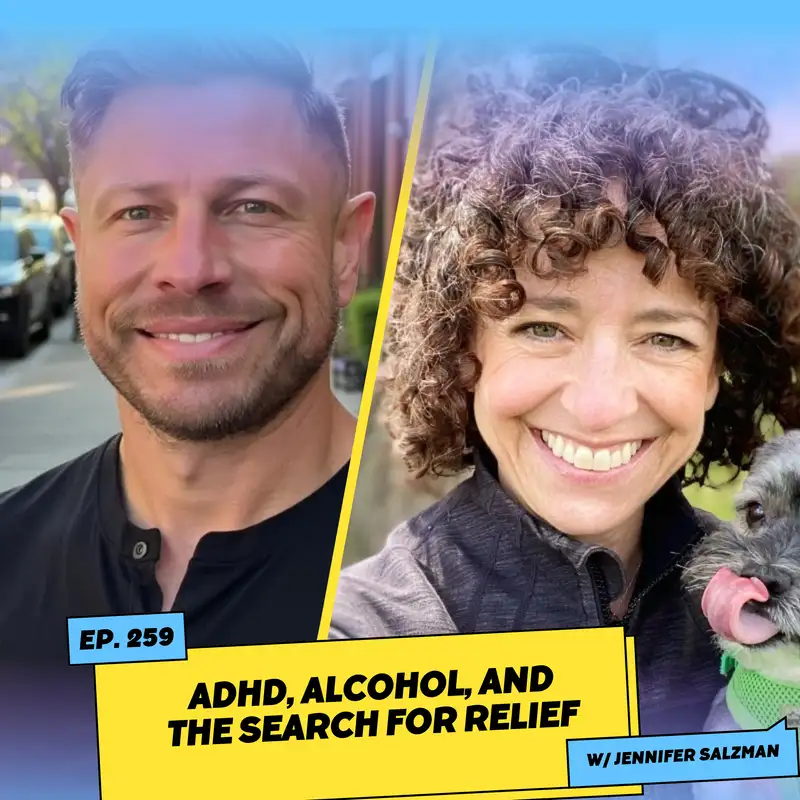
ADHD, Alcohol, and the Search for Relief w/ Jennifer Salzman
In this episode, I'm joined by Coach Jennifer Salzman, an ADHD advocate, mindfulness practitioner, and alcohol free life coach. Jennifer spent years feeling uniquely flawed before receiving an ADHD diagnosis in her 40s. Looking back, she began to understand why alcohol had felt like such a reliable form of relief. We talk about the connection between ADHD and alcohol, why drinking can feel like relief for an overwhelmed brain, and why willpower often isn't the right tool for change. Jennifer also shares how mindfulness, self awareness, and ADHD friendly strategies can help people interrupt autopilot habits and feel more in control.
Speaker 2:Jennifer, thanks for coming on today.
Speaker 3:Thanks, Mike. It's nice to be here.
Speaker 2:We're going to have a great conversation, and I want to jump right into it because you've shared that for years, you felt uniquely flawed and struggled with things like school, work, relationships, and emotional control. Can you take us back to that period of your life before this ADHD diagnosis?
Speaker 3:Well, that period of my life was my whole life, because I didn't get a diagnosis till I was 41, I think. But yeah, growing up as neurodivergent but not knowing it, I always just felt like I didn't quite get it, even though I didn't always know what it even was. I tried to gauge how other people behaved because I felt like I wasn't socially in tune with people. I wasn't always sure how to act properly, and I was always being told by my family and teachers, You're too sensitive. Get ahold of yourself.
Speaker 3:And what's interesting is that typically we think of ADHD as little boys being hyperactive. Especially because I'm a Gen X, girls didn't have ADHD, apparently, back then. But the hyperactivity was really internally. It was in my brain. It's not that I was running around physically, but there was constant chatter in my brain, and I didn't know how to shut it off.
Speaker 3:Just moving through life, knowing that I was different but I couldn't quite explain why or how, it just sort of shaped my identity of feeling like I'm just weird. I'm just fundamentally flawed in some way, and I'm not sure why. And that just kind of became how I felt about myself until I got that diagnosis.
Speaker 2:Yeah. Well, we talked a little bit off camera that I can also identify that I was diagnosed young, however, with ADHD or ADD, and I actually want to talk to you about that a little bit. And even the more newer modern term of saying things like neurodivergent. I think some people you hear the terms, not everybody they think maybe it's like one of those words that you hear and you think you know, but maybe you don't know. And unless you really take some effort to look into that.
Speaker 2:And so I want to talk about that and we're going to tie into how this relates to alcohol and how there's some unique perspectives in that and you're going to share how you've sort of addressed it in your own life. But before we do, give us a little bit of rundown of how these things that you're now looking back on retrospectively, how they look, or how you identify, how that affected how your relationship with alcohol was.
Speaker 3:Yeah. Well, so having that feeling of just being different and kind of a misfit and not understanding social cues as well as other people and having a hard time making friends, as soon as I discovered alcohol, and I was young, was 17, 18 years old, soon as I discovered alcohol, all of that chatter, all of that feeling different and weird, all of that not knowing how to talk to people vanished. Suddenly I had friends and I was going to parties. I finally felt like normal. Alcohol was sort of this magic elixir.
Speaker 3:I loved it from the very beginning. Developing a problem with alcohol took a lifetime, but I immediately knew that this was a way that I could function like a more normal person in the world. And so I took to it very young.
Speaker 2:Yeah, I kind of felt the same way. Was, It felt like I was a little out of place, a little bit nerdy. And I went to a new school and it was around the same time that I was of that age to start drinking. I felt like, okay, this is like this common denominator that we all kind of gather around and hang out. And I felt part of that group and it allowed me to kind of loosen up.
Speaker 2:I can definitely identify with what you're saying there. And I think there's of course tie in with just people that aren't ADHD that felt that as well, of course.
Speaker 3:But
Speaker 2:you know, before we go too far, as far as like ADHD, ADD, and neurodivergent, I know you think about these things. Is there any difference? Is there just a way of saying it in a different way? Maybe shed some light on that.
Speaker 3:Yeah, I think that ADHD is just an updated version of ADD. I mean, I'm not I don't diagnose people, but I think that ADHD is just kind of the standard now. And I think probably back when you were diagnosed, it was referred to as ADD. I'm not sure why.
Speaker 2:Yeah. No, I was just curious. I might as well ask you. You think about it. For me, it's a little bit it's something I'm thinking about more often, but it's not something that I had thought about for a long time.
Speaker 3:Yeah. And I think that part of it is it's not just the lack of attention. I don't know when it changed from ADD to ADHD, but I do think it's just an updated version of the same thing. But as far as neurodivergent, that can refer to any condition where our brain is processing information differently. So people that are on the autism spectrum, people that struggle with other mental health issues like bipolar disorder or depression or anxiety.
Speaker 3:I think those are all versions of neurodivergence. When you hear people talking about it, usually they're referring to people with ADHD or people with autism or a combination of the two.
Speaker 2:Yeah. That makes sense. Okay. I know that I wasn't quite sure what that updated term was so because of the hyperactive part, because I was more the daydreamer. So there's, like, such a spectrum of it.
Speaker 2:Like, I was more the daydreamer. What did you say? I was not the boy jumping out of his seat. Now let's fast forward a little bit. So you finally received in your 40s this ADHD diagnosis.
Speaker 2:What did that change for you? Maybe emotionally, maybe the way you look back on alcohol?
Speaker 3:Yeah. Well, what's interesting is I didn't know what ADHD was. I was not seeking a diagnosis. I was I was going through a divorce, and so I was seeking the treatment of a psychiatrist. I was meeting with him, and I was depressed, and I was on antidepressants.
Speaker 3:But the more we talked, and the more I shared with him what was actually troubling me, I couldn't get my work done. I couldn't sit still. I had a nine to five corporate job, it was torturous being there every day. And like the fluorescent lights, and I couldn't do the work, not because I wasn't able to do it. I just couldn't get myself to do it.
Speaker 3:And I'm like, there's only so much longer I'm going get away with not doing this work at my job that they're paying me for. And my emotional volatility. I think a lot of times we don't talk about the emotional aspect of ADHD, but my highs were really high, my lows were really low, and I think that's why I was mistakenly diagnosed with depression. But it wasn't like I stayed in that low mood. It was just that my emotions were very intense and hard to manage.
Speaker 3:My relationships were very volatile. My marriage had just ended, I was very on edge. The psychiatrist asked if I had ever been assessed for ADHD, and I was quite frankly offended. Was like, Never. What are you talking about?
Speaker 3:Now I have something else, some other mental health issue that I have to deal with. But when he did give me the assessment, I passed with flying colors. I was very ADHD. And so there was that moment of relief. This is what I've been struggling with my whole life, and there's a name for it.
Speaker 3:I'm not crazy. There's not anything really wrong with me. I just have ADHD, and now this all makes sense. All the puzzle pieces finally made sense. And then on the other hand, I'm 40 years old.
Speaker 3:What am I supposed to do with this? This is who I am now. How am I supposed to deal with it? The truth is, there wasn't much of a treatment plan. The doctor wrote me a script for Adderall and said, See you in three months.
Speaker 3:And I sort of had to navigate it on my own, which I didn't do right away. It took me some time to sort of understand what this actually meant. So from an emotional standpoint, it was it did. It felt like a relief. And there was also some grief, like, what might my life have been like if I'd known this earlier?
Speaker 2:So it sounds like that was like the door opening a little bit, but the knowledge was still way ahead of you. Had to step through it and explore. So did you end up go ahead and trying the medication? What were the next steps that you took with once you had the diagnosis?
Speaker 3:Yeah, so I did take the medication. I was drinking at the time. I didn't put the connection between alcohol and ADHD. I knew that I think one of the part of the questionnaire or in the description is that, like, can abuse substances? But I didn't realize, like, that it was so closely linked and, like, the reason that I had really been self medicating all these years without realizing it.
Speaker 3:Oh, I
Speaker 2:don't think it's out there all. I have these conversations daily. I'm always putting my time to doing research, and this is more of an emerging conversation. So I think the fact that you just didn't put the link together is because it just really wasn't out there being talked about.
Speaker 3:Totally. Yeah. I had it didn't even really occur to me. So, you know, now I have this Adderall script and I'm still drinking, and that is actually when my drinking escalated and got to harmful levels. Because what I didn't realize, and I'm shocked that my psychiatrist never really addressed this with me that I recall, Adderall's a stimulant.
Speaker 3:Alcohol's a depressant. So when I started taking it helped, actually, in many ways with my executive dysfunction. But it also increased my drinking because I was already drinking anyway, but I didn't feel the effects of the alcohol until much later. Was drinking more and more without even really realizing it, and that's when I sort of After doing this for a year plus, I started to wonder, like, Are these things What's going on here? Because this is My drinking's getting worse.
Speaker 3:The Adderall's helping, but something's wrong. Without going into the details of how my life sort of exploded, that's when I finally started to research this and decided to take a break from alcohol. And then my life got so much better that I haven't had a drink in six years. But I didn't realize the connection between the two, how much one was affecting the other, how the Adderall was affecting it all, until I quit drinking and started researching this and understanding myself and how ADHD was showing up in my life now that I wasn't drinking.
Speaker 2:I just remember when I was 16 or something like that, when they were just handing out ADHD medications, like it was aspirin basically. And even at eight or 16, I just remember like, yeah, it did improve some things, but towards the end of the day, was like, oh my God, I can't handle all of this movement going on. And then, yeah, if you're on and up or it takes more of the alcohol for it to have the same effect. And, yeah, that's where things can go from bad to worse pretty quickly for a lot of people.
Speaker 3:Yeah. It it gets pretty messy. So, you know, and like you were saying before, there wasn't tons of information out there about, not even just about the connection between ADHD and alcohol, but being diagnosed with ADHD as an adult. I didn't see tons of information about that either. And that's why I started talking about it.
Speaker 3:I talked about it on social media. Is anybody else experiencing this? Because I'm realizing that I'm not really an alcoholic. I don't identify as an alcoholic. I was self medicating this ADHD that I didn't know that I had for twenty plus years.
Speaker 3:And so many people are like, Oh my gosh, this is me. This sounds exactly like what I've experienced. I didn't know there was a link either. There really isn't a ton of research out there. So, you know, I'm self taught in this and I learn more and more each day.
Speaker 3:And I talk to people like you, you know, like, who didn't even realize that either they didn't realize they had ADHD or they didn't realize that they had been self medicating or a combination of both. And so that's how this kind of became my focus. It fascinates me because it really took up such a huge chunk of my life.
Speaker 2:Yeah. And I mean, it comes out in ways that many people don't even think. So for example, you just said the office was kind of killing you. That that drains my soul. Also, just saying the the fluorescent lights, being sensitive to things like that with most people, I don't think anybody really loves fluorescent light, but I would be very bothered.
Speaker 2:I'm very bothered if I'm in a room and the lighting isn't very nice. And it's like and and I just could not sit in a room if it had fluorescent lighting. Just like there's so many different things that are, are brushed off as if that's just how I am or, you know, but, but they're, they all kind of connect in some way or another. But I think one thing that is really interesting is that this idea of willpower in the ADHD brain. So what's happening in that executive function in that moment that maybe makes it more challenging?
Speaker 3:Yeah, so ADHD people, we have an interest based nervous system. So the only things that can activate us to get things done is if something's really interesting, if it's new or challenging, or if there's some sort of competition involved, or if it's urgent, like a do or die deadline. We are not motivated by things that maybe neurotypical people are. It just has to get done. You're just supposed to do it.
Speaker 3:That's not enough of a motivation. The punishment's not enough of a motivation. The reward's not enough of a motivation. I have to be interested in what I'm doing to do it, right? Because sometimes, if you're interested in what you're doing, I don't know about you, but I can be hyper focused and you cannot pull me away from what I'm doing.
Speaker 3:But if it's like an administrative task, that won't even take me that long, it might take me twenty minutes to complete, I'll spend weeks agonizing over, like, I just don't want to do it. And I think it's because can't I'm not interested, right? And there's no consequence until the deadline. Unfortunately, that is something I struggle with a lot, waiting until there's no more time left to finally get off my butt and get something done. Right?
Speaker 3:So that's a very ADHD trait.
Speaker 2:I mean, I drive my wife crazy because she's all packed for the airport days in advance, and I'm packing the morning of
Speaker 3:Yeah. Well, that's another ADHD thing. It's like there's only two times. There's now and there's not now. So I know what now is.
Speaker 3:I'm experiencing it. Right? But the not now part, it's hard. It's a time blindness thing, too. It's not happening right now, so whether it's a day in advance or a week in advance, it's almost hard to tell the difference.
Speaker 3:You It's know what I hard to explain that to someone that doesn't understand it. But a perfect example, last week I had a call set up with somebody. It was on my calendar. I got the reminder thirty minutes before, and I was like, Okay, I have this call in thirty minutes. I can do this one thing before I get on the call.
Speaker 3:So then my phone and my calendar's away. I do the one thing. I look at the time because I'm like, Oh, the call. And it's already forty five minutes past the time that I was supposed to be on the call. I knew it was coming.
Speaker 3:I had every intention. It was on my calendar, and I didn't show up. And that doesn't happen often, but it recently happened. And I could do nothing except apologize and say, in perfect ADHD fashion, I got just confused about how long this was going to take me. Then when I didn't get a second reminder, it just left my brain.
Speaker 2:Let's talk about the typical things that are traits of ADHD related to alcohol. So I'm hearing in your story, my own habits, things like settling the mind down in the evening. Impulsivity is definitely that's pretty obvious to most people. But with the people that you work with, are there some common denominator traits that you're constantly seeing or that, you know, in your own experience, have seen?
Speaker 3:Yeah. I mean, I think the big one is just calming your brain. Because I think, for me at least, the first drink or two, I even notice feeling tipsy. For me, it always made me feel normal. Like, that's my baseline.
Speaker 3:Because, you know, when you have ADHD, you have a lower baseline level of dopamine. And when you drink, you get that artificially high spike in dopamine. And so that's like where most people are all the time, right? So that's your baseline. And I think a lot of people just feel like it is medication.
Speaker 3:I mean, it's not supposed to be, but it just helps to calm people down so that they can feel more focused. And so that's why it's so dangerous, because it can work initially. It can really help initially. But that's a dangerous game because it's an addictive drug and it's not like it's prescribed and monitored by a doctor. It's also a social lubricant, so it's a fine line between, Oh, I'm going to have two drinks to just medicate myself, versus I'm going to drink a whole bottle of wine because that's the habit that I get into, right?
Speaker 3:And so I think it becomes a ritual for a lot of people. It becomes the habit. It works as far as settling our mind and feeling a little bit more focused and calming our emotions, right? But it also affects the same part of the brain that struggles with impulsivity. You're already impulsive if you have ADHD, so if you drink, it makes that impulsivity worse.
Speaker 3:So it's this double edged sword, right? It helps, but then it becomes a problem in itself.
Speaker 2:Take us back so a little bit, though, to your own story, that you got this diagnosis, you tried the medication, you decided to take a break.
Speaker 3:It's interesting. I tell this story all the time. A lot of things happened throughout the course of my drinking career that one would have, in hindsight, why wasn't that a rock bottom? That was good. I'm like, nah, I'm an overachiever.
Speaker 3:We'll have a few of those. But what's funny is that the actual sort of moments that got me to quit drinking was pretty ordinary and uneventful. But just something happened that totally shifted in my mind, like, Something's wrong here with the alcohol use. I don't have control of it. I'm not just having fun.
Speaker 3:I'm not just overdoing it. I don't have control of it. And I was just driving home from somewhere, and I realized I didn't have booze in my house. And so I'm telling myself, Oh, I'm not going to stop at the liquor store. I'm not going to drink tonight.
Speaker 3:I'm just going to go home and do nothing, get a good night's sleep. Literally, as the words are coming out of my mouth, I pull into the parking lot of the liquor store, and I bought myself a couple bottles of wine. I went home, polished off one of them, passed out. I wake up the next morning, I'm drunk texting people. I'm in my late 40s by this time, or middle late 40s.
Speaker 3:I'm like, This is not cute. There's something wrong. How can I be speaking words that I don't want to do something and doing the complete opposite and feeling so much shame and embarrassment for doing that? So that's when, was the last time I ever drank. I woke up the next morning and I said, I must take a break.
Speaker 3:Something's gotta change. It seems like every problem I'm having in my life, there's one common denominator, which is alcohol. And so this is one thing that I can actually fix, so let's see what happens. And this was before I was even thinking about the connection to the ADHD still. My life started to improve and I started to learn more about why I had been drinking so much, and then making that connection to ADHD, understanding how ADHD was showing up now in my life that I wasn't drinking, and having to learn healthier coping skills so that I could manage it without going back down that road of self medicating and numbing out and just avoiding it.
Speaker 3:So that's different for everyone, but for me, the emotional dysregulation piece was huge. So just like learning how to feel my feelings, allow myself to express my emotions in a healthy way, even the ones that didn't feel very good and were scary to feel. Whereas the person who used to drink, any uncomfortable emotion that would come up immediately, like, We're not going there. Let's start drinking. You have to learn now how to, without that crutch, how am I going to deal with this?
Speaker 3:Because I don't want to avoid it. I don't want to numb it. But how do I learn to process it in a healthy way so that it can have less power over me? That was my journey of being a non drinker, being an un medicated ADHD er, mapping out who even am I? I've been masking and drinking and taking meds, I don't even know who I am.
Speaker 3:It's sort of this journey of self discovery. And also working with other people and sharing ideas and information of what works for us, what helps us cope, right? Because humans aren't meant to be happy all the time. So how do we figure out how to handle the emotions that are not happiness and pleasure and fun stuff.
Speaker 2:I want to say that again. Humans are not meant to be happy all the time.
Speaker 3:That's what makes us human. Our feelings exist for a reason, and to not be terrified of them. I used to be terrified of them. They're just feelings. They come and go like the weather.
Speaker 3:And it's a message. That's all it is.
Speaker 2:Yeah. Challenges can be just as fulfilling in our lives as the ones that make us happy and bring us joy, even though we don't all wanna admit it or have to go through it. But, you know, I love your story because it's unique. And sometimes people hear stories like, oh, they just quit one day and that was it. But the truth is the amount of effort and dedication is the same no matter what the story, whether you try, fail, try, fail a 100 times, or you make that decision and you're able to sustain it.
Speaker 2:All of those things take massive efforts. They're all our own journeys. How will you get to where you want to go is as nuanced as your own history and personality. So I always love hearing not even a rock bottom story of just like, that was it. I just made that decision and I never looked back and kept growing to be able to have coping skills to not only deal with my history with alcohol, but also moving forward with this diagnosis that you got.
Speaker 3:Right. And I think that I had taken breaks from alcohol for a week at a time. Maybe I did a dry January once here or there, but never with the intention that I'm quitting for good. Even though I knew alcohol, like I was drinking too much and it was a problem, I never really thought about giving it up, even if I knew I had to take a break here and there. The day that I actually did quit, that was the first time that I was committed to removing that substance from my life, if not forever.
Speaker 3:I've never said I'm never drinking again. I don't want to right now, but I've never said I'm never drinking again. But that was the first time that I was like, This I don't need this. And I was right.
Speaker 2:I think that setting that I'm never drinking again, which, although most of the time gets broken anyways, so you have less trust in that. But it sets depending on where you are and your goals, but it sets sets such a high bar.
Speaker 3:I don't know what I'm doing tomorrow, let alone every day for the rest of my life.
Speaker 2:I don't know who I'm going to be in five years because I'm definitely not the same person I was five years ago either. So it's so hard to put a permanence on something unless you find benefit out of it.
Speaker 3:But it is an identity shift. You have to start thinking of yourself as a person who doesn't drink. And I think that was the most challenging part for me because it was such a huge piece of my identity, right? The ADHD was a fun, quirky thing about me, and drinking a lot was like, Oh, I'm the life of the party kind of thing. And so now realizing, no, ADHD has actually been disabling.
Speaker 3:Some people have considered it a disability. It really was disabling. I didn't realize it. But the way that I struggled to do things that everybody else could just do, I didn't realize that it didn't have to be that way. So figuring out how to work with your brain instead of against it.
Speaker 3:That's what we're doing. This world was made for neurotypical people. We're given this owner's manual of how to do it that way, but it doesn't work for the way that our brains work. So we move through life thinking, What's wrong with me?
Speaker 2:Yeah, that owner's manual analogy, I love that because some people could say, Oh, diagnosis this, diagnosis that. But no, it's really about shedding light on insights. Okay, that makes sense why I'm acting this way. And instead of like shaming yourselves for being different, realizing, okay, well, first of all, I'm not the only one that acts like this. And second of all, I might, might as well either write my own instruction book or, or follow some of those who, like you example, who have done this before.
Speaker 3:Right. And that's why I talk about it because it can feel really lonely. Like, even the way that I set up my life and my business, maybe it wouldn't make sense to other people, but the system works for me, and I know that it works for me, so I can do it that way. Somebody else might look at it and think, is crazy. How do you function this way?
Speaker 3:I don't know. That's just how I do it. And so instead of feeling like, Oh, I'm doing it wrong. There's something wrong with me. Can't I'm like, This is how I do it.
Speaker 3:It's working for me right now. And until it doesn't work anymore, I'm not going to do it a different way just because that's the proper way, right? Like, this works for me. And so it looks different for everybody. But I think just self acceptance and self compassion and realizing that you may need accommodations to get things done.
Speaker 2:So let's talk a little bit about coping. A big part of coping and also just putting this to work in practical terms includes things like mindfulness. But you can laugh at it thinking about an ADHD person naturally wanting to be gravitated towards mindful practices because, that overstimulated mind and restlessness is difficult. So how does somebody approach mindfulness practices that might not be naturally drawn to it just because of how they're wired?
Speaker 3:Yeah. You know, I think there's like a misunderstanding about what mindfulness really is, because it's not like being perfectly still and clearing your mind and having some sort of mantra or a guru or becoming a monk on top of a mountain. All that mindfulness is, is being aware of what you are doing while you are doing it. It's being present in the moment and not judging yourself, not trying to change what's happening, but becoming aware. Because you can't fix a problem that you don't even know you have.
Speaker 3:So when you're practicing mindfulness, and even just sitting here right now, noticing what's happening in your body, and I noticed my legs were crossed very tightly for some reason. Don't know why, but I think I'd probably be more comfortable if I sat more relaxed. Just noticing that. I wouldn't have noticed if we didn't just talk about mindfulness. When you start to become more aware of how you feel in the moment, what your thoughts are in the moment, what your body feels like, your emotions feel like, then when they come up in times of stress, you're training your brain to say, Okay, that's just a feeling.
Speaker 3:That is just a thought, and I will allow myself to feel it without trying to change it, without trying to judge it. Probably in the next ninety seconds, it's going to go away, because feelings don't last forever. The good ones don't and the bad ones don't. So just noticing it and understanding, where's this feeling coming from? What is it trying to tell me?
Speaker 3:And just noticing it. So we're not living on autopilot. And I think a lot of times with ADHD, it's like things were for us, such as drinking. So that's just like, at 05:00, it's time to wind down. That's what we do.
Speaker 3:Let's start drinking. Being mindful is like stopping, pausing for a moment, because between the desire to drink or the craving to drink and the actual doing of the drinking, there's always space in between. Just pausing and paying attention to the feeling I'm having that is making me want to drink right now. And just that pause, you're starting to interrupt the pattern a little bit and showing your brain evidence that, Oh, wait a minute, I didn't automatically reach for a drink. Maybe there's an alternative there.
Speaker 3:Little by little, you're teaching your brain that there's an alternative. You might not automatically have some perfect coping skill that replaces drinking, but you're just now starting to teach your brain that it doesn't have to be alcohol right away, every time.
Speaker 2:I'm really glad that you said that, as in mindfulness gets mistaken as mindfulness equals meditation, which it can, but that's a very narrow point of view if you think that that's all it includes. In fact, it's funny because I actually don't think much about how I'm wired, you know, ADHD and why am I like this, But I am as we're having this conversation. So for me, for example, I've tried over the years many times, I'll admit meditation is very difficult for me. I give it a good run, right? But breath work, that works for me, but it does take me to a meditative mindful space.
Speaker 2:Same with like mountain biking. When I'm focused going down the mountain, I can't be thinking about something else, you know, going on in my life. I am like singular focused on one thing. I am in that moment. And I joke like that.
Speaker 2:That replaces my meditation. That is my meditation. So, I think anybody that that's listening like, you get to define what that is. If you can get to a mindful state, whether it's just removing the thoughts and being in the moment, or if it's being mindful, like you said, Jennifer, in sort of drawing back that impulsivity.
Speaker 3:Yes, it's just learning how to pause, it's learning how to say, Oh, okay, I feel agitated. I feel tired. I feel lonely. It's like the hungry, angry, lonely, tired. There's always a reason why we do things.
Speaker 3:We want to feel a certain way. Just stopping and saying, What is it that I actually need right now? It's never alcohol. It's never alcohol. I don't judge people who drink.
Speaker 3:Used to love it. I had enough alcohol for many lifetimes. But it's never really what you need. What you need is to change your state in some way, it was never really about the alcohol in my experience. But mindful walking, take walks, I live by the water, and just paying attention to the ground under your feet, right?
Speaker 3:And the sun and the wind and people walking, and even noticing how does your state change when somebody walks by? Maybe you get a little more self conscious, or you notice them, or you just change your gait. It's just noticing these little things. And when you become present like that and more aware of what makes you do the things you do, you have more control over how you want to respond to things.
Speaker 2:I think there's something that you said there also that I don't want to go past without repeating, is that it was never really about the alcohol. Everybody wants to blame, if I could just this is the issue, but there's there are ways to indirectly address an issue, not head on. So elaborate on that for your from your own experience. It was never really about the alcohol.
Speaker 3:Yeah, I didn't drink because I just loved whiskey so much, you know? It was because I didn't have any other healthy coping skills, and I wanted to check out. And that was the only that worked immediately, And it was effective until it wasn't. But it wasn't because, again, I don't identify as an alcoholic. I don't believe that I have this special allergy reaction to alcohol than everybody else.
Speaker 3:It's like nobody is immune to becoming addicted to an addictive substance. But that's another conversation. But I realized it wasn't It was just me not knowing how to deal with my feelings, not knowing having social anxiety, not knowing how to manage my ADHD. But it wasn't because I loved alcohol so much. And that's why I think that once you cut down on your drinking or remove it altogether, that's when the real work starts, because now you're not clouded by the substance anymore, and you can figure out what is it that I actually need.
Speaker 3:What have I been using alcohol to do for me? And what are other ways that I can fulfill that need without poisoning myself?
Speaker 2:If somebody came to you and said, You know, I think I'm drinking too much, and I know you work with ADHD people. Maybe I am ADHD. Like, what should I do? What should I do right now? Like, should I go make an appointment?
Speaker 2:What would you tell them as a first step?
Speaker 3:I believe that self diagnosis is valid. I don't think that you need to have I mean, if there's enough information out there now on social media, there's hundreds of people just like me talking about this stuff. So if you relate to a lot of it, it resonates with you, then you might have ADHD. I don't think that people who are not neurodivergent or don't have ADHD or autism sit around wondering if they do. I really don't.
Speaker 3:I think everybody experiences the ADHD traits at one time or another in their lives because these are just human traits. But when you have ADHD, they cause problems in your life. They're pervasive, and it starts in childhood. Have to have these symptoms starting in childhood, even if you weren't diagnosed in childhood, for it to be diagnosed as ADHD. It has to be consistent throughout your life and causing problems in your life.
Speaker 3:Everybody procrastinates sometimes, but if you have ADHD, a lot of times it causes major problems, like you don't graduate from school or you get fired from a job or you have problems with your relationships. It's not just like, Oh, I don't feel like doing this right now. It can get pretty serious. So if the diagnosis is important to you, see your doctor, talk to them about it. If you just know that you relate to these things and you want to figure out how to cope with it, I would say, stop trying to stop drinking.
Speaker 3:Start drinking mindfully. Start paying attention to why you're doing it. I tell my clients to use the twenty minute rule. If they're about to start drinking, set a timer for twenty minutes and just wait. Just pause.
Speaker 3:Not that we're not going to drink, but what happens in that twenty minutes? How do I feel? Am I freaking out? Does it feel fine? What's going on?
Speaker 3:And again, it's just the awareness, starting to understand why I'm doing the things that I'm doing.
Speaker 2:Makes total sense. Well, I think that that is a great place to stop today. You've shared so much, and you've actually got me thinking a lot. So I might actually go off and see what I find and apply to my own life here. I think also another next step, if somebody's interested on what they should do next, is to maybe go check out your stuff, because this is what you specialize in.
Speaker 2:If you want to share where people could find you, learn more, or potentially reach out.
Speaker 3:Yeah. So this is all I do. I work with ADHD adults who are struggling with their drinking or other compulsive habits, because it doesn't just have to be alcohol. But I do one on one coaching. I have a self guided course for people who don't want to invest into coaching, which offers all of the coping skills that I use.
Speaker 3:So my social media handle is rebelwithoutadrink on both Instagram and TikTok. And I also have a website. My coaching practice is called almightyrebel dot com. So you can learn more about me on my website. You can watch my videos.
Speaker 3:Yeah, that's me.
Speaker 2:I love it. And I love the branding. Can I just say that too?
Speaker 3:Thank you.
Speaker 2:Alright, Jennifer. Thanks so much for coming on and sharing today.
Speaker 3:Thanks. It was great chatting with you.
Creators and Guests