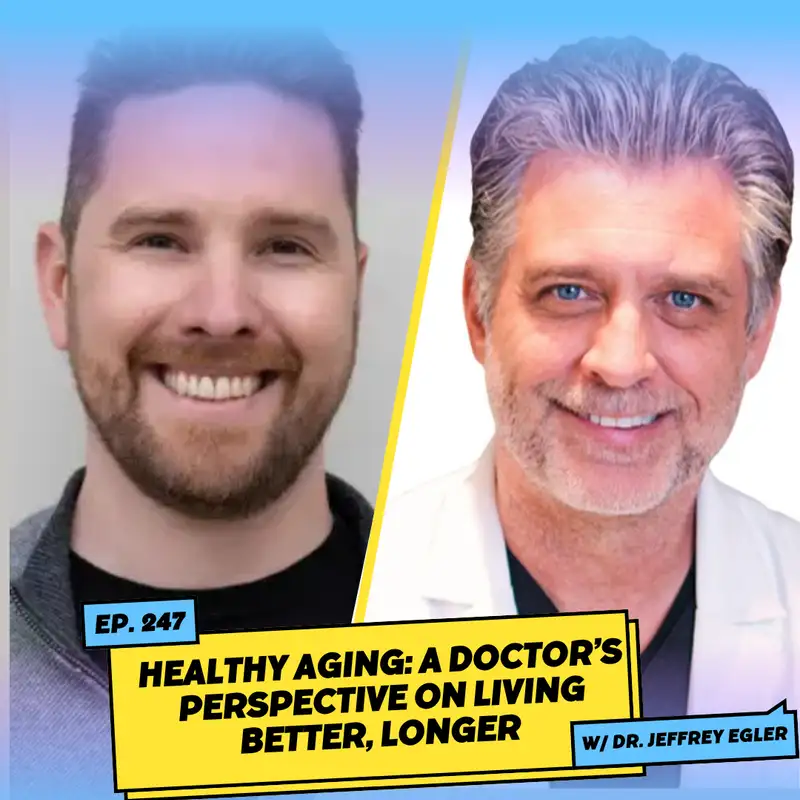
Healthy Aging: A Doctor’s Perspective on Living Better, Longer w/ Noom CMO Dr. Jeffrey Egler
This week I'm handing the mic over to Nick Allen, Co Founder and CEO here at Sunnyside for a conversation with Doctor. Jeffrey Egler, Chief Medical Officer at Noom. They get into healthy aging, behavior change, alcohol, and what it really takes to build habits that last. I think you're gonna really enjoy this one, so I'll let Nick take it from here.
Speaker 2:Hey, everyone. Nick Allen here, cofounder and CEO of Sunnyside. I'm excited to be your guest host today on Journey to the Sunnyside. Recently, Mike and I were joined on the show by Jeff Cook, the CEO of Noom. We had a great conversation about food noise, alcohol noise, and how medications like GLP ones in the case of food and naltrexone in the case of alcohol, paired with the behavior change programming offered by Noom and Sunnyside, can be a game changer for rewiring deeply ingrained habits around food and alcohol.
Speaker 2:You If haven't checked out that episode, I encourage you to do so. It's a it's a great listen. Today, we're continuing that important conversation. I'm excited to be joined by doctor Jeffrey Egler, chief medical officer at Nim. We'll be expanding on the conversation from a few weeks ago and exploring a topic we know many of you are interested in, healthy aging.
Speaker 2:So let's go ahead and dive in. Doctor. Egler, thanks so much for being on the show.
Speaker 3:Well, it's great to be here, Nick. Thank you for inviting me. It'll be a fun follow-up to your conversation with Jeff.
Speaker 2:I'm really, really excited to jump in. Maybe So to kick things off, let's listen a little bit about you. Can you tell us about your background and the path that led you to kind of the CMO role at Noom?
Speaker 3:Yeah, sure. So I could not have planned it this way. I certainly wouldn't have had the insights to do that. And it's all just been an evolution and has laid out in front of me just take putting one foot in front of the other and sort of following my instincts and my interests and that's, this is where it is led. But I started off as a conventional medicine physician, family medicine trained, and I spent the first ten years really by the book guidelines based traditional contemporary medicine, conventional medicine.
Speaker 3:And what I found is at the end of ten years, I was really unhappy, unfulfilled discontent, and just in life. And as far as medicine went, I thought it was me. I thought sort of I was the problem. I don't fit in here. Maybe I can't cut it, whatever it might be.
Speaker 3:And that was, I think unfortunately, that's what a lot of people feel for a very long time. So the interesting pivot for me was, and I think we'll get into talking more about behavior change and and the consequences of that, but I had wanted to make changes in my life holistically for probably a decade or as long as I could really even remember. And I didn't know how to do that. I know as a highly trained physician, as much school as anyone would want to ever have, I didn't really know how to change myself. And so finally, an opportunity was presented to me.
Speaker 3:I passed on the opportunity, but then it came back again two years later and it was maybe you should do a master's degree in spiritual psychology. And the first time I heard it, it sounded a little bit too woo woo for me. The second time it came around, I was sort of on my knees. I really need to make a change. Don't know how to do this and so I looked into it.
Speaker 3:I said, I'll try this out for a month or two and, every month I just said, I'm coming back next month and so I got my master's in psychology and that really changed the trajectory for everything, so I spent the next ten years thinking very differently, functional medicine training, lifestyle medicine, double board certified, and then the past five years really that has all evolved and led to, you pair conventional medicine with a functional and lifestyle approach, you add psychology to it, and now you have longevity medicine. So I was recruited by Noom to help lead strategy for moving from being a metabolic and weight based company to focusing more on longevity and how do you just help people live longer better.
Speaker 2:I love that. And that will definitely be the theme of our conversation today is exactly that, living longer better. Before we get into that topic and kind of talking about healthy aging broadly and providing some practical tips for our listeners, I'd love to just kind of hear how you see that intersection, right? So you started in traditional medicine. It sounds like you kind of had some burnout, maybe you didn't use that word, but kind of sounded a little bit like that.
Speaker 2:And then kind of bringing in the psychology now kind of focusing into longevity. Talk to me a little bit about kind of like where you saw the shortcomings of the current traditional health system and what pulled you in this direction?
Speaker 3:Well, great. The first thing that comes to mind is there's really not a lot of behavioral science training. We're taught about social determinants of health. We're taught about behavior change, but we're really not taught about how to use that as actual tools. What really motivates people and how can you educate and activate persons to really make changes in their lives?
Speaker 3:I think that what I experienced for the first ten years in medicine was educating people, telling them what I thought perhaps they should do to have better outcomes, but not really being able to talk to them about how do you do that? What are the actual tools that you can use? What's the process for doing that? And quite frankly, it was because I had never really learned it. I had never really experienced it myself.
Speaker 3:So that's a really big difference that I think that most people in conventional medicine still, suffer from. The other thing is, and rather than save this for later, I'll just out it on the table right now for us to talk more about later, but one of the big transitions from the way I practice before to the way I see things and do things now is a focus on health and well-being. And this is just so fundamentally different than the way that I was trained in conventional medicine. Everything is disease focused, and so when you're doing that, you really don't focus on an individual until they have a problem. Do they have a diagnosis and what is their diagnosis?
Speaker 3:Then there's a solution, usually a medication for that. But most doctors aren't taught nor do they think about evaluating a person in terms of how well they are. What is their functional capacity? Are they really living up to their potential? Based on where they really are in terms of health, what is their trajectory towards disease?
Speaker 2:Yeah, and this is so true when we talk a lot about alcohol on this show and then kind of in the Sunnyside world, the same idea where, you know, we wait until alcohol becomes a diagnosable addiction or condition where we do something about it, when in fact, you know, starting proactive and getting started early on the path to a healthier relationship with alcohol and many other areas of our health. There are so many advantages to that strategy, and yet there isn't really a vocabulary or a set of tools in traditional health system to do that, which is why tools like Sunnyside and Noom, I think, are so important in the overall kind of toolkit of our health. I want to transition now into this kind of conversation around healthy aging. So in my conversation with Jeff a few weeks ago, and in a lot of his recent public interviews and writings, he's hinted that Noom's ambitions go well beyond weight loss. And he's kind of talked specifically about this idea of healthy aging more broadly.
Speaker 2:So I want to dig into this with you and kind of start with maybe the most basic question. So as a clinical leader at Noom, what does healthy aging mean to you? And yeah, just talk about kind of that vision.
Speaker 3:Well, Nick, if you don't mind, before I jump into that, I just want to backtrack to the previous question. Just want to share a very personal experience that I think is very relevant to you speaking of alcohol and alcohol abuse and moderation. I haven't drank alcohol in almost ten years. I'm on that path as well. Basically, think it's a very interesting thing to think about and certainly I make that connection, but it didn't really hit me until the way that you were saying it.
Speaker 3:I mean, past ten years where I've really changed my life in so many ways, it just so happens that, alcohol has not been a big part of that. And I'm not necessarily suggesting people don't drink alcohol at all. Obviously, your whole platform is about helping people with moderation and finally kind of figuring out where they are on that, but it's definitely been an interesting journey. Yeah, so I think that that's just obviously relevant for you to know so that can kind of color the conversation as we move forward too, my experience in that as well, both personally and professionally. So then coming back to healthy aging, so what does healthy aging mean to me?
Speaker 3:In some of the conversations we were having leading up to this, we talked about biohacking, the Brian Johnson movement of Don't Die, There are legitimate scientists that are suggesting that we have the technology now, David Sinclair, for example, at Harvard. We have the technology now to make the average life span 125 years old. And some people even suggest that with the technology that's coming, can death be optional, which is a completely different conversation, right? But that's not how I think about healthy aging and that's not how Noon thinks about healthy aging. When I think about healthy aging, think about my mother.
Speaker 3:My mother had an untimely demise at the age of 75. She had Parkinson's dementia and so I had to watch her decline over a decade. And when I think of healthy aging, that's what I think about. I think about how could her past have been different. And what's super interesting to me about that is, ten years ago, I was halfway through my medical journey thus far.
Speaker 3:I've been in medicine for twenty five plus years. I was a faculty member in the Department of Family Medicine at the time my mother was going through this. I was teaching doctors to be doctors and yet I didn't have much to offer her except for what medication should you be on, what medication should you not be on. Now, fast forward, if I had known then what I know now, you know, could I help, could I have helped to provide a healthier framework for her? Could I have educated her in different ways about, because just providing the education, of course, is not going to be enough.
Speaker 3:But being able to link that education to her own motivations, her own whys, her reasons, and being able to maybe transform some of the lifestyle factors that led up to that. Of course, knowing that ten years ago probably wouldn't have been enough because these processes actually start decades before the signs and symptoms start setting in. But getting back to the original question, I think of healthy aging as how do you stay vibrant? How do you stay functional? And how do you live your best life as long as you possibly can?
Speaker 3:Are you familiar with the concept of the marginal decade?
Speaker 2:No, I don't think so. Share with us.
Speaker 3:So the marginal decade is this idea that in The United States, for example, and typically in Western civilizations, the last decade of our life and sometimes longer is really marginal in terms of how we live it. I mean, we're really most people that are in their 60s, 70s, and 80s are not having the full vibrancy of life experience that they've had when they were significantly younger. And so what we try to do in longevity medicine from my perspective is realistic practical applications, typically a lot of lifestyle medicine that helps to contract that marginal decade and expand your functional years, putting not only more years in your life, but more life in your years, as we say, so that the time of disability is significantly decreased.
Speaker 2:Yeah. Yeah. And I just want to repeat that quote, because I I just absolutely love it when when talking about kind of the difference between, you know, this, like, biohacking longevity space and healthy aging as defined by Noom and kind of where Sunnyside plays. It's not about adding more years to your life, but more life to your years. Just think that's such a powerful concept, and one that really shapes this conversation in a way that goes from being inaccessible and maybe this movement for the elite, you know, the billionaires spending tons of money on, you know, extending their lifespan, to really being more about accessibility and something that everybody can latch onto as something that is attainable and a goal that all of us, whether we realize it or not, are seeking to achieve.
Speaker 2:So with that in mind, I'd love to just kind of hear, you know, from your perspective, you know, what are the components of the modern healthy aging toolkit? How do you think about shifting from, you know, sick care as it stands in the old system to this proactive approach to healthy aging and vibrancy in a way that is attainable for the everyday listener?
Speaker 3:Yeah, sure. There's multiple ways to think about it. There's different paradigms of thinking about it. I should say that certainly any conventional medicine doctor, myself, when I was faculty at USC or when I was practicing, I would have heard a conversation like this and said, We do this, we talk about lifestyle, we talk about behavior change, and of course we do and they do. It's just different when that's the focus, when that is the primary foundation of what you're doing.
Speaker 3:And even most of the guidelines in medicine have lifestyle built in. But quite honestly, it's almost sort of like a joke or just sort of a checklist item that you have to do before you start somebody on a medication. And so what we're really trying to do at Newcomb is drill down into these lifestyle factors. Your question was, what are these elements? What are the tools in the toolkit?
Speaker 3:We're talking about pillars like nutrition, healthy eating, movement. Exercise might not be the best term because people have certain reactions to that, but just fitness in general, activity, sleep is obviously a big one, social connections, relationships, and then there's biologics as well. So medications have a role, nutritional supplements have a role, some of these new advancing biologics. So I don't necessarily discount all of the things that are in the toolbox of the biohacker and more cutting edge longevity minded person, but these are not what I consider to be the foundations. Know, I don't think that peptides are the answer for somebody that doesn't eat well, doesn't exercise, has poor sleep, and too much stress.
Speaker 2:Maybe drinks in an unhealthy way.
Speaker 3:There may be other low hanging fruit opportunities to reach for, but as you know, Nick, those are the hardest things to do. It's quite easy to take a peptide. It's quite easy to take a medication. But what we usually talk about at Noom is that taking the medication, doing the biologic, whatever it might be, it doesn't really solve the problem. Right?
Speaker 3:It provides a biological solution to it. But the analogy that I like, I think you'll I think you'll like the snake, is I always describe, imagine custodian, a janitor wiping up a puddle of water on the floor, right? And behind them is a sink and it's turned on and the water is coming out and it's overflowing, right? And they're frantically mopping up the floor. That's sort of what we're doing in conventional medicine.
Speaker 3:We're trying to clean up the mess, but what we really ought to be doing is just reaching behind and turning off the water so that we stop causing the problems and then we might not need the medication as much. And even if and if we don't turn off the water, you're going to continue to need the medication indefinitely because you haven't gotten to the root cause of the problem.
Speaker 2:Yeah. One of the things that I think is so interesting just to kind of build on on this idea of these pillars of the healthy aging toolkit is we've also historically thought about these things somewhat in isolation, right? Sleep and nutrition and movement, and, you know, the role that alcohol plays in our health, and stress and mood. But I think we're increasingly, you know, learning to see them as interconnected systems.
Speaker 3:So
Speaker 2:I'd just kind of be curious to hear about how you and maybe Noom broadly think about the interplay between these pillars and how healthy aging is really about kind of putting those pieces together more so than kind of managing each of them in isolation.
Speaker 3:Absolutely. That's why we can talk about each of the pillars, but we do, to your point, have to be careful about not necessarily over focusing or in isolation focusing on any one of the pillars. And when you think about in functional medicine, we talk about thinking about systems biology. We think of biology in terms of the systems and how they affect each other, and a conventional medicine physician will say, well, we do that. It's all systems, GI and respiratory and cardiovascular.
Speaker 3:The problem is that with such focus and expertise and specialists in each one of these systems, they do it does start to become siloed and less interconnected. Whereas a systems biology approach is really taking a step back and thinking more about how all of these things are interconnected. When you change your nutrition, you're affecting your sleep, you're affecting your metabolism. Another great example is if you don't sleep well, it can affect your hormones that are associated with sleep. Cortisol might be off.
Speaker 3:So when you don't sleep well, it's very well known that your insulin sensitivity is off. You tend to have more cravings. And so if because you didn't sleep well, you're reaching for more SNAPs that you wouldn't typically have, there goes your nutrition.
Speaker 2:And you can start to
Speaker 3:see how all of these things are certainly interconnected and there's a common thread in between them.
Speaker 2:Yeah, we think, you know, at Sunnyside, we think a lot about alcohol as this kind of, you know, changing alcohol habits as a keystone to impacting a lot of those other systems, even though you might not otherwise connect the dots between drinking less and sleep quality and nutrition and a lot of these other pieces. And so just as one example of kind of the interconnectedness of these systems, our listeners are obviously keenly interested in understanding how alcohol impacts healthy aging, and really the opportunity in drinking in more healthy ways as a way to support healthier aging goals. Anything that you can share from your point of view, and maybe even from your own lived experience around the role that alcohol plays within these systems and how drinking less can have a positive impact?
Speaker 3:Sure, absolutely. I mean, I think it's easy to speak of how less alcohol can have a positive impact, but I want to be sure that I'm not coming from a perspective of that's part of the reason I shared what I shared with you earlier on is that to start telling people that they shouldn't drink or they shouldn't drink less might not be the right step in that direction, right? People have to come to things on their own and when they're ready in order for them to make any significant changes. But unfortunately, what we do know is that alcohol is a toxin, and for many years, I think the vast majority of my practice in medicine, the speak was that there are certain healthy levels of alcohol that actually if you drank moderately, that could actually be healthy for you, and that was typically two drinks for a man, one drink for a woman on a daily basis, And in the past five or plus maybe 10 or so, we have really reversed that. We've basically stated that the medical community now states that there is no healthy level of alcohol consumption, meaning that whether you have one drink or more, that still affects your body in a toxic way.
Speaker 3:But I think it's also worth so that doesn't come off as too prudent. I think it's important to realize that we as physicians have to realize that that just might not be a practical message for most people. And is it really healthy to live without something that you enjoy to some degree? And so moderation in terms of, and balance in your life, moderation in terms of how do you find a healthy balance? Because I can argue that alcohol can be toxic, but at the same time, I think it can be toxic to deprive yourself of, to live in deprivation.
Speaker 3:But I think obviously individuals have to honestly ask themselves, do I am I able to engage in this substance, whether it's alcohol or food or whatever it might be, social media, in a healthy and balanced way so that it's not having negative consequences.
Speaker 2:Right. I greatly, and I'm sure our listeners do too, greatly appreciate the empathy and the nuance with which you kind of address this topic, because it is not so easy, right? You know, there's there's the biochemical and the physical impact, but there's a lot of psychological and behavioral components to drinking too, such that, you know, drinking, you know, cutting alcohol out completely may or may not be the right choice for someone in the moment, and, you know, might not be the the path to kind of the most most fulfilling life. And so coming at this from a place of non judgment, meeting people where they are and helping them kind of achieve their own unique goals, and explore their relationship with alcohol, I think, is a great way to help people get started in the exact same way that that Noom works with kind of food and other of these kind of healthy aging toolkit to help folks make long term sustained change.
Speaker 1:All right, that's it for today. I love where Nick and Doctor. Egler went in this one, especially the shift from treating problems to actually building health and how small changes early can completely change your trajectory over time. If this resonated, make sure you stick around because in the next episode, they go deeper into behavior change, moderation, and what actually makes habits stick long term.
Creators and Guests