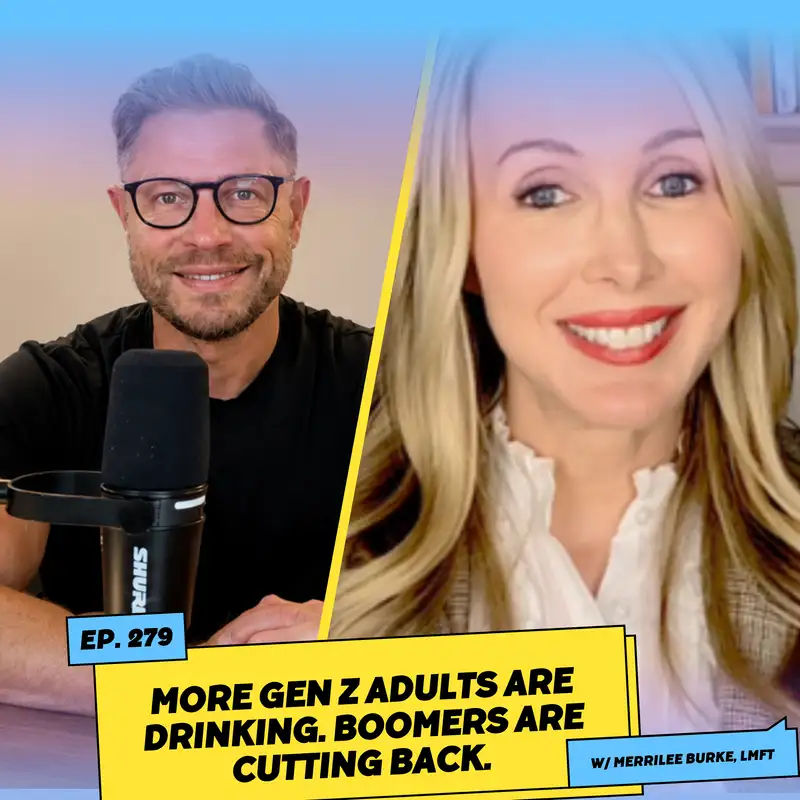
More Gen Z Adults Are Drinking. Boomers Are Cutting Back. w/ Merrilee Burke, LMFT
Today, my friend Merrilee Burke is back on the show. Merrilee is a licensed marriage and family therapist with more than twenty years of experience specializing in alcohol moderation, trauma and eating disorder recovery. She recently sent me an article from IWS on the leader in beverage alcohol data and insights. That challenged the story that we've been hearing about Gen Z turning away from alcohol. Their latest survey included more than 32,000 people across 19 markets.
Speaker 1:Looking at the 15 markets that they tracked over time, the percentage of Gen Z adults who said that they had consumed alcohol within the previous six months rose from sixty percent to seventy four percent over three years. That six month window is important. These aren't U. S. Monthly drinking rates, and the increase doesn't mean that each person is drinking more.
Speaker 1:It means more Gen Z adults reported drinking during that period. Their habits also look a little different. Gen Z drinkers were especially likely to choose cocktails, pay attention to government health guidelines and drink socially in larger groups. Meanwhile, seventy one percent of boomers across the same markets reported drinking within the previous six months, the lowest rate of any generation. They also drank on fewer occasions and had fewer drinks when they did.
Speaker 1:Across the population overall, the percentage of people drinking has barely changed. What has changed is how often people drink and how much they have at a time. Both are coming down. So maybe the bigger story isn't that Gen Z is drinking more or that Boomers are drinking less. Maybe it's that moderation is showing up differently across generations.
Speaker 1:Merrilee and I sat down to talk through this and what it might mean. Let's get into it. Merrilee, thanks for coming on today.
Speaker 2:Thank you so much for having me back. It's good to see you.
Speaker 1:Yeah. It's always fun for us to have these conversations. And you sent me an article the other day that you thought would be a good topic of discussion for us here on the podcast, and I agreed. So let's just start with why'd you send me this article and what really stood out about it?
Speaker 2:Well, there were a lot of really interesting, details in it that we can cover. But the main crux of the article, there's been the research has shown up until now that Gen Z was drinking less than other, generations and less than other generations at that age. So Gen Z right now, I think, is, like, 14 to 29. And, you know, typically, millennials, gen x, boomers, at that age, they were drinking significantly more. So that's what the research was showing was that gen z was just not really drinking the way that other generations have.
Speaker 2:And this new research is showing that they've caught up. And so now they're drinking at about the same levels as other generations. I think it's a really interesting conversation about how do we approach moderation for this younger generation? How does that conversation look different than it does, for instance, when you're having the conversation with somebody in Gen X or Boomers? You know, people of different ages, they're at different stages.
Speaker 2:And I think that they need, different information and different guidance in terms of drinking. So it's kinda seems like for me, I see it as a as a real opportunity to help people to learn about moderation when they're younger so that they don't have a lifetime of problematic drinking and then try to change that later on in their life. I think let's be having this conversation about moderation with people not only in their twenties, but even with people in their teens.
Speaker 1:Totally agree. I thought it was worth the conversation definitely because it's showing that we're confusing sober curiosity in some of these headlines and the way people are talking and maybe the saturation in social media about people talking about stopping drinking with actually rejecting alcohol. What are your thoughts on that?
Speaker 2:Well, you do see some of that, that kind of, you know, rejection of alcohol, and it's a toxin, and it's poison. And you see some of that, but I also kinda I think kinda what you were getting at, which is this idea, it's always been cyclical. There have been times throughout human history where alcohol has been prohibited, where it has been less popular, and it always comes back around. You know? It's been part of our history since the dawn of recorded history.
Speaker 2:So this notion that this generation's gonna come along and they're just going to stop drinking and alcohol is just gonna go out of fashion, I'd never really thought that was likely to happen. I thought it was more that it was kind of an ebb and flow and that it would come back around and that young people, I think, will always drink. And I think if you compare it to cigarettes, like, there really has been a decline in people smoking over, you know, the last centuries and especially the last couple generations. And I think that's a permanent decline. Whereas alcohol, I feel like just has a very different place in human history, and I think it's always going to come back.
Speaker 2:And so I wasn't really surprised to see that the numbers of people in gen z drinking have increased. And I think that the the conversation is about how do we, you know, reduce the harm that these people might experience from drinking and maybe things that our generation went through. How do we make this a more positive experience for them? Because the reality is that drinking alcohol can be a positive experience. And so I think the conversation isn't about, is it good or bad that this generation is now seemingly embracing alcohol?
Speaker 2:I think the conversation is how do we, what can we do to make sure that they have a better experience maybe than people of other generations have had?
Speaker 1:Yeah. Absolutely. I
Speaker 2:mean, what I'm hoping is is that the conversation isn't about drinking or not drinking, but more how to drink. And it seems like that's happening. It seems like this generation is they're drinking less often. They're drinking less when they do drink and hopefully drinking more mindfully. That's my hope is that this is that this generation that, yes, they will and maybe are already embracing alcohol as part of their lives and part of their social connection, but that hopefully they're doing it in different ways and in ways that really aren't destructive or harmful or, you know, causing long term repercussions.
Speaker 1:Yeah. That was one thing I wanted to talk about is, do you think that they're approaching it differently? Because I know, you know, I'm I'm the Xennial, so I'm, like, kinda, like, in between the, millennial and Gen X where we didn't grow up with the Internet. It was all analog, but had technology as we grew into it. And that was still in those times of red cups, binge drinking.
Speaker 1:If you go to a party, there was no limit. You never really thought about moderation or even use that word, really, unless you were driving that night. Are they thinking about this a lot differently than the example I just gave you?
Speaker 2:I think so. I think that there is enough information out there about moderation. And I'm I'm guessing that that's coming a lot from social media and a lot from TikTok and a lot because people of older generations and Gen X and the Boomers, they really had a shift in their drinking with COVID. And so there was a a really drastic increase in drinking with older generations during that time. And then when COVID kinda when things back went back to normal, there were a lot of these older people who would be, you know, like the gen z's parents who suddenly are thinking, oh my god.
Speaker 2:What am I doing? I'm drinking a bottle of wine or more every night. This has to stop. And they had to do some work to to shift that. And I think that's when the moderation conversation really started to come up and about, like, okay.
Speaker 2:If you're having a problem with alcohol, does that mean you're an alcoholic and you have to quit and never drink forever? Well, no. Because that doesn't fit a lot of these people who have maybe maybe they've had some issues with alcohol throughout their lives, but their relationship with alcohol really changed and became problematic because of this situation that they were in with COVID. And so then they were able to, you know, work to change. And I I think the this article also showed that boomers are now drinking less.
Speaker 2:And I think that has a lot to do with this moderation conversation of people realizing that there was a spike in drinking and that people can get their drinking back under control. And I think that that conversation was happening online. It was happening through, you know, the media. And probably a lot of gen z were witnessing it with people and their families and people that they knew from older generations. So I think that they're going into drinking a little bit more aware of what the problems can be and how to get the problems under control.
Speaker 1:Yeah. One of the things that I'm sort of drawing from this article and, of course, this is just my observation, but I think it's starting to show a picture that people are using alcohol in a different way in that we're seeing the younger generation do it more, but they're also citing that they're doing it more often with groups of people. And we also know that Boomers or Gen X, more likely, they're at home, normal lives, and, well, they probably have a social life. Not everybody. Their drinking lasts for different terms.
Speaker 1:But it seems like instead of going a complete sobriety route, they're choosing moderation because they're choosing the benefits of alcohol in their life and trying to pull back the negative consequences that come with overdrinking.
Speaker 2:Right. I I think that's true. I mean, I hope it's true. Maybe I'm being overly optimistic, but I really hope that that's what's happening. That, like you said, that it's not that there's more awareness and mindfulness around drinking with this younger generation that they're using it to connect.
Speaker 2:And I think that's always been true of younger people, teens, and people in their twenties that they're more likely to drink in groups, at parties, in social settings, you know, than drinking at home by themselves. So I think that that but I think what's different is hopefully that binge drinking component. This idea that you can drink with other people and you can party and you can let loose, but that doesn't mean you have to black out. That doesn't mean you have to be hungover and feel miserable the next day. Doesn't mean you have to put yourself in potentially dangerous situations.
Speaker 2:That there is a way to drink and to really enjoy it and connect with other people and have fun without it becoming a problem. And so I think that's kinda what the research is showing, and I'm hoping that that's what's happening and that there there's just a lot more mindfulness and awareness around the risks of drinking. And maybe that's helping to temper the drinking and to make it into something more positive and intentional as opposed to just here's a red cup of something. Just drink it and see what happens.
Speaker 1:Do you think this jump in that percentage with Gen Z is either misreported originally, or do you think that maybe they realize, I gotta get out. I gotta do things. I gotta be with friends and having an occasional drink. I don't need to set this forever sober lifestyle in my twenties.
Speaker 2:Right. Well, exactly. And maybe some people tried that, tried to be sober and and realized, you know, there were benefits to that, but they also want to try something else. I think, you know, we can't underestimate the impact of COVID on younger generations too that, you know, they couldn't go out. I mean, there were years where they really weren't learning how to socialize, and they didn't have opportunities to socialize.
Speaker 2:So I think that that kind of contributed to to, like, just kind of a slowing down of what we would have seen naturally, which is just like a an interest in and a curiosity around drinking that kind of increased, you know, as they became of the illegal drinking age and then continued. I think that got kind of stilted a little bit. And then a lot of the negative conversations that were happening around alcohol in terms of, you know, its health consequences and those sort of things. But I think that, you know, ultimately, it was inevitable that it was gonna come back around.
Speaker 1:We started having this conversation the last time you were on in that there was this really strong momentum for mindful drinking and also a strong momentum for sober curious. But then in your practice, you were probably starting to see something else. What were you seeing in the people that you were talking to or working with?
Speaker 2:Mhmm. Well, the people I I was working with, you know, they were obviously coming to work with me, which, in case anyone's listening, they don't know. I'm a therapist in private practice, and most of my practice is helping people drink in moderation. And so what I noticed is what they were reporting in terms of when they would socialize. Because for a while, there was this stigma around drinking.
Speaker 2:And my clients who maybe were heavier drinkers felt very self conscious, made them not wanna go out. And then all of sudden, there was a shift, and they were thinking, here, I've been working on my moderation, and I've got this under control. And now I'm watching people around me drinking more heavily again. And suddenly, you know, I've been working on this, so I'm having a good relationship with alcohol, and I'm starting to see people just drinking heavily more often. And, you know, it just kinda seemed like those those guardrails that were there kinda just fell off.
Speaker 2:You know? People just, I think, lost a lot of the interest in being sober and have kinda returned to where it was before. Whereas the people who, you know, recognize that they had a problem and work to change it, they're doing great with that. But they're just noticing, like, that they they are not the pariahs that maybe they were for a few years there. But, you know, I I think it's kinda like the pendulum was swinging back and forth, and now I feel like it's kind of settling down in the middle.
Speaker 2:I think there were a lot of people who were hyper focused on their drinking and hyper focused on how is everybody else drinking and what are we all doing now and what's normal, what isn't. And now I think it's gone. It's come back, but it hasn't swung the other way, which is back to binge drinking and and kind of, you know, less responsible drinking. I don't think it swung back that way. I think it's kind of found this nice place in the middle where people who maybe weren't drinking for a period of time wanna bring it back and they wanna be able to experience it and enjoy it, but they also know they don't need to get hammered.
Speaker 2:They don't need to get hammered to have a good time. They've they've been in this kind of sober curious conversation long enough to understand things like the importance of measuring and tracking drinks and and being able to admit like, hey, I've met I've hit my limit for tonight. I need to stop and have that not be something I don't think people are pressuring each other to drink and to drink excessively maybe the way that they used to. So I think that that has really shifted. I think it's kind of like a nice place where we've kinda ended up in this nice in between where it's not this total fixation and it's not this black and white, you know, kind of no no guardrails at all versus just really restrictive or completely abstaining.
Speaker 2:You know? It's like I kinda think we've come to a place, hopefully, in the conversation where it's just like, people like to drink. A lot of people like to drink, but they don't necessarily want the the negative outcome.
Speaker 1:Yeah. You know, it's funny. I've seen it just over the last year. It's like the cat's out of the bag. People are now talking about it.
Speaker 1:And, of course, we're talking about it right here, and that might not be news to anybody here, but it's as I've seen unfold. I would agree that, like, that pendulum is kinda swinging pretty even in the middle these days more than I have seen it recently because, for example, I went to a barbecue at a friend's house in the neighborhood. They had beer, and they had NA options. And I didn't feel pressured to have either one. Some people I noticed were having drinks.
Speaker 1:Some people were not. Nobody was going overboard. Whereas I think back to maybe in my thirties, I go to something like that. There were definitely would be one or two people that were drinking more or trying to top somebody off. And then maybe a year and a half ago, it was more, like, on not drinking.
Speaker 1:So I feel like it's kinda gone in the middle. Right.
Speaker 2:And I think, you know, something that was in that article that I thought was really interesting is that Gen Z is more likely to follow recommended guidelines in terms of drinking, which I think is a positive thing, but it also concerns me because we really don't have very good guidelines right now. The guidelines that we had were I think it was like no more than one drink per night for women or that women could have one drink, men can have two drinks. And it didn't say, well, is that an average? You know, if I'm only drinking twice a week, does that mean I can have three drinks? It didn't really specify.
Speaker 2:It didn't address age because age is a really important factor in terms of how much alcohol you can process. It there were a lot of things that it didn't factor in in terms of those recommendations. They were very vague. They confused people, and they were very limiting. And so and then this this kinda current administration has gotten rid of kinda I think all recommendations.
Speaker 2:They've just kinda said, well, don't drink too much. But but drink sometimes because it's it helps you socialize. So that isn't great. I would love to see really like, some really solid research that shows, you know, does it is it safer to drink fewer drinks more nights a week or have more dry nights and you can drink a little bit more the night you do drink? I'd love to see that kind of research.
Speaker 2:I, you know, I just would love to see kind of more solid, like, you know, things where it's like incorporating, like, how much you eat and how much water you're having and like, hey. For these this group of people, this cohort who alternated their alcohol with water had this outcome, whereas this other cohort that didn't, It's just I would love more specificity and just better research and better guidelines and things that incorporate someone's age and not just their gender because those factors are all important. So it's wonderful that that gen z think it shows that they're really curious and they're interested in in drinking in a mindful, you know, way, but but we need to have good information to give them if they're looking for it.
Speaker 1:I totally agree. I mean, those guidelines were out when I was younger, and I didn't know what they were. So getting not just having clear guidelines, but just having them some place that that somebody can trust the resource because they come from all over the place. I mean, you have the CDC making this recommendation, but then you go across the border in Canada and they they're giving you another. Then you listen to a podcast with Huberman who's saying one thing, and then this biohacker saying another.
Speaker 1:So I think it's having a consolidated guideline at least that people can accept and then also know just like you said, you know, should I have more on a Monday and a Wednesday, or should I have, like, even it out? You know? And I don't wanna make recommendations, but I from what I know is that it is better to have like, let's say, you're gonna drink five drinks in a week. You'd be better off spacing that out versus just, like, having one drink per day every single day throughout the week, Monday through Friday. It just gives your body time to recuperate.
Speaker 1:But then that doesn't mean which goes in that doesn't mean binge drink on those other nights and and kinda say, well, my number is still low. And that's those are all the sort of things that should go in the guidelines. Like, for example, I didn't even know that, like, until I read them and did the work that I did, that I was binge drinking on nights that I thought I was being moderate. You know, like, four drinks, I just thought that was that was hey. It's not a full six pack.
Speaker 1:And even that, if I drink a six pack over a whole party night over four hours, I wouldn't have ever been like I been binge drink that night, but by classification, I did. So we need the I a 100% agree. We need those guidelines to be out there and trusted for us to keep going in this positive direction.
Speaker 2:Right. Well and a lot of people also don't know that the the those numbers for binge drinking are in a two hour period, and that part of the the stat got dropped somewhere along the line. So this thing if you're having four drinks in four hours, that's not a binge. If you're having four drinks in two hours, that is a binge. You know?
Speaker 2:So those kinds of details really matter. And they matter a lot because not just because people wanna make the healthiest choice they can, but also because there's a lot of stigma and there's a lot of fear. And so a lot of people kinda I'm sure that you didn't feel good when you said, oh my god. I've been binge drinking and I didn't even know it. That probably was stressful for you.
Speaker 2:And so that's why we wanna give people the most accurate possible information that we have. And of course, research is never perfect and science isn't perfect and no two people, you know, respond to alcohol in exactly the same way. But let's at least try to make the the information. Let's as a as a culture, you know, and as a community, let's try to get the best possible research and the best possible information, especially now that we have this generation that is paying attention and really wants the information. They wanna know, okay.
Speaker 2:How do I do this thing? How do I drink and enjoy it and have it not be detrimental to me?
Speaker 1:Where do you think drinking culture goes from here?
Speaker 2:I think I would I would like it to be kinda what we're talking about, which is more individualized, you know, and people figuring out what works best for them and, you know, maybe more of a focus on, you know, drinking. This is gonna sound kinda highfalutin, but not as an art form. But you know what I mean? It's like it's something that people really appreciate the way that they appreciate fine dining and having this generation maybe come up. I saw that they drink more cocktails than other generations.
Speaker 2:And so I thought, well, that's kinda interesting. It's a little concerning because it's like, do they mean, like like, crafted cocktails? And are they sitting there with their bitters and everything and measuring? Or are they talking about just, you know, a half a gallon of vodka and a little bit of orange juice thrown in? It's like, I don't know exactly what that means.
Speaker 2:But I don't know. It would be interesting to see if if there's more of a, like, an appreciation of drinking as opposed to just, you know, drinking whatever is there just to get drunk.
Speaker 1:I'm just thinking back to days of you knew on a Monday you went to this bar because it was this cheap and things like that and cheapest beer you can think of. So I think it had nothing to do with quality. It had nothing to do with sipping anything. And I think just drinking in groups versus some of the other patterns that don't match previous generations is showing that, yeah, maybe they are drinking this way. So I I think what's interesting with the drinking culture as things go, both for boomer and for Gen z and Gen x, is we already have the wearables.
Speaker 1:So the wearables are starting to give us biofeedback as in regard to how we're reacting physically. I can only foresee, like, in five, ten years, we're gonna have individualized blood testing on a regular basis at home or AI recommendations, and people will get even more feedback on not just making decisions on how they feel, but also how it's affecting their body, and they'll know what a more of a safe amount is. That's what I'm hoping anyways.
Speaker 2:I would love to see that. I think because it is so personal and and people being able to recognize like you're saying, not just, okay. I drank this much, and I felt crummy the next day, which I think that's really good information too. Yeah. Really being able to see how it's impacting you.
Speaker 2:Because, again, that's that's more information about the risk, and then you can weigh that with, you know, what are the positives? What am I trying to get out of this? And it's interesting when I was young and I was having problems with alcohol, I never went out and said, wanna get wasted. I wanna just get completely trashed. I never said that and yet it happened.
Speaker 2:Right? Because it's like, don't think I really knew what I was trying to accomplish with my drinking. I don't think I knew what I wanted it to look like. So I think it's really worth having that conversation of why am I doing this? What am I trying to get out of this?
Speaker 2:Do am I drinking because I really enjoy this particular kind of drink? And, you know, how do I wanna feel? Maybe I wanna get kinda drunk, but I don't wanna black out. And so I think knowing what are the benefits you're trying to accomplish and then what are the risks and being able to to weigh those. And I think the more information someone has, the better.
Speaker 1:This has been a really good conversation. I'll leave actually the article if anybody wants to read it in the show notes. But I think, honestly, you could read headline and say they're drinking more, but the way that they're drinking to me and also the reduction with other generations is all really good news.
Speaker 2:Mhmm. I hope so, and I hope it continues.
Speaker 1:Well, Merrilee, this has been awesome. It's always fun to hang out with you, have these conversations. If anybody wants to go and learn more about you and reach out, where can they go?
Speaker 2:They can visit my website, merrileeburke.com. And I have a secret project that I'm working on, but I can't talk about it yet. So maybe I'll talk about it next time I'm here.
Speaker 1:Oh, I'm intrigued. So we'll definitely have to do that. So
Speaker 2:You'll be one of the first people to hear about it.
Speaker 1:Yes. Awesome. Well, thanks thanks a lot again. If anybody's listening, reach out to Merrilee. She is just so amazing.
Speaker 1:So thanks again.
Speaker 2:Thank you so much.
Creators and Guests