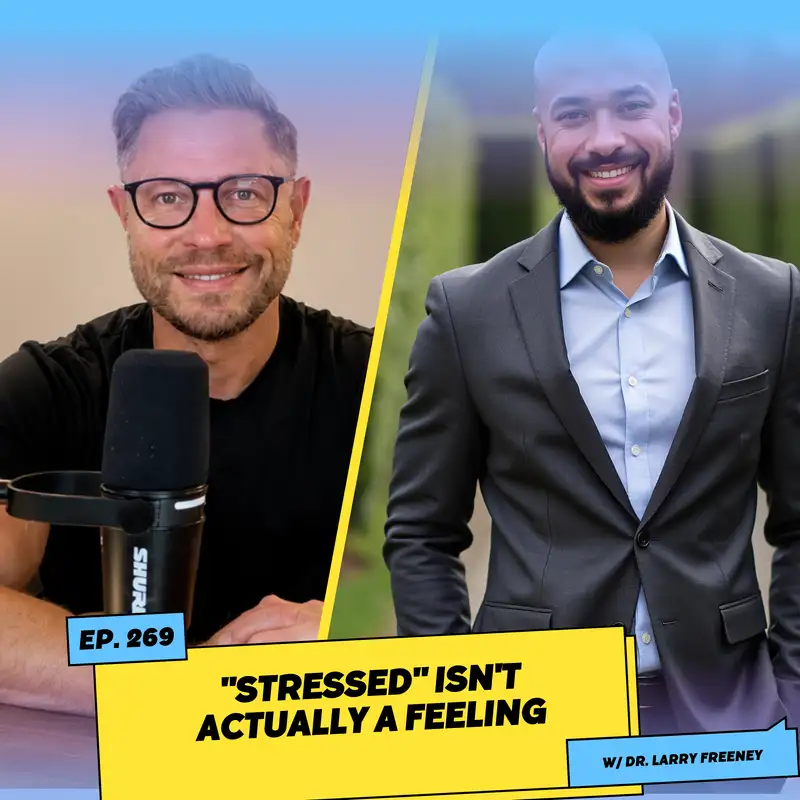
"Stressed" Isn't Actually a Feeling w/ Dr. Larry Freeney
Doctor. Larry Freeney has spent thousands of sessions in the counseling chair, and he keeps meeting the same person. Someone whose life looks right on paper and still feels off. He's a PhD counselor educator, a father of five, and a Spartan race athlete. We get into why most of us can only name about seven of our emotions.
Speaker 1:How language changes what you can actually perceive, and what to do once you've named the real feeling under a hard day. Plus the small exercise Larry gives people to figure out which of their values are actually theirs. Larry, thanks for coming on today.
Speaker 2:Thanks for having me, Mike. I'm looking forward to our conversation.
Speaker 1:Let's start at the beginning because your path in this work started around when you were 12 years old, when your mother attempted to take her own life. How did that experience shape the work that you eventually chose to do today?
Speaker 2:Yeah. I believe that's kind of experiencing that. So growing up, I was raised by my grandparents, and I had experienced kind of a a sheltered life, if you will. So my grandparents were born in the thirties, and so it was a little little different than the typical parents or guardians of my peers. And so I think for me that that was my first interaction with real really what mental health looked like.
Speaker 2:It wasn't even a buzzword really back then in the early nineties. Actually, at this point, let's see. I was 12, so it was actually in the early two thousands. And just the it kinda opened the door to a question for me. It was, you know, finally understanding what that meant that my mom was had a had attempted to take her life.
Speaker 2:Right? That people could experience such pain, such disconnection, such, you know, sorrow that they that dying seemed like their only way out. So for me, that kind of planted a seed in my mind, and I wondered, you know, what it was like to journey with people who had it experienced that low. For me, as crazy as it sounds, I enjoy all of the human spectrum. So that means the good, the bad, the painful, the sorrow.
Speaker 2:I have five kids. The oldest is six. The youngest is three months. And, you know, as you have kids, like, you always worry about them. You want them to make the right decisions.
Speaker 2:And so for me, I worry about being present and focused and really building that relationship, connecting with them because I could do what I can do, but tragedy happens. You know, life happens. And so I never wanna be in a position where I look back and I am full of regret of the could've, should've, would'ves. Right? I wanna live my life so that heaven forbid something does happen that I was at least present and made the most out of the time that we did have.
Speaker 2:That's been a difficult kind of experience because I did lose my brother to suicide in 2020. So my daughter my first daughter was born in January. My brother died in February, and then we had COVID in March. So it was a crazy three month period. And, of course, the world shut down.
Speaker 2:We had to go from being fully in person counseling to completely online within forty eight hours. And then people were stuck with each other. So wives and husbands were getting tired of each other, and tempers were flaring. So looking at it, you know, it's something that comes to my mind from that and the work that I do is kind of the thought process by Vishen Lakiani. He talks about, you know, how did you grow?
Speaker 2:So your company, you know, went belly up. How did you grow? So the relationship fell apart, but how did you grow? So it's kind of this idea of changing the tiny parameters of success and making it, how did you grow? Instead of saying I have to make a 95 or above on this test, whatever grade I make, how did I grow?
Speaker 2:How did I become a better person? What did I do with that information? So I think that's for me is, you know, that kinda opened the door starting with my mom's, you know, attempted suicide is, you know, how did I grow? What did I learn from this, you know, the situation? And then how will I carry that forward in all the work that I do?
Speaker 1:Well, I can certainly identify with a lot that you said there, especially around the parenting side of things. You know, we all wanna protect our kids. We wanna give them the ideal life, but the truth is nothing is guaranteed, and bad things do happen. So I love that being present and being focused is more of what gets your attention versus trying to maybe shelter or change the inevitable. So I love that.
Speaker 1:So as you moved into clinical work and, you know, you I've saw on your website, you've you've worked with thousands of people. What did you begin seeing over and over again?
Speaker 2:I began seeing that so first of all, many people play life safely. As you were talking about, it's kind of this this sheltered approach. Like, we don't wanna experience pain. We see discomfort, pain, fear as bad, but I see them as reverse indicators. So I know that whenever I'm uncomfortable, that this is a sign that whatever I'm doing, whatever I'm attempting to do, there's growth potential on the other side.
Speaker 2:Same thing with fear. I believe I got this from Robin Sharma in one of his books, probably the everyday hero manifesto, where instead of running from fear, fear means we should run towards the thing. Right? That's where the growth is. That's where the other version of us is on the other side.
Speaker 2:In twenty twenty five, January, in fact, I attempted to do what's known as a Spartan winter death race. So it is a crazy endurance event that it lasts for up to around seventy two hours, and the issue is you can never really train for it. You never know what's gonna be required of you. In June, they recently did the summer death race, and they had a ammo can that they had to get, and they had to stand on their ammo can. Think it was, like, three or four hours without saying a word.
Speaker 2:So you can just imagine just things that you think that you can prepare for when you're in the moment. Like, for us, it was we started off by our bibs were frozen in the middle of a lake, and so we had to start on one side, take our axes, and cut our way to our our bibs and find our bib. Right? I was bib number six. That was my number.
Speaker 2:So I found bib number 7. I found 19. I found eight. I found three. I found all of them but mine.
Speaker 2:I was in the water for, I don't know, like, twenty minutes. It made me get out because it's like, you're gonna catch hypothermia. I was like, isn't that the point for you for it's like, yeah. But not this early in the race. So I just remembered never being that cold in my life, never being that uncomfortable, never being that separated in my life.
Speaker 2:It was some of the most powerful experiences of my life because I was embracing, you know, the the quote, embrace the suck. I was embracing the discomfort, and I was finding out who I really am when you strip away the technology, the comfort, the the excuses, and you're out there. You're exposed, and it's really you versus yourself in nature.
Speaker 1:You know, you said something there that is run towards the fear, and that's where growth lies. And I think a lot of us have heard this. They've we've read it. But I think that there's a there's two people. There are people that take that, absorb it, and integrate it into their life.
Speaker 1:There are other people that read it, set it down just like any self help book, and they understand it, but they don't put it to practice. What do you think is that gap between somebody that does and does one of these crazy races that you did or faces challenges in their life could be health crisis. And those people that allow the they understand the principle, but they just can't move towards it with embracing it.
Speaker 2:So in my coaching program, there's this idea, the main central piece of my own personal philosophy is called the heretic gap. And this comes from the word arete used by Aristotle. So arete is excellence. It's flourishing on all levels. And the gap is the distance between who you are in actuality right here, right now, and who you could be in potentiality if you made all the best decisions.
Speaker 2:And it's asymptotic, which means that we can always close the gap a little bit a little bit a little bit, but as we further close the gap, we realize that it's asymptotic, like it never fully closes. There's always work to do. And in this gap, I talk about a a headed enemy, the hydra of half living. So my whole philosophy is about living fully alive, and the hydra of half living is the seven headed monster that stops us from closing that gap, and it's based on two things, fear and laziness. So what you were just talking about is what I call the phantom.
Speaker 2:And so the phantom is the head that's where you daydream about the life you want, you can vividly see it. But what happens is your brain has this uncanny ability that when you think about something long enough, it tricks you into thinking that you've made progress when you've really done a thing. So what's happening is imagine yourself climbing Mount Everest, and you're at the middle of the mountain. You're thinking about what it's gonna be like to be on the summit. You're thinking about the rest of the climb, what you're gonna do when you get to the top, and the feeling that's gonna happen.
Speaker 2:But here's the thing. In that moment, you're not climbing. In that moment, you're not getting any closer to completing the goal, and instead, you're wasting time thinking about it. And so that's what many of us do. We stay on the side of the mountain and we don't put in the action and the here and now to make it happen.
Speaker 2:So many people, it's it's procrastination by movement. So we think we need to read one more book. We think we need to do one more course. Once we do that course, then we'll have enough information. We read this book, then we can write the thing.
Speaker 2:Instead of one of the things I talk about is the becoming loop. So the default loop is you wait until you're ready. You wait until you have the feelings to do something before you do it. And the becoming loop is you act first, then the feelings will follow. So if you're like me, like I said, I have a bunch of kids, and getting to the gym isn't always easy.
Speaker 2:Sometimes it takes an act of God in in in life, right, with the move things around. And I know sometimes when I wake up in the morning, especially if I haven't slept well, I don't wanna go workout. Right? There's a part of me that says, I don't wanna go workout. I don't feel great.
Speaker 2:Now many people, that's where it stops. I don't wanna go workout, so I don't. Now if you want to be like the 1% in life, right, you have to do what the 99% don't wanna do. So when I get up and I don't feel like working out, that doesn't mean I'm gonna work out. It means I'm gonna work out whether I feel like it or not because I know this is in my best interest.
Speaker 2:I know it's gonna be something that I can build upon. It's gonna help me become that version of me that I wanna become. Now I may have a run that's, like, seven miles, so I'm not David Goggins. Right? I like to say I'm Goggins leading, I'm but not David Goggins.
Speaker 2:So I'm not gonna get out there and run 14 miles because I was supposed to run seven, and I don't feel like it. But I will go run at least one, two, or three miles. Right? Because consistency is more important than intensity. So I'm gonna do these things here, but I think a lot of it is what's called the tyranny of the or versus the genius of the and.
Speaker 2:So the tyranny of the or says, I can either go run my seven miles or I don't work out at all. There's no middle ground. And so what happens here, this is where we hide behind perfectionism. This is where we hide behind this false belief that doing something is not as good as doing the whole thing. Right?
Speaker 2:So if we're not gonna do the whole thing, then we should do nothing. No. It's the genius of the and. It can be, I'm sick, and I don't feel like running seven miles, so I'm gonna run three miles. So at least I get some workout in, and I build upon that momentum.
Speaker 2:And it's very common for people to read books like, oh, I read a 100 books this year. Awesome. How much of that did you implement? What did you do with that? Because if not, that was entertainment, which has nothing wrong with entertainment, but how did you better yourself?
Speaker 2:And that's the hard part. That's the vulnerable piece is to take to read something. And I say whenever you read a book, you should not agree with a 100% that the author says. There should be, you know, maybe sixty, seventy percent you agree with, but the other should be where you're going to, you know, push back a little bit. So you shouldn't take everything because that means that you can't think for yourself, and you will listen to the the sexy language of whoever's speaking at the time, and that will persuade you.
Speaker 2:That means you don't really have a solid foundation. So when you start building that solid foundation, you can say, what what did I just read? How could I use this in my life? How would my life be different if I did utilize this? And what am I missing out on if I fail to implement this into my life?
Speaker 2:So for me, it's reading with a purpose rather than just acquiring, you know, general basic knowledge.
Speaker 1:Yeah. I think much of what you said there is that there are so many different things that we can do that make us feel like we're being actionable that actually lead nowhere. Like, the example of somebody on the side of Everest, obviously, that shows that no action is being taken at that very time. But so many of us wanna think our way out of things. And for the topic at hand here with the podcast, many of us that are trying to change our relationship with alcohol, number one, we think that we're taking action by just replaying and thinking, and that actually really isn't leading into anywhere.
Speaker 1:Also, other thing that you said there with, if I'm not gonna go all the way, I might as well not go at all. But the truth is is that any action taking a step towards the right direction of where you wanna go is still taking action versus inaction. Now I wanna ask you, you have something called the prism. So what problem were you trying to solve when you built that?
Speaker 2:So the prism is based on some of Brene Brown's work. In her book Atlas of the Heart, she kind of identifies the 87 different emotions on the human spectrum. So many people, you ask them how many emotions they can name. Right? They get to like seven.
Speaker 2:And the ones that we can name and identify in our body is the big three, so it's the mad, sad, glad triad. So with the prism, I wanted to think of that, especially with most men. I say most men because that's just if you look at society, we aren't forms to really be able to speak, understand, process, and make meaning of our emotions. They're kinda just something that we, you know, push through. And so I like some of the language, but I I wanted to create the language that helps us on this journey.
Speaker 2:So I have to think of the journey of being fully alive, the journey of or the book that I'm writing, the unreasonable life, it's a journey. And someone may be on a similar journey, but there's no path that looks exactly like yours. So we want the book. We want the blueprint. We want the map to to for our journey, but it doesn't exist yet.
Speaker 2:We have to write it as we go. And so for me, the prism was this idea of when we look at light around us, right, if you look at yourself, like, around yourself right now, you see white light. Right? That's what we see. We don't see the full spectrum of light that make up that white light, except when you bring a prism and you let the light pass through the prism, then you can see the full spectrum of that light, which at first glance seems like white, but you see it's made of, you know, Roy G.
Speaker 2:Biff, right, the colors of the rainbow. So the same thing with our emotions. If you don't have the words to conceptualize the emotions that you're feeling, then you just see it as white light. You just see it as this one big conglomeration. But the idea of the prism is to make sense of, to distill your experiences, your emotions down so you can make meaning of it.
Speaker 2:So for instance, if you were looking forward to getting this position or this job and you didn't get it, are you angry? Are you frustrated? Are you disappointed? Are you feeling guilt? Are you feeling shame?
Speaker 2:Right? So there's so many different emotions that can happen at one time. Right? I call it the emotional cocktail. But if you don't have the words to understars to understand it and the process is, oh, I'm feeling frustrated.
Speaker 2:Well, if you don't know the difference between frustrated and angry, then you can't distill those two. You can't separate them. So it may feel like one emotion even though anger and frustration are the same emotion except for anger. You get angry about something you can control, you can do something about. Frustration, you have no power, no control.
Speaker 2:So if I locked you in a cage and said, this is your life now, you can be frustrated. Now you could be angry because you trusted me and your friends told you not to trust me. So you can be angry and frustrated about the same thing, but they have different places that they reside in our body, and they have different meaning making schemas. So why is this important? This is important because if we don't have the words to describe what we're experiencing, then we're disembodied.
Speaker 2:So many men, and I've done this before, is we intellectualize everything when we feel emotionally vulnerable if we don't have the words to describe what's happening. So we're disembodied. We're not connected to our body. We will tell you why a painting is beautiful, not what makes it beautiful. For instance, I can tell you from the intellectual point, oh, this painting is beautiful because the artist used this type of shading, which is rare back in the day, but it was used to bring the full spectrum and pop in front of you so that the foreground was highlighted and the background was kinda blurry.
Speaker 2:That's cool and academic and intellectual, but it misses out on the beauty of the piece. Now someone who's speaking from an emotional stance will say, looking at this painting reminds me of my grandmother's house. Growing up and playing football on the field with my brothers and my cousins who I haven't seen in years at this point. Point. But I remember at every time when one of us got hurt or it got dark or we heard a scary sound, we could turn around and see grandma's house, and we knew that we were safe.
Speaker 2:We knew that we were home. And this painting brings me back to that place, the sense of nostalgia. Now you can see the difference between me describing why this should be beautiful intellectually and then connecting with my humanness, with my memory, with my pain, with my my feeling of joy, of homecoming with the painting. So that's gonna be the difference here. So the prism allows you to not only see things intellectually, but also be able to see them emotionally and integrate the two.
Speaker 2:Here's the intellectual about it, or here's the emotional piece. This is kinda how I'm thinking about it. This is the meaning that I make from that experience. So so many times remember, but life is only experienced emotionally. It's not experienced intellectually.
Speaker 1:Would you say that this is a limitation of the English language or of all languages? Have you given this thought? Like, talk about that.
Speaker 2:Yeah. So I think it's a limitation of so there's some cool words, like, in English. There's a kind of a word for it, but we don't really use it. So there's the word schadenfreude, which is basically the joy of someone else's pain. And so we see this in they've actually done a study this between The U the New York Yankees and the Boston Red Sox because the fan the fan bases hate each other.
Speaker 2:Like, it's literally, like, in their DNA, they hate them. And many times, they don't even actually see the members of the other teams as human. They dehumanize them. So short in Florida is when you have Yankees fans who trip and fall and get hurt in the Boston Red Sox fans are super excited. They're happy.
Speaker 2:They're great. They deserve it. That's Jordan Florida, taking joy from other people's pain. And it was never meant for us to kind of experience that. The only way we can do that is if at first, we do dehumanize people.
Speaker 2:So I don't think at its core, there are some experiences that don't really have words for them. So one of them is this. It's when you meet your soulmates at the wrong time. So you meet somebody, you would be perfect on paper. Right?
Speaker 2:You have this, this, and this, but the timing is off. Either one of you is in a relationship, one of you has been hurt, and it's not in a place to connect, or, you know, you live in two different parts of the world, whatever it is. Right? So there's this kind of this bittersweetness, this nostalgia, this kind of sense of animesis. Right?
Speaker 2:So animesis is a sense of knowing that kind of surpasses what you've actually experienced. So it could be hearing a song for the first time, but there's a sense of knowing. Like, I know this song. I know the essence of it even though I've never heard it before. So there's definitely the language for that, and a lot of it's not in English.
Speaker 2:It's in different languages. But I think here is the goal isn't to be a one stop shop because sometimes you have to make up words. Sometimes you have to invent words. You have to create things. But it really is is giving you the ability to further conceptualize so that you can then do something about it.
Speaker 2:So I did the study one time about language, and there was this theory that the color blue wasn't actually a word, a condition until much later. So if you listen or you read Homer's Odyssey, he said the wine red sea. It was never like the blue. Right? Blue wasn't used in ancient writings, and it wasn't until they conceptualized the word that they could actually see the the color.
Speaker 2:So in Russian so if we think about English, blue is the word, and then light blue and dark blue are adjectives that describe the type of blue. So it's like a spectrum of blueness. However, in the Russian language, light blue and dark blue are two different colors. They're not rooted in the same. So we're not describing blue as light or dark.
Speaker 2:It's a whole different color. So they perceive colors differently because of the language that they have. So language allows us to see things. Counseling with couples, one thing we talk about many times is what the Gottmans refer to the four horsemen of the apocalypse, which are basically these four conditions in your relationship that can destroy the relationship, the marriage. And many times, we do these things, but we can't conceptualize them.
Speaker 2:We don't have a word for it. But once we have a word for it, we can measure it. And what do they say? If you wanna change something, you first have to measure it. So I think as Brene Brown says in Atlas of the Heart, our this is a paraphrase, but, basically, our language gives us the ability to see worlds that exist beyond the physical.
Speaker 2:So many of what we agree on today, like the fact, you know, I live in Texas. So Texas as a state doesn't actually exist. Texas is only exist as an entity because a bunch of people agreed that it exists as an entity, and we treat it as if it exists. Thing is same thing with money. Money, paper, has no value.
Speaker 2:It has value because we say it has value, and everyone agrees that it has value. And so without that language, we miss out on so many experiences and and the opportunity to make deep meaning from our experiences from our lack of our words.
Speaker 1:I find this topic particularly interesting probably because I'm a language nerd, and I I like foreign languages. And, you know, in my own studies, I've come across words that there's really not a direct connect in the English language, same with limitations going the other direction as well. But I wanna take this concept that we're talking about without nerding out on that side of things into more of one that would be relatable to somebody listening today. So let's just say 6PM, the day is done, somebody pours a drink, and if you ask them why they're pouring that drink, a lot of the times, it'll just say it's because I'm stressed. Based on your work, what might actually be underneath that word?
Speaker 1:Or I'll put it one more step forward. What if they could better identify what they're feeling, could they take away from that?
Speaker 2:Research shows us that the more nuanced our emotional language, the more resilient we are to the highs and lows of life just because we're able to make sense of it. So stressed is kind of like our our token word. Stress is one of them, anxiety is one of them, and good is one of them. So I'll say, hey, Mike. How are doing?
Speaker 2:You know, I'm good. Right? But, we're not many times, we're not expecting the follow-up. So I think it's pouring the drink because, one, as John Safoury talks about in the Wealthy Gardener, one of his kind of rules of life is he wants to have a straight edge. He says that the pressure of life is what motivates him to to move and to do things.
Speaker 2:He says he needs that pressure. He needs that edge to poke into him so that he will get into motion and do what he needs to do. He says when we take off the edge, we're blunting these forces that will cause us to change, if you will, or that will annoy us enough to finally get up and, you know, stop sitting on the mountain and finally go climb it. And so we're look by and say, okay. Stressed.
Speaker 2:Is it a short term? Is it eustress, or is it distress? Right? Eustress is the healthy stress that, you know, without stress, we wouldn't have gotten out of bed this morning, or is it the distress that is the crippling type of stress? Right?
Speaker 2:It's the difference between stress, overwhelm, and, you know, anxiety and worry. Second, we wanna figure out what's causing this high level of stress. It's in the actual change in demand, or is it how we're perceiving it? So we look at our work. Does our work fulfill us?
Speaker 2:So many people aren't fulfilled by their work. So they go through and they just kinda it's it's just a job, which is one of the most terrible things that you can say. Right? It's just a job unless it's a stepping stool until the next position. Right?
Speaker 2:So one of the things is we want what we do the most of our time takes up most of our time, which is typically our work today, like our tribe is now found at work. We want it to be able to give us a sense of purpose and meaning, but also to replenish us. So if we're spending most of our day at a place that pulls from us and doesn't refill us, over time, we get drained more and more and more. We become disconnected from ourselves because sometimes that can be depressing at this aspect. We're not where we wanna be.
Speaker 2:And so what do we do? Men typically avoid and women typically worry. Now that's not all the time, but it's this idea of I'm gonna worry about this. I'm gonna worry about this. I'm gonna worry about that.
Speaker 2:Men, we're just like, I'm gonna avoid it. So alcohol can be used as a way to avoid the tension, to avoid the pain so that we push the problem on. Right? It's still there. We just don't feel it.
Speaker 2:So it's kind of like looking at your house and being on fire, but I put shades over my eyes so I can't see it. Right? The fire is still there, but I have said it's not my problem right now. That's a problem for future me. And I'm not saying, you know, in essence, having a drink in and of itself is terrible, but we wanna figure out why are we having that drink.
Speaker 2:What is it either numbing, taking the place of, or what is its purpose in our life?
Speaker 1:So in the context of the prism, I wanna give a little bit of devil's advocate here. And, like, let's say somebody let's say somebody, you know, they they discover a better way that is beyond language, but how do you make it so that somebody can actually have meaningful change in practice rather than maybe simply giving them better language to understand their own emotions or feelings at that time?
Speaker 2:Right. So as we were talking about earlier, like, the reading the book analogy. So you could read the book, but if you don't implement any of it, it doesn't mean anything. So the language is the first step. One, it allows me to understand what's happening to me better, then I can share it with you.
Speaker 2:So for instance, if somehow subconsciously you're annoying me, Mike, but I don't know how to, like, verbalize it or what it is, I'd say you're annoying me. You're like, well, what am I doing? And I'm like, I don't know. Right? So nothing can be done about it.
Speaker 2:And then you do your thing and it annoys me. But once I've gotten the word for it, oh, it's, you know, this idea. So now we can talk about it. It's like, hey. When you do this, it frustrates me.
Speaker 2:Right? Can we figure out a different way to do that? So remember, information in and of itself that say information is power, it is not. Information is potential power. So same thing here.
Speaker 2:Words are potential power. How are we using them to make those change? Remember, it's action is the only thing that's gonna change this. So once we have this understanding, great, but what am I going to do with it? So if I understand that, oh, when I have to work a double in a row and my when I get home and my partner isn't emotionally available, I know that I withdraw and I drink.
Speaker 2:So it's kind of my way of numbing the pain of loneliness and after working all these hours. So now that I have that information, okay, what can I do about it? So I can let my partner know, hey, babe. When I wear doubles and this is a thing, I really need that connection when I get home. Right?
Speaker 2:If not, that's what that's where, you know, drinking will fill that void. They say the nature abhors a vacuum. So if there's nothing there, something else will fill the the for that void. So allowing your partner to know that's how you build your relationship. Or maybe you've experienced this, Mike.
Speaker 2:There there's this time where there's something in the relationship and there's, like, something in between you and and your partner, And, like, it's kind of, like, under the consciousness. So it's kinda like when you see was it lettuce or something in someone's teeth? Like, you notice it, but you're not, like, saying anything yet because it's kind of below the surface, but, like, you pick it up. And then later, you're like, oh, by the way, Mike, you got something in your teeth. Like, sorry.
Speaker 2:I was right? It's kinda like that. Like, we notice that there's something going on, but we don't bring it to the surface. We don't say anything. So it's really about, great.
Speaker 2:You have this information. And so it's one of the questions I ask myself. You have this you have this information. What am I gonna do with it? Right?
Speaker 2:Because if you have the information, you have the winning lottery numbers. Right? You know what they are. But if you don't go buy a ticket, it was useless, and you wasted this opportunity. So it's now that I have this, now that I'm learning this, how what actions will I take to either be closer to myself, to, you know, honor that promise I made to myself, to go for that crazy, hairy, audacious goal that has been escaping me.
Speaker 2:Right? Language is the first part, but it's necessary, but it is not sufficient. Right? It is the first part that we build upon on this crazy journey.
Speaker 1:And that makes total sense. And, you know, you can have all the information. We kinda touched on this as we opened. But if you're not taking action on it, that's just one of the pieces. Now I wanna kinda conclude with this question, and it's kinda broad, so you can go wherever you want with it.
Speaker 1:But to that point, there this is was true in my own life. Somebody whose life looks really great on paper, but, you know, something just doesn't feel connected or feels off. And that that's a really hard place to be for a lot of people, but I think getting in touch with yourself is the first step. But if you were to give somebody that action step like, hey. Everything looks good, but it still feels off, what was what would be one first step that you would have them take this week?
Speaker 2:So one of my favorite exercises so we're not gonna do the whole thing because it it can be kind of rigorous. But it is to look for times in your life where you felt respected, where you felt excited, when you stood up for something that was important to you, when and when we think about memories. Right? So memories, they're they say that the the body keeps the score. So a lot of times, we remember stuff because it was important to us.
Speaker 2:And so I would think of one to two memories and kind of look at the context. What was happening in this memory? What was either being honored or what was being disrespected? Right? So it's typically the good memory is something that we care about is being honored.
Speaker 2:And the bad memories is something that we care about is being dishonored. Then from here, we wanna look at of all the millions of moments now MJ DeMarco talks about this in his new book, Choose Hard, Live Easy, that a moment is roughly ten seconds. And if we're not happy with the quality of our life right now, it's because of how we've been spending our moments, what we've been using those ten seconds for. Each action that you take is a vote for who you'll become. So you wanna be an athlete.
Speaker 2:Every action you take to get up and run and to eat well and to exercise and to avoid junk food, all those are votes towards that identity, that reality. Whenever you decide to sleep in, you know, watch one more episode on Netflix when you should've gone to bed hours ago, break open those Doritos or that chocolate or that alcoholic drink whenever you're feeling a little stressed, right, that is a vote for a different life. So the culmination of who you are right now is those little votes. Right? Was it for or was it against?
Speaker 2:So I say that because we want to look down and see this is what I call your your your soul print. Right? It's like a fingerprint before your soul. It's like the unique expression of who you are. So many times, pick up on the values of our family, of our culture, of our work environment, and we adopt them, but they're not really ours.
Speaker 2:So by going through some of your memories, you can kinda see, oh, here, I really resonated with family. Family is important to me. And when you start doing this process, you start seeing the the values that are important to you. So now you know if you're in a relationship and your partner doesn't value family or your partner doesn't value physical exercise and that's something important to you, then that's gonna be a moment of contention. Right?
Speaker 2:It's kind of like your your limbs. So your values, as John Safouric says, your values are the part of you that if you don't honor them, a part of you dies. And so sometimes we can look at ourselves. We can be successful because we've done all the right things, but it doesn't align with who we are. It doesn't bring us joy.
Speaker 2:It's not something we enjoy. We just happen to be good at it. And many times, we will sacrifice what brings us joy, what brings us happy, for what brings us that external accolades, what says that we are worthy of being a person. And that's a that's a that's the golden handcuffs. It's a terrible place to pee, and I see it with a lot of my coaching clients.
Speaker 2:And so I think the first step is to kinda identify and understand, okay, what is truly important to me? Like, important to me, not what should be important to me, not what my parents told me is important to me, but me, if you strip everything else away right now, what do I value? Then begin making your decisions based on those values.
Speaker 1:Such good advice, and I know how powerful looking back, it seems so obvious to do, but we skip that whole entire thing and go into action mode. And I love what you said there. Each action is a vote for what you become. So, Larry, this has been incredible. Thanks so much for coming on today.
Speaker 1:Anybody wants to reach out, learn more about you and say thanks, where can they go? Where can they go?
Speaker 2:So I'm glad you asked, Mike. So I have a website. It's called choosefullyalive.com. That's right. Just choose because you have to choose to be fullyalive.
Speaker 2:So choosefullyalive.com. And I'm gonna upload a new version today. So by the time you watch this, it should be up. And it'll give you a free assessment. So you could go around, learn a little bit more about me, what do I do, get in contact with me.
Speaker 2:There's a free assessment at the bottom. It's called the Heretic Math Gap. And what it will do, the assessment will look at these 12 areas of your life. I call it the symphony of your soul. Right?
Speaker 2:Who you are as a person. There's 12 areas that we need to be happy, functioning members of of life, of the world. And it'll give you a free based on your results, it'll tell you what your biggest gap is, right, where your biggest gap is. It'll tell you what your biggest strength is, and it'll tell you where's the best place to start. So it'll give you a free fourteen day process that you can follow, and the goal is 1% of your day total.
Speaker 2:So 1% of your day is roughly fourteen minutes and twenty four seconds. So to start jump starting your life, if you can dedicate 1% of your day, after two weeks, you can start seeing visible change as you're building new routines, as you're doing new things to get to know who you are more often. So once again, that's choosefullyalive.com.
Speaker 1:Thanks, Larry. Anybody listening, go check out his website, and thanks so much for sharing today.
Speaker 2:Appreciate you. Thank you so much for having me. It's been a pleasure.
Creators and Guests