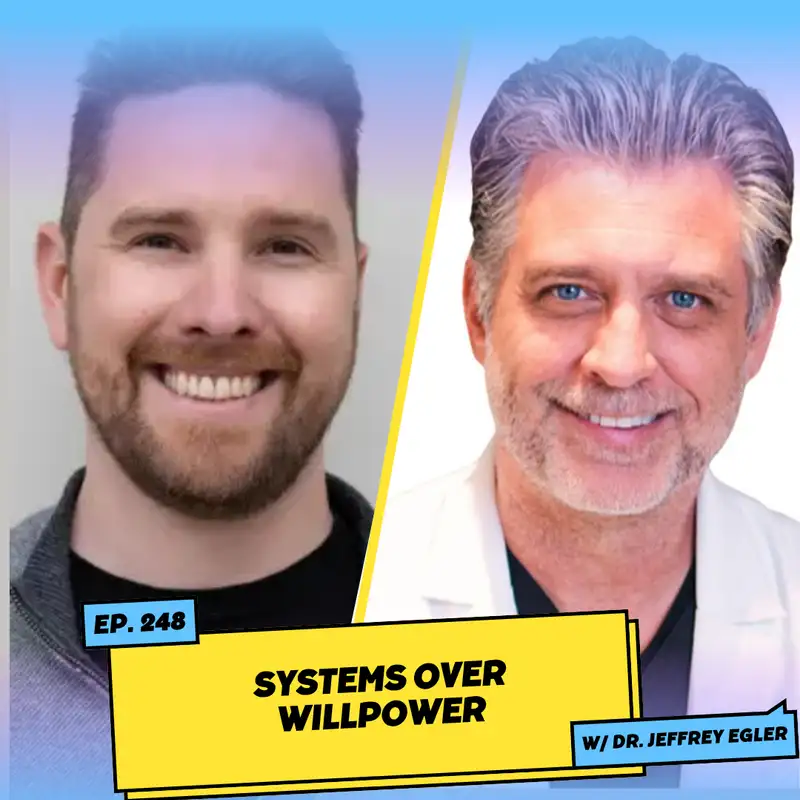
Systems Over Willpower w/ Noom CMO Dr. Jeffrey Egler
Welcome to Journey to the Sunnyside, the podcast that helps you build a better relationship with alcohol and uncover the secrets to mindful living. Each episode brings you real stories, expert insights, and practical tools to support your goals. Whether you're cutting back, taking a break, or thinking about quitting for good. I'm your host, Mike Hardenbrook, bestselling author, neuroscience enthusiast, and habit change expert. This show is brought to you by Sunnyside, a personalized science backed program that helps you to drink less through habit change, coaching, and community.
Speaker 1:And for added support, we now have Sunnyside Med, a clinical option offering access to compounded naltrexone, a prescription medication that reduces cravings and helps prevent binge drinking. Ready to start your journey? Get your free fifteen day trial at sunnyside.co. This week we're doing something a little different. I handed the mic over to Nick Allen, co founder and CEO here at Sunnyside for a special two part conversation with Doctor.
Speaker 1:Jeffrey Egler, Chief Medical Officer at Noom. You can listen to this episode on its own, but I'd recommend checking out part one for a broader conversation around healthy aging. They get into behavior change, moderation, and why most people struggle to make lasting changes.
Speaker 2:Sorry to interrupt, but do you mind if I ask you a question before we move on? Because I feel like you are expert in something that, given the chance to talk to you, if I don't talk about this, it's a really missed opportunity. It seems to me that you and in Sunnyside are experts in dealing in moderation, right? You correct me if I'm wrong, your message is not sobriety necessarily. In fact, it's really how do you learn to live in that moderation?
Speaker 2:I think that that is so key and important for not only alcohol, but so many other aspects of the healthy living and healthy aging. I'd just like to hear a little bit more if it's okay about what you've learned in that space. I'll give you a little context. I don't do well with moderation and that's really with all things.
Speaker 3:You
Speaker 2:know, so it's just easier for me to not drink alcohol at all than to moderate myself. The same thing sort of goes with, exercise. I'm either sort of doing it on a regular routine or I fall out of it. So what are some of the key takeaways or tips that you've learned in terms of, or just even philosophy of really living in moderation successfully?
Speaker 3:Yeah, well, first of all, I think that that insight that you shared about yourself is such an important one to have found. And what Sunnyside and kind of our broad mission is to help people explore their relationship in order to uncover the insights about how they drink and what is sustainable for them in terms of long term relationship with alcohol. For some people, you know, they start with Sunnyside, and they explore, and they track, and they set goals. And ultimately, they find that moderation is not appealing to them or not realistic for them, given kind of the way that they tend to drink and the habits that they have, you know, deeply ingrained around alcohol. So for many people, the pathway is, you know, starting with us, you know, using us as a front door, but then ultimately realizing that, you know, sustained abstinence is actually kind of a more appealing or a more, you know, realistic pathway.
Speaker 3:Many others, on the other hand, you know, start the exploration, they bring some structure and some scaffolding around the way that they drink. In some cases, they bring medication into the mix as well in order to kind of support moderation outcomes. And they find that they can strike a balance where alcohol is a generally positive part of their life, and where they can kind of cut some of those negative experiences out of the equation, and ultimately get to a place where that is a sustained, moderate relationship with alcohol. For Sunnyside, the goal for us is really to help people take that first step and to open a welcoming door for them to explore their relationship with alcohol without judgment, and without kind of presupposition that they need to get to one specific outcome. Too many other systems out there, right, it's about helping the quote unquote problem drinker on the path to complete sobriety.
Speaker 3:And that's kind of the only path that's presented in many facets of the treatment landscape. And with Sunnyside, you know, one of the key insights that we built this business around is that there are many millions of people who are drinking enough to have alcohol impact both their short and long term wellness, and yet who may or may not be open or interested in the idea of cutting alcohol out entirely. And I fell into that camp, you know, I was in a place where I too have, you know, heavy drinking tendencies if I'm not being conscious of the role that alcohol plays in my life. And yet, for the most part, drinking has been a positive part of my life up until this point, but one that I want to manage proactively and that I want to kind of keep tabs on, because I know I've got some of those risk factors in my personal life and in my family. And so, giving folks the option and a pathway to explore without judgment and to find the balance that works for them is something that's so important for us.
Speaker 3:And what we've seen ultimately in this space is like, when presented with the idea of admit you're a problem drinker and go totally sober, or do nothing. Before Sunnyside, the vast majority of people were choosing to do nothing, or to go it alone. And we're leaving this huge opportunity to improve their wellness on the table. Drinking less is better than drinking more, right? To your point, we objectively understand that no matter where you are in your relationship with alcohol, less is better.
Speaker 3:So we wanna make sure that we're not making perfect, AKA abstinence, the enemy of better by helping people kind of achieve moderation. And so, built on lived experience and personal insight, but really about this idea of creating a front door for anyone who's looking to explore their relationship with alcohol and figure out what that means for them.
Speaker 2:Yeah, I can see. Just hearing that, you can start to see how it relates to so many other things. Somebody might be able to eat potato chips in moderation and somebody else might not be able to, but I like what you said about, it's really about exploring and having a greater awareness of where you are as an individual and sort of what are your strengths, where are your challenges, what's a good idea, what's not necessarily a good idea. But I think, what I heard in that is whether your issue is with alcohol or it's other things, including alcohol in the realms of healthy aging, moderation is either really a key for some people or it can be really challenging. So get help and get assistance in terms of like, how do you better educate yourself?
Speaker 2:How do you better assess yourself? And then how do you better support yourself? And there's a lot of tools in that toolbox, and obviously Sunnyside, just like Noom, is providing those things.
Speaker 3:Yeah, and the thing is alcohol is many of us have just like food, we have so deeply ingrained habits when it comes to the way that we drink and the way that we eat, that often, you know, a goal on its own is not enough to make sustained change. And so I think, you know, this is a great transition actually into talking a little bit more about the specifics of Noom and Sunnyside where it makes sense. But this idea that, there's a quote from James Clear, which I love, which is, we don't ride to the level of our goals, but we fail to the level of our systems. And so I think about Sunnyside as the structured system for habit change around alcohol. So, you know, coming in with an idea of how you want to change that relationship is often not enough without the scaffolding and the structure around that goal to make, you build new daily habits, to unpack and break down deeply ingrained routines and rituals that are often very, very hard to change on your own, and ultimately to replace them with habits that set you up for long term change, rather than white knuckling through willpower, reaching your goals for a week or a month, and then kind of jump bouncing right back to, you know, old habits.
Speaker 3:The structure is really what makes the difference for both Sunnyside and certainly for I'd you know, I'd love to kind of use that as a transition to our next conversation, just a little bit around kind of, you know, we defined healthy aging at a high level, and now really want to kind of focus on how Noom and kind of the tools that you all provide really help folks, you know, make that long term sustained change. So for starters, Newm's mission is to empower individuals, I think you said this earlier, to live better, longer every day. So maybe start by just kind telling us about what that means for you and how Newm brings that to life every day.
Speaker 2:Yes, live better, longer every day. So every day is really carrying a lot of weight in that sentence, And how do we design habits or systems that help support people in their goals on a daily basis, right? Because you don't get to longevity. We don't really focus on living to 85, 95, 100, 125, whatever it might be. We focus on getting to wherever you're going by doing your best today.
Speaker 2:And how do we help people in doing that? Your point about structure around habits is so important. So it's only in the past five or ten years when thinking about things differently, thinking about psychology, learning how to set yourself up for success that I've thought a lot more about your environment. I chuckled when you mentioned the James Clear quote only because it's such a great quote and I thought about it myself this morning, sort of getting ready for our conversation. And I think part of the reason I failed for so long at changing my life is because I just thought I've had a goal and here's me and here's the goal and I'm just going to go get it.
Speaker 2:And that required motivation and that required willpower and that wasn't always there. And we talk about those things and educate people about those things at noon all the time is that this idea for the past fifty years watching the obesity, and perhaps substance abuse, epidemics creep up on us of this being a willpower issue or if it's not working, you have to try harder. Where has that strategy gotten us? Right. And so seeing how much more beneficial creating an environment, creating a structure around yourself, doing things in community with friends and family, asking a friend, you can now invite a friend to join you on Noom.
Speaker 2:We found that people that do that have twice as much engagement than people that don't. So it's pretty significant and it extends how long you're engaged as well. We see this happening naturally in the world in blue zones. I'm sure you're probably pretty So familiar with blue for people that might not be, blue zones are those areas of the world that people tend to live the longest. And when you ask those people, what do you do for exercise?
Speaker 2:Most of them are not suggesting that they go to yoga class, they do a treadmill, they're going to the gym. It's just more entrenched in their life. It's just more really in what they tend to naturally do. They don't drive as much. They ride a bike or they walk.
Speaker 2:They prepare meals with their family. They take more time for meals. They have longer breaks in their days where they do those kinds of things. And so that shows us that naturally environment, how you build your environment, how you construct your lifestyle has tremendous effects on whether or not you can get to your goals or not. Willpower is not a sustainable resource.
Speaker 2:And so you have to, like James Clear suggests, have a system that allows you to rise above where you would otherwise fall.
Speaker 3:Yeah. And I think it's so important when you talk about this idea of in weight and alcohol, for sure, idea of like, just eat less, just exercise, just drink less, or just stop drinking. These kind of statements that just carry so much judgment as if it is the individual who is to blame if they are not, you know, achieving, you know, long term habit change. And I think that when we start to shift that conversation away from willpower to providing tools and structure, and in some cases, medication, where you've got this whole kind of new revolution of capabilities of the tools available to us, it completely changes how we can look at and think about these topics, and really does start to remove willpower from the equation. I'd love to hear from you, Doctor.
Speaker 3:Egler, what would you consider kind of the active ingredients that make Noom effective as you kind of look at the individual pieces and have a change? How do you break down what an effective behavioral health program looks like through the lens of Noom? What are some things that our listeners might be able to learn from that?
Speaker 2:Sure. Well, this is a little counterintuitive, but I think it's really important. As a functional and lifestyle medicine provider for the past ten years, have thought about putting behavior and lifestyle first, right? And then building the foundation there. And then only when that is not as successful as you would want it to be, adding medications.
Speaker 2:And I think that's how most people think about things. Unfortunately, what we typically see is that people don't do much and then they get sick, they have symptoms, and
Speaker 3:then they end
Speaker 2:up on the medication, right? Because they're so far, they've tried things that hasn't worked. They're so far in terms of their habits that really changing their lifestyle doesn't work. And now they're kind of stuck with the medications. After ten years of thinking and evolving towards a longevity mindset, it's interesting that I've come full circle in spending the first ten years putting people on medications according to guidelines, you admit, you hit this criteria, you have a disease, let's try this medication to spending the next five years in functional medicine, trying to get people off of medications,
Speaker 3:and we want you to be
Speaker 2:healthier so you don't need the medication. Now coming sort of full circle to this longevity perspective of maybe it's not or, but and so that medications might not necessarily be a bad thing. They might not be only when everything else fails, but in addition, so even healthy people, I think the future of health and wellness is actually also using medications, biologics, to help people be healthier than they would otherwise biologically. So all of that to say that for some people that have been challenged with behavior and willpower for so long, sometimes the medication actually comes first and that's okay because what we found is that the medication is a catalyst and it provides people with a spark that then allows them to more successfully engage in the behaviors that finally start to demonstrate results for them. It's this energy of activation.
Speaker 2:I I deal with this every single day. Later today, I'm going to go out and I'm going to I'm going to do some weight training in the backyard and I guarantee there's going to be that, oh, do I really want to do this? And every day I have to get you would think that it would and it does get easier with time, but it's still I don't think necessarily doing it gets easier. I think it just becomes a habit not doing it is a non negotiable. So but every day I have to get over that energy of activation.
Speaker 3:So
Speaker 2:what GLP-1s as a medication, for example, do is help people lower that energy of activation. It's easier to find the motivation or to not engage in certain habits. Then that energy that they've been spending and trying to overcome that is then actually freed up to engage in other types of things. And what I have seen is remarkable in terms of people that are using GLP-1s that really are for the first time in their lives changing their lifestyle. They're exercising more, they're eating differently because for the first time in decades, they're actually seeing themselves move the needle in this and success breeds success, right?
Speaker 2:So that's, but that's, I don't necessarily mean to put a medication first philosophy here, right? I just think that it's realistic to utilize that as a very important key tool in the tool belt. I think the original question was?
Speaker 3:And this is so true. I love the way that you're talking about this is kind of like medication previously seen as a last line of defense. This is so true in the medication assisted treatment landscape for alcohol as well, where up until this point, and up until kind of some of the stuff that we're doing with Sunnyside Med, you know, medication was treated as a last line of defense after the behavioral interventions failed, right? And often when someone was kind of reaching a point of crisis or beyond that point of crisis, where like, now we'll bring kind of the medication into the picture. And we take this exact same philosophy with Sunnyside Med, which is this medication is perfectly safe for proactive and preventive prescriptions.
Speaker 3:And if you can get if we can get people started with medication, plus a structured approach to behavior change early, we can avoid the most negative consequences of long term, you know, unchecked alcohol overuse. And so it's just so interesting too, mean, in this landscape with alcohol as well, just how much it's been pushed to the very, very end of the acuity spectrum, and how much of a gap that creates for folks that could really benefit from a biochemical intervention earlier on in their journey to a healthier relationship with alcohol. So just that resonated so much with me in terms of our world at Sunnyside as well. But you were getting to, I do want to touch on this too, kind of this idea that medication is a part of the toolkit, but not the end all be all. So tell us a little bit about kind of the pieces around the medication and that scaffolding, if you will, that helps folks to create sustained change in a medication supported way?
Speaker 2:Sure. So Noom was a very successful platform for weight management, metabolic health, weight loss for a decade before GLP-1s even came along. And the interesting thing was that the business started to go down as GLP-one started to become more available in that. So people had sort of a more easier out, but we're clearly through phase one. Phase adoption.
Speaker 2:So many people have tried GLP-1s now. Most of them, eleven out of twelve persons will stop taking them within three years. One out of three people, two out of three people stop taking them within a year. It's not a durable habit for whatever reason. And so we're, we're moving into phase two of this whole GLP medication revolution and gaining ground on obesity, where we learned that durability is what we, how do we make these changes durable?
Speaker 2:And that's where behavior change everybody's coming back to. You need to use the medication as a catalyst, as a spark, but the medication may open a window or a door, but you have to step through that door with some powerful tools and able to be able to get on the other side of the wall. And so what Noom has cleverly designed is a platform that makes it easier, it makes it more fun, and it makes it doable by breaking it down into steps. So we talk about gamification. People like this.
Speaker 2:I mean, they like getting streaks, they like earning rewards. Full disclosure, I have been for the past couple of weeks logging my food. Prior to this, food logging was not anything I was ever interested in doing. I didn't necessarily see the benefit of it. I know what I'm eating.
Speaker 2:How is that going to help me? But I'm kind of, even as a physician who's been practicing this for twenty years and working for Noom for a year, I'm a little surprised by the effect that it's actually had on me beyond the sort of cognitive factors, because just the fact of me, just the process of me stopping to enter my foods on a daily basis, the level of awareness of what I'm actually eating. And sometimes it works in fact of like, if I'm going to eat something, I think I'm going to have to log that later. Do I really want to, do really want to eat that? And now I see how it's affecting my calories and the protein amounts.
Speaker 2:And so it's, it's raised my level of consciousness and awareness about what I'm actually putting in my, in my mouth every day. The app notifies me if I didn't complete my food log yesterday. So I don't want to lose my streak. So now it's gamified. So now I'm doing it every day.
Speaker 2:So gamification, breaking down more complicated goals into micro habits, making them more easily, easily accessible to people. These are the tools that we typically embed in our platform so that the whole game of behavior change becomes not only doable, but easier.
Speaker 3:Yeah, and those micro habits are so important, I think, with a goal like weight loss or alcohol reduction. You know, the long term impact takes a while to recognize in both of these cases. And so the more that you can kind of break down that long term impact into, daily and weekly mini games, allowing you to kind of see and sense that progress every single day while you're laddering up to kind of the larger, maybe not immediately tangible results, just kind of gives you that thread to keep going as, you know, willpower is ebbing and flowing and as, you know, maybe a single day might not feel as impactful. But kind of having that visual and having those those kind of games to bring you through is just really, really powerful. So I totally agree.
Speaker 3:Same thing with dinner cooking, by the way. I think that the idea of of tracking as a way to bring mindfulness is exactly why Sunnyside does drink tracking as a core component of our of our daily ritual. You know, we create a pause between every drink if you're tracking in real time that allows you to really ask yourself the question, you know, do I wanna continue to the next one, or do I wanna stop? And we create a moment to celebrate when you do make the decision to not drink or to stop that can just, you know, provide that dopamine hit and keep you going on a daily basis. So both of those things just completely echo in the Sunnyside System design as well.
Speaker 2:One thing that made me think of is just, I think, just an interesting tidbit about behavior change that is so important, and I'm sure that you, experience this in in your audience and with Sunnyside so much is that I didn't want to do the food logger.
Speaker 3:Right? And I didn't think it
Speaker 2:was gonna be valuable to me. But so many people as illustrated by our love doing that and they they really resonate with doing that. I was wrong. And by trying it, I've got to see something that was going to be helpful for me, that I would not have thought about. So I think that there's this important point there about behavior change where if what you're doing isn't working, you may have to try something completely different that you didn't think was going to help you or that you didn't think resonated with you only to find out that you were wrong.
Speaker 2:By being wrong, you get the opportunity to have a completely different experience. Psychology has taught me that, and it has really opened my mind to trying different things and getting different results.
Speaker 3:Right. Yeah. And folks come to us all the time, you know, skeptical of this idea that drink tracking and goal setting can have an effect. Right? You know, these habits are so deeply ingrained that this simple act of, you know, writing it down or logging it within the app feels too simple to possibly be able to make a difference.
Speaker 3:And then people are so surprised when they actually get into the habit of every week setting their goals, every day logging how they did relative to those goals. The awareness that it brings just by taking the pause to take conscious action and to measure these habits makes an incredible difference, or at least opens a door to use that mindful space productively to make change. So I just I just think it's so interesting that it really starts with bringing attention to previously maybe automated or subconscious routines as a pathway to creating change.
Speaker 2:Well, was just going to add, we talk about micro habits all the time. I think that you clocked that word earlier in the conversation. And as a physician, as someone that has had some level of measured success, I do sometimes underestimate the value of these small steps, but they are revolutionary and the effects that they can have once taken. So we talk about micro habits and help people, even when it seems so silly, just doing this one little thing, momentum is so important and being able to stack one habit with another so that in time you're really putting these building blocks together and you're really gaining a tremendous amount of traction. One other thing that I thought of when you mentioned mini games, And I think that we talk about gamification in app building and and helping people have more fun and reducing the friction of change.
Speaker 2:But I just wanted to share that I think that I I recently I've heard this quote in a number of different areas. I don't think it was Jimmy Carr, the comedian that coined the phrase, but it's certainly he's the person that I heard say most recently. We don't get we don't stop playing because we get old. We get old because we stop playing. And culturally, that has just really struck me with two little children of my own.
Speaker 2:I have a 10 and a seven year old now. And I have been for twenty years. How do I get more active? How do I exercise more? And now it's right there in front of me.
Speaker 2:I have two little kids that want to play baseball and they want to go out and play kickball. And my my 10 year old wants to skateboard, and I've never been more active than trying to keep up and and be engaged with them. But the point is it's really helped me realize why in this country, do we stop playing games? Why when you graduate from high school was your athletic career or or being on a team or playing soccer or whatever it might be. Why does that stop?
Speaker 2:I think it's really a cultural fault.
Speaker 3:Yeah. Yeah. So interesting. I've, I've got a five year old, a three year old and a two month old. So I'm, I'm right there with you with that.
Speaker 2:Oh, it's it's come for you.
Speaker 3:Oh, yeah. It's it's already it's already here for sure.
Speaker 2:It's it's so much fun though. I mean, recently said, you know, people say I'm living my second childhood. In many ways, it's it's even more fun.
Speaker 3:Mhmm. Yeah. Yeah. Yeah. Exactly.
Speaker 3:Learning to learning to re see, the world through through their eyes has been
Speaker 2:And re appreciate it and re engage in it. You know, I'm I'm trying to be a dad who participates in baseball, for example, on the field rather than just in the bleachers. And that's so good for me in terms of lifestyle. Right? Like, if I'm if I'm playing on the baseball diamond with my son for an hour, then I don't have to find the time to go to the gym that day.
Speaker 2:And I kill two birds, family time, community, social, and fitness.
Speaker 3:I love that. So I've got one last question for you in this topic, and then we'll we'll we'll wrap up. For for our listeners, you know, many folks are kind of actively on the pathway towards, you know, a healthier lifestyle, whether that's drinking less, you know, and tackling many other kind of health goals. I'd be curious, you know, from the clinician's perspective and from the perspective of Noom, you know, for someone who's just looking to get started, you know, what advice might you give to, take the first step? These changes can be really intimidating, as you know, and finding that activation energy upfront can often be the hardest part on the journey.
Speaker 3:And so how can folks get started on the path to healthier aging?
Speaker 2:The first thing that I would do is I would suggest to people to identify that one thing, because there's lots of things that you can do. We've talked about all the different pillars of well-being and healthy aging. There's lots of things that you can work on. I don't know about you, but I tend to work on the things that I'm good at working on and putting the things that are more challenging to the side. I would encourage somebody to stop for a moment and think about what do you think are the changes or the change that would make the, from your own intuition, not what your doctor's telling you, not what your friends are telling you, not what the media is telling you.
Speaker 2:What is your intuition about the one thing that you could change that would have the greatest effect on your trajectory of health? It's that thing you're thinking about right now, Nick, that's the thing. What's getting in the way is that it seems hard. Then I would think about what in our environment, whether it's the people we're hanging out with, whether it's our schedule, whether it's our job, what are the dynamics and structures in lives that are making that difficult to change? And I would go back to what we started with just a few minutes ago, micro habits.
Speaker 2:What are the ways that I can break this goal or thing that I want to change up into smaller things that are more digestible, are doable? And how do I just do that today? Tomorrow, not start on Monday, today. And I think that brings up another really important aspect of behavior changes that so many people, if they have a bad day, they just sort of throw in the towel for that day. I'll start, I'll pick it up tomorrow.
Speaker 2:Day is still your best opportunity. So what that you ate the whole bag of potato chips or you had one extra drink? You can stop there. Or you can just have a healthier snack moving forward so that you do salvage the stay. And if you don't know how to break it up into smaller steps, if you don't know how to get into the micro habit and you don't know how to activate that, then the most important thing is call support, get support, get somebody to do it with you.
Speaker 2:Or most importantly, call that friend that, you know, that has done it successfully ask them what they think you should do.
Speaker 3:Yeah. Or find your way to Sunnyside and Neum and look at these tools and end up actually kind of be great, great first steps, along the way as well.
Speaker 2:Yeah. Neum ends up being your friend on a daily basis that can hold your hand and walk you through it.
Speaker 3:Yeah, I love that. So one of the things that you talk about with this idea of kind of get started today, and I think is a really, really important undertone of this overall conversation that we've been having, is this idea of kind of proactive and preventive health care and our approaches to health being really thinking about how do we get started as early as possible as kind of a key way that we kind of unlock a path to healthier aging before the disease or before the diagnosis. So can you just talk a bit about kind of your case for preventive and proactive health versus maybe the alternative?
Speaker 2:Yeah, sure. So this circles all the way back to the very first thing we talked about in our discussion, the difference in philosophy of a conventional medical system, and my intention is not to knock the medical system at all. We do a good job at certain things, but what we don't do a good job of is prevention. And so what we know is that most diseases, you don't have a heart attack when you're 65 or even earlier or younger because of what you're doing in your 60s. This starts in your 20s, 30s, 40s, and so it's never too soon to start your new health journey and to start reducing your risk.
Speaker 2:I think of it in terms of trajectories, right? If you have a certain lifestyle, if you have certain habits, you're going to get to that disease, whatever it is a lot faster and more furious than if you would change things earlier on the past, it changes the trajectory. So like you're not going to get there as fast and it's not going to be as furious. It's a fulcrum. Further you move the fulcrum away, the more leverage you have on it.
Speaker 2:So one of the things that's really important from a medical perspective is that this is the best example. You go to the doctor on a yearly basis and they'll give you, they'll do labs on you, right? Well, what they're looking for is disease and most people's experience with this is that they said everything was fine. Fine is not something that I'm interested in. I don't want it to be fine.
Speaker 2:I don't want it to be normal. In a culture where two thirds of the population is overweight, one third of the population is obese, And we know that nine out of ten individuals are metabolically unhealthy in The United States based on the definition of metabolic syndrome. That's normal. I don't want to be normal. I don't want my wife, my kids.
Speaker 2:I don't want my parents to be normal. So we want to try to be optimal. So you have to think in terms of what is a better number for that, right? So a hemoglobin A1C, for example, is a measure of whether it's your average blood sugar over a ninety day period. Doctors use that to see if you're diabetic, pre diabetic or normal, right?
Speaker 2:So at noon, we have at home diagnostic testing and we give you more information about being proactive, preventive so that you can actually do things that we give you actionable insights into that will reduce your hemoglobin A1C or your marker of prediabetes well before you would actually develop the problem so that you're moving into a healthy, you're moving in the healthier direction instead of the others. So I would just say that more proactive mindset, you need to be thinking about what's the healthiest version of me rather than I don't have a disease. Absence of disease is not how I define health.
Speaker 3:Yeah, seeking optimal health. I think taking the analogy into the alcohol space, the NIH defines what's called this lost decade between the onset of risky drinking behaviors and actually seeking ten years on average between someone starting to drink in ways that impact their health and long term outcomes, and actually starting on a path to getting healthier and achieving an optimal relationship with alcohol. And so that's a lot of kind of how we think about this too, is this idea of if we can cut that gap, if we can reduce that decade before getting care, it just makes it so much easier to make the type of impact that you want. And that fulcrum is so real, right? The earlier we get started, the more opportunity we have to bend the curve in the right direction.
Speaker 3:So I just love it.
Speaker 2:It's interesting that that very it's interesting that that very much corresponds to the decade that it usually takes somebody to be diagnosed with a medical problem. That's before it's even diagnosed and addressed, which may take another five years or so to find suitable solutions. I like that idea of acting early and acting more aggressively.
Speaker 3:So I have one, maybe two last questions for you as we wrap up. I want to shift our focus to the future a little bit and kind of hear it from you where you think this healthy aging category is going over the course of the next five years. What changes do you see on the horizon that you're particularly excited about, or kind of how does this world evolve?
Speaker 2:Yeah, I think that the most fundamental change that I am excited to be a part of with Noom is because the conventional medical system, and again, not to, you know, I am part of the conventional medical system. I'm trained as a conventional medicine doctor, again, not to, be disparaging there, but because they're not necessarily that that system does not focus on preventive health. We're seeing growing numbers the direct to consumer space of companies that are providing greater insights and greater support in terms of looking at health and wellness rather than focusing on disease. You know, an interesting pet peeve that I have is I don't really even like the idea. I don't like the focus on preventive health because for me it's still disease focused.
Speaker 2:What are you trying to prevent? You're trying to prevent a disease. It's still focusing on disease, sort of subconsciously defining health as the absence of disease and that's really not what we want to be doing at all. We want to be better quantifying sort of where we are in health and comparing ourselves to other cohorts that are having different experiences, maybe being more vibrant, having greater functional capacity, and how can we do things differently to get into that space? And so what I see happening in the market now is a movement towards this, people increasing their interest in it, they want more information, they want to have better understandings of their biometrics, and most doctors aren't able to really talk to them about what really should this be, what would be more optimal for you, because I just know you don't have prediabetes and you don't have diabetes, and that's what I'm going to be focusing on.
Speaker 2:So I think that's where things are going. I think that more focus on lifestyle, more focus on behavioral science, while we start to add more technology in terms of, at home diagnostics that people can get and utilize themselves, AI features along with clinical supervision through telehealth that can help people get health insights and implement these things, and then, whether it's helping to reverse biology or to improve biology, the biologics that are starting to become available for us as well, only to treat disease, but to move into living healthier.
Speaker 3:Mean, couldn't be more aligned and in agreement with everything you shared today. Doctor. Egler, thank you so much for joining us today on the show. This has been incredibly insightful. I appreciate you giving us practical advice from the clinical lens, and just so excited to have this conversation with you.
Speaker 3:So thanks for everything, and we'll go ahead and sign off there.
Speaker 2:Absolutely.
Speaker 3:All
Speaker 1:right. Journey to the Sunnyside is brought to you by Sunnyside, a personalized science backed program that's already helped over 500,000 people cut out more than 24,000,000 drinks. No matter where you are on your journey to build healthier drinking habits, Sunnyside meets you where you are. And now with Sunnyside Med, you can access compounded naltrexone, a doctor prescribed medication proven to reduce cravings and prevent binge drinking, giving you the peace of mind you need to make lasting change. If you could benefit from drinking a bit less, head on over to sunnyside.co for a free fifteen day trial.
Creators and Guests