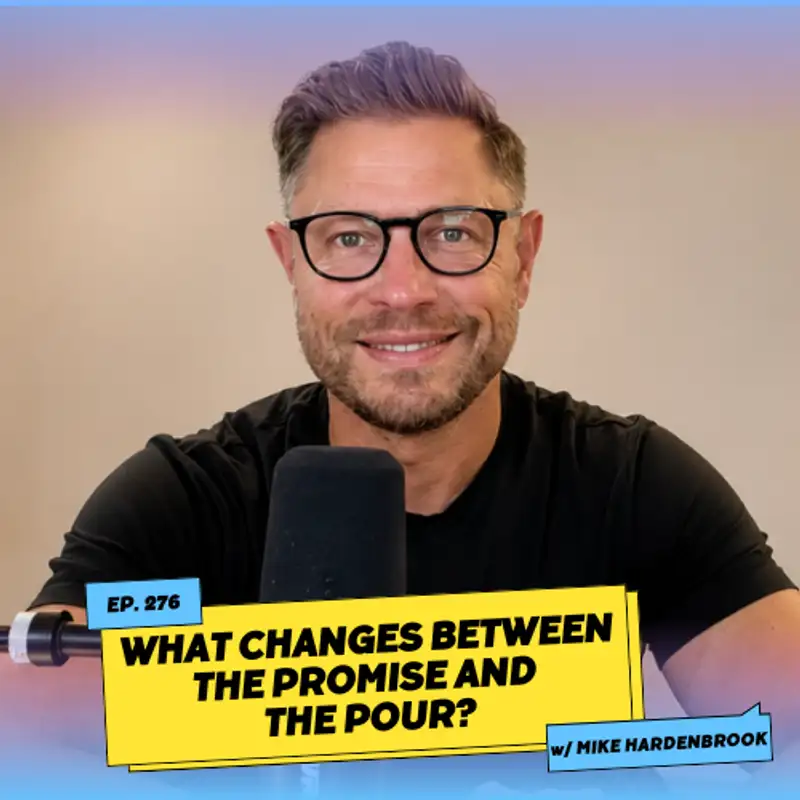
What Changes Between the Promise and the Pour?
Hey, everybody. Welcome back to another one of these ten minute Mondays. Today, I wanna try something a little bit different. I've been working on this new idea for quite a while now, and it came out of my own experience with my drinking, talking with hundreds of people here on the podcast, trying to understand a question that I think a lot of the listeners here have lived. How can one version of you make a promise that another version of you breaks?
Speaker 1:And I lived this one for years. I'd roll over at three in the morning after drinking more than I wanted, counting the drinks from the night before, already thinking about the day to come. And the case for drinking that night felt pretty airtight. Not tonight. That's it.
Speaker 1:And the truth is, I meant it. But then by 06:00, it would come around. I'd have a long day. I was tired. Work was still running through my head.
Speaker 1:And then suddenly, having a drink looked a little bit different than it did in the morning. In the morning, alcohol was the thing that caused the crappy sleep, the regret, the anxiety. But by evening, it was looking more like relief. It was the same person, same alcohol, very different decision. Now, in my case, most of the time that gap was often between morning and the evening.
Speaker 1:But it isn't always. Maybe Sunday rolls around after a weekend where you drank more than you wanted, and you decide, hey, next weekend is gonna be different. Then Friday comes around, the week is over, friends are making plans, and that decision that you made last Sunday starts to change. Or maybe you took a few weeks off and you feel great, and then a wedding comes up or a vacation or some other occasion. The promise, it doesn't really matter the gap.
Speaker 1:It might be a few hours, a week, a month. Something about that moment changed. That's what we're zeroing in on, not on whether or not to drink, whether to drink less, or whatever your goal is. Something about that promise changed. Really, the question is working on this.
Speaker 1:What changes between the promise and the poor? And here are the three layers that I think are worth looking at. I've been calling them the job, state, and pattern. This is the core of the book that I've been working on, and I want to run it by you today because I genuinely am curious whether this describes what's happening in your life as well. There's also a practical reason I think that matters.
Speaker 1:The same thought, boy, I really want to have a dream, can come from three different places. And where it's coming from can tell you where to make the change first. So again, we have the job state pattern. Let's start with the job. For years, I would have told you that I drink wine in the evening because I really just enjoyed having a drink.
Speaker 1:And while that's true, it doesn't explain very much. Because if I just liked wine, why did I want it so much more at, say, 06:00 after a long day than I did at noon? The drink was doing something for me. A really common example is the end of the day. You've been working.
Speaker 1:Maybe you've been taking care of the kids. You've been answering people, solving problems, doing whatever the day has been asking of you. Then finally, you get to a point where you want the day to be over. And guess what? A drink marks that transition.
Speaker 1:Okay, I'm done now. This part of the day is mine. That is a job. Researchers who study why people drink often find two broad motives underneath it. We're trying to get something that we want, like pleasure, confidence, connection.
Speaker 1:Or we're trying to get away from something that we don't want, Things like stress, boredom, feeling uncomfortable. Often the same drink, it does both. So when I say the job, what I'm really asking is this. What changes are you expecting alcohol to create? And I'll say this, that alcohol earns that job because it works, at least in the short term.
Speaker 1:If you're stressed and a drink repeatedly brings relief, your brain learns that relationship. If you're uncomfortable socially, you have a couple drinks and the conversation gets easier, that gets learned too. Let's say that alcohol is the thing that tells you that the workday is finally over. And you heard somewhere that great way to skip a drink is by having a nonalcoholic option or sparkling water with lime. And while that works great for some people, if it doesn't work for you, maybe the sparkling water or the alternative drink isn't the problem.
Speaker 1:What happened is that you replaced the drink, but you didn't replace the ending. If the job is ending the day, you need to find another way to create that ending. If it's connection, you need to preserve that connection with something else. If it's reward, whatever you're replacing, it probably has to feel like a reward. That's why identifying the job really matters here.
Speaker 1:You're not asking, what can I drink instead? You're actually asking, what is alcohol actually doing for me? Alright. Let's move on to the state. And I think this is the easiest way to see this for you to imagine it.
Speaker 1:Think of two Friday nights. The same person, the same house, the same bottle of wine in the kitchen, the same intentions, maybe to drink less. On the first Friday, you slept well. Work was pretty easy. Nothing major is bothering you.
Speaker 1:Basically, you feel pretty good. And you think about having a drink, and maybe this is one of your days that's supposed to be dry. And instead passing on it doesn't really feel like this massive sacrifice. Now jump ahead one week. Another Friday night, but you slept terribly.
Speaker 1:Work was brutal. Something has been bothering you all afternoon, and you basically spent the entire day dealing with people, problems, and decisions. And now that exact same glass of wine feels a whole lot harder to pass up. The alcohol didn't change, the goal didn't change, the setting didn't change, but your state changed. There's a behavioral science idea that helps explain part of this.
Speaker 1:George Lowenstein calls it a hot cold empathy gap. Basically, when we're in one state, we're surprisingly bad at predicting how much another state will change what we want. There was this study with smokers where people weren't craving a cigarette, and they underestimated how valuable that cigarette would feel later when they actually were craving one. Now I know this wasn't an alcohol study, but you can probably recognize the pattern. Morning you feels that exhaustion and stress and anxiety really, really close, but you can't completely recreate that feeling.
Speaker 1:And that's where the evening you, while it can remember the regret from the morning, it can't really feel it with the same force. The body doesn't make the decisions for you, but it can change the terms of the decision. And if state is actually carrying that moment, this is where a lot of the mindfulness tactics that you may have tried or heard about can work. Things like meditation, a simple physiological sigh, things like tapping and urge surfing, because these have a way for you to change your state in a very fast way. So in those cases, those things aren't necessarily replacing what alcohol does for you.
Speaker 1:They're helping to change the condition that you're making the decision from, or at least creating some space around the urgency in that moment. And that's an important distinction. This is why I would try and other people say, hey, I've tried things like meditation, but it doesn't really work for me. Well, if what you're actually needing is an ending to my workday or some sort of reward, then meditation really isn't gonna solve that problem. But if you're anxious and overstimulated or wound up and then you're carrying that whole day in your body, something that changes my state may be the exact right tool.
Speaker 1:So change the state first and then see whether the drink really feels quite as urgent. So with state, we ask, why does this feel urgent right now? So we've done job, and we've done state, and now there's pattern. And I wanna be clear about what I mean by this because I don't mean by you're on autopilot and suddenly looking down and you somehow have a drink in your hand. It's usually much more subtle than that.
Speaker 1:Think about maybe a normal evening. It's 06:00, comes around, you start making dinner, maybe you have some music going, your partner comes into the kitchen, work's done. This is usually around the time that maybe a bottle of wine starts to sound pretty good or is opened. You might not have been thinking about alcohol maybe even twenty minutes earlier. But now you're in this familiar routine and suddenly a glass of wine sounds really good.
Speaker 1:That's pattern. Your brain gets really good at learning what tends to happen next. And some of the dopamine research actually helps to explain why. Now I used to explain dopamine as basically this feel good chemical. That's not really a good way to describe it in this case.
Speaker 1:One of its important roles is actually helping the brain learn what deserves attention and pursuit. In classic reward learning research, once something reliably predicts a reward, the brain starts responding earlier to the cue that tells it what's coming. So the reward doesn't really have to be there yet. The prediction starts doing some of the work. So with drinking, that cue might be the time, the kitchen, the dinner, the end of work, your normal Friday night.
Speaker 1:The whole routine starts bringing the drink top of mind because your brain has learned what usually comes next. And if the pattern is carrying that moment, you need to look earlier in the routine. Start making some observation. What keeps bringing the drink to mind? And what could you change before the urge gets strong?
Speaker 1:Maybe it's what you do right after work. Maybe it's changing your usual dinner routine. Maybe it's having something else ready before that normal cue shows up. The point really isn't to create something that is complicated in your life. It's actually to stop running this exact same setup and then waiting until that urge and that desire becomes really strong to try and make a different decision.
Speaker 1:So that's the pattern. What's happening right before the drink starts sounding good. Now I want to mention these layers, they can overlap and they actually usually do. But one is often doing more work in a particular moment. And this is why a perfectly good tactic can still fail.
Speaker 1:Meditation, it might help your state, but it won't necessarily give you a reward or an ending that you were looking for. A new evening ritual, it might be great, but if you're completely depleted, your state may be needing more of that work. And you can understand exactly why you drink, but if the same routine keeps bringing alcohol top of mind every single night, then insights alone may not change the pattern. And that's the point. The tactic has to match what's actually driving the moment.
Speaker 1:And that can change for the same person on a different day. And that was the big realization for me. I'd try something, it wouldn't work. And I'd think, well, I guess that just doesn't work for me. Sometimes the tactic, it wasn't the problem.
Speaker 1:It was my aim. So instead of starting with how do I drink less, try these questions instead. What do I expect alcohol to do for me? That's the job. Why does it feel more urgent right now?
Speaker 1:That's the state. What happens right before the drink starts sounding good? That's the pattern. And then ask one more question. Which one is doing the most work right now?
Speaker 1:And that's where you start. I want you to try one change that actually matches that layer and then pay attention to what happens. Did the craving and the urge get easier? Did it show up differently? Did nothing change at all?
Speaker 1:You need to collect all that data as information. Maybe one layer is actually carrying more of the moment than you actually thought. And that's really the concept that I've been working on. So here's what I need your help with. I don't want to just know whether you like the name, job state, and pattern.
Speaker 1:I want to know if you felt it. Did you hear one of these and immediately recognize something in your own drinking? And what seems to be doing the most work in the moment? Is it the job? Is it the state?
Speaker 1:Is it the pattern? And if none of these explain it, I actually wanna hear from you too because this show is a big part of where this idea came from. Years of my own experience, years of research, and years of guests and listeners telling me things that keep showing up again and again until I couldn't really ignore this pattern that was emerging. You guys have been a part of how I got here. So I'd love to hear from you.
Speaker 1:Send me an email, [email protected]. Tell me about the last promise that changed and what you think might be happening between that promise and the poor. Thanks again for hanging out with me this week. And until next time, cheers to your mindful drinking journey.
Creators and Guests