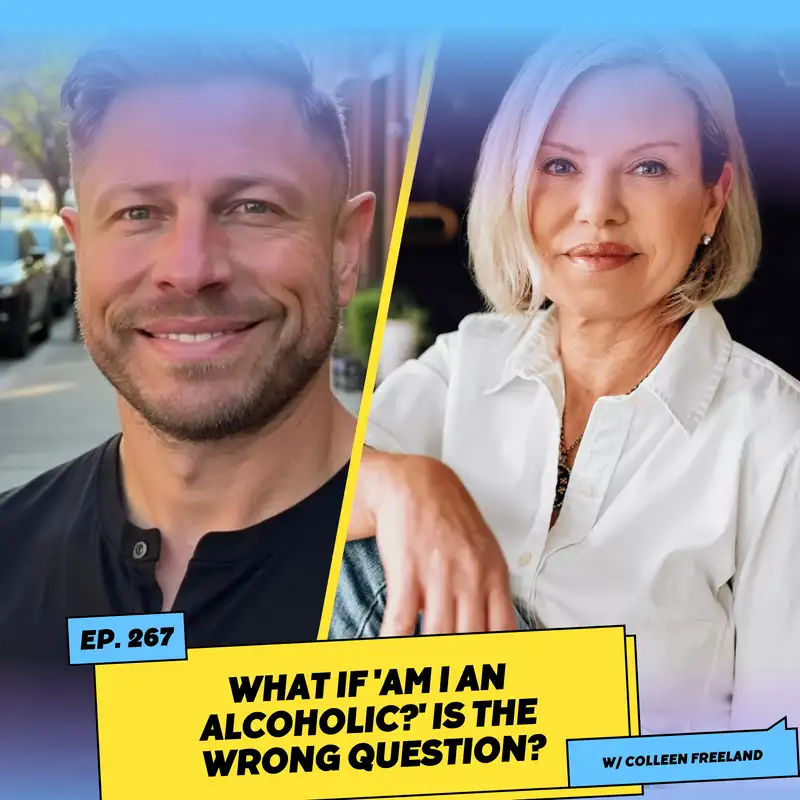
What If 'Am I an Alcoholic?' Is the Wrong Question? w/ Colleen Freeland
Today I'm welcoming back Colleen Freeland, a master life coach and recovery specialist who helps high achieving women drink less without labels. We talk about her journey from nightly drinking and three years in AA to a conversation that changed everything. Then we get into why the word alcoholic can sometimes keep people stuck and why moderation may be a real destination for some. Colleen, thanks for coming on today.
Speaker 2:It's good to be here, Mike. Thanks for having me.
Speaker 1:Well, first of all, welcome back. It's been over a year since our last interview, which was one of our most popular interviews. And you and I are friends, so we chatted all along in between the last one. But for anybody that's listening, that's meeting you for the first time, give us, you know, your version of where what did your drinking look like? You have such a great story, and I'd like to give you the floor to just share it.
Speaker 2:Yeah. Well, I think my drinking was heavy, but still on the normal side. You know, I was a partier in college and had lots of hangovers, but I thought that was just the cost of doing business and being one of the cool kids. I never had any trouble not drinking when I was pregnant or nursing my babies. You know, I have four kids.
Speaker 2:But by the time my youngest was two, I became a daily drinker. Not intentionally. It was one of those just kinda slippery slopes where I didn't realize that there was actually a neurological shift that had happened in my brain. You know, it's like one of those things when when there's a line, you usually can't see it till after you crossed it. And so, like, I have the story if you wanna me to share that with you about the night that I became a daily drinker.
Speaker 2:I had been on spring break with my family, four little kids, beautiful week, and drinking had been normal. You know, moms are drinking cocktails on the out of our Yetis, and dads are got the beer by the grill. And we're walking at sunrise with the kids looking for seashells, and it was so fun. But then there's a fifteen hour drive home with four sunburnt little kids. And by the time I got home, it was school the next day, and I decided to just power through, get the car unpacked, get the laundry done.
Speaker 2:And while I was unpacking, I found the vodka and the cranberry juice and thought, I know how this could be better. And I didn't over drink. I wasn't hungover the next day. In fact, I was so morally superior because I knew my house was clean and my laundry was done, and I was teaching boot camp at 9AM after I dropped the kids off to school and my friends, not not quite that cool. And but that was the first night.
Speaker 2:Instead of needing a reason to drink, I shifted the default. I needed a reason to not drink. Why wouldn't I pour a drink? And so the next night, I'm walking the kids down to baseball, not driving, and I'm like, I think I'll just put a little more of that vodka in my Yeti. And that began because what happened is the shift in my brain.
Speaker 2:I went from positive reinforcement where alcohol is adding to an already pleasurable event, where I instead, alcohol became a coping mechanism, mommy's little helper, where it was making something hard a little more tolerable. And I didn't know that at the time, but I didn't fall asleep sober again for fifteen years.
Speaker 1:Yeah. I think a lot of people can relate to what you're saying there, but tell me the next step. Because the next step afterward, you kinda set it up like, okay. This is how you got there, but what was next? What got you from that to making a decision to change, and what was that path looking like on the way to today?
Speaker 2:Well so I would say my first big pivot was actually, I had the date, 04/21/2020. Where were we all? Six weeks into lockdown. And I had tried to be a good citizen and support my local businesses, which, of course, was just the liquor store. And all of a sudden, I realized all of the guardrails that kept my drinking somewhat moderate, somewhat manageable were gone.
Speaker 2:And when I'm going to the liquor store and Patty's looking at me buying two mega handles of vodka, I couldn't tell Patty I was having a party. And all of a sudden, I'm faced with, oh, I'm drinking all of this. Like, I'm I used to just kinda hide it for myself. I'd have I'd buy so much alcohol, and I'd have so many bottles in different places that I never had to confront how much I was drinking. So six weeks into lockdown, I woke up one day, and I thought, the only thing worse than the idea of quitting is the idea of not quitting.
Speaker 2:But at the time, there was well, I I don't know if Sunnyside was there or not, but I thought there was two paths. Either continue doing what I was doing, hide it and try to fix it and just willpower my way through it, or raise my hand, admit that I'm an alcoholic, and go to AA. And that was the only thing I knew to do. So I made the call, and within three minutes, I'm sitting on a sobriety meeting. And so that was kind of my first pivot.
Speaker 2:But within a year of going to sobriety meetings every single day and having conversations with people about alcohol and being addicted to alcohol when nobody in the room's drinking, Like, it just felt like the twilight zone. And I suddenly was like, don't I have better things to do? Don't we all have better things to do? I appreciated the support and the camaraderie, especially in the first few weeks. But then after that, I feel like I'd accepted this burden that I'm an alcoholic when I just drank my ass off for twenty five years, and I'd never thought of myself as an alcoholic before that.
Speaker 2:So it just felt very counterintuitive. And then being what I do, I'm a perfectionist. I go big or I stay home. I started my own sobriety coaching program and very quickly realized one of two things was true for my clients. Either they were not staying sober and lying about it, and they couldn't talk about the fact that they weren't completely sober because that's not why they signed up.
Speaker 2:They're doing it wrong. Or they got the sober trophy after twelve weeks, and then six months later, we're catching up, and they're right back where they were because we didn't solve the problem. We will powered our way through the behavior. And so that's when I kind of went out onto what I would call from the sobriety community thin fucking ice because I had to say, alright. I'm gonna support my clients with their agenda, not my agenda.
Speaker 2:And then, of course, for professional purposes, I decided, well, you know, I better test this because I'd been brainwashed over a year to think that once an alcoholic, always an alcoholic. You can't unpickle your cucumber. And so I decided to have a glass of wine, and that's when I realized all the crazy came back. I had a half a glass of wine, and I felt hungover for three days. And I was all up in my head.
Speaker 2:What's my husband gonna say? What are people gonna think? Like I I'm an alcoholic, and I'm drinking, and now blah blah blah. And so that began my own deeper dive into the research where I started looking at neuroplasticity. And what did I discover?
Speaker 2:AA was invented before we even knew what neuroplasticity was. There's not one scientific reference in the big book. So I'm studying neuroplasticity. I'm studying nervous system regulation. You know, instead of trying to control my thoughts, maybe I could just calm the hell down and relax a little bit.
Speaker 2:And then I just had such wonderful clients that my program just evolved into this emotional sobriety approach.
Speaker 1:I love your story because you were hands on. You went through a lot of the things that I know I went through, which is the AA model, which for decades, we've been told that addiction is a lifelong chronic disease. And probably if you're even thinking about changing your drinking, that means that you're an alcoholic. You're a straight shooter, which is why I love these conversations. You're not afraid to to stick your neck out and say what you believe in.
Speaker 1:Where did you feel failed, and where do you think that that's been wrong for many years?
Speaker 2:Well, I think that people are doing the very best they could. And in the, you know, February into 2020, we had a lot of people like Annie Grace, sober sis, one year no beer. We had a lot of trailblazers break out of the AA model. The the they tried to break out of the disease model of addiction, but they they didn't go far enough where you know, like, my podcast is it's not about the alcohol. And so you have all of these sober influencers who are wonderful people doing amazing work in this world.
Speaker 2:I worked with Annie Grace. I signed up for Sober Sis. Like, I did all the things. They're wonderful. But you end up painting yourself into a corner because you're you're joining a community.
Speaker 2:And in order to be in that community, you have to be sober or else you have to ask for help, which is that's fine too. But you have to agree that no alcohol is the pinnacle. It's the it's the high bar. And which means if you decide you're going to Italy and you wanna have some wine, now you're forced to think, well, why would I even want wine? Alcohol is a toxic poison.
Speaker 2:It's not healthy. It's a class one carcinogen. And the reality of the world we live in, pretty much everything's a class one carcinogen. You know, the secret to health and happiness is not avoiding all the bad shit. It's connecting.
Speaker 2:And so these communities of people that are built on what I consider a faulty premise that the absence of alcohol is the same as, you know, thriving beautiful freedom. These these programs that speak directly to sobriety, they they support you. They can sure help you break a behavior cycle, but you're not free at the end of it. Now you're tied to a set of rules. And here's the thing about rules.
Speaker 2:They work till they don't. And then, also, your needs are always changing. It's the same it's you know, sobriety is the nothing in the all or nothing cycle. It's the same thing where I thought, I'm never gonna give up drinking. I can't imagine life without alcohol.
Speaker 2:Hangovers are just a cost of doing business. These are my people. This is my purpose. And that changed. And then I got sober for a while.
Speaker 2:And then that changed. Like, turns out yesterday's truth is tomorrow's bullshit. You gotta plug your brain back into your body and start thinking for yourself and stop thinking that you have to make a rule that works right now and that that rule is going to work for the rest of your life because your future self is perfectly capable of making good decisions, and she doesn't need to pay for how much your past self drank.
Speaker 1:Absolutely. I mean, forever is a big commitment, and it not only sets a lot of people up for failure. It also keeps people from taking that first step. And Yeah. I think one distinction for sure is that you're not against sobriety, but you're also about transparency.
Speaker 1:Transparency in that, there is another option. And some of those names that you mentioned, all roads kinda lead to Rome. Rome with no wine, basically. You know, it might look like moderation is that first step in a phase on the way to quitting. But you've actually cited some research that former problem drinkers successfully returned to moderate drinking.
Speaker 1:Can you talk a little bit about some of that information?
Speaker 2:Well, sure. You know, I've seen statistics. I'm not quoting them, but I've seen statistics that about half of people who at some point qualify for an addiction, you know, like, you know, they they have negative consequences. They wanna stop. They can't stop.
Speaker 2:And addiction is also a spectrum. So we don't say you're you know, alcoholism. We say alcohol use disorder, and that goes from anything from a bad habit to a dependency to a actual physical addiction. But fifty percent of people who qualify, which I most certainly did, I was I was on the heavy end, fifty percent of people who qualify self correct on their own. In fact, it is the label of I'm an alcoholic.
Speaker 2:I can never drink again. There's a difference between a normal drinker and an alcoholic, and some people just can't control themselves. And for whatever reason, I'm one of them. If you believe that about yourself, your risk of binge drinking in the future, no matter how long you stay sober, is, like, nine or 10 times higher. And so we all know people in our lives, they go through the divorce.
Speaker 2:They lose the job. They go on vacation way too long. They're living on a beach, and they're drinking every night. And then they decide, this doesn't serve me anymore, and they pull themselves out. But the people who get who accept an identity label and define themselves by how much they do or don't drink are actually putting themselves at risk in the future.
Speaker 2:And we all know that from AA. People talk about one of my favorite podcasters, Dax Shepard, who I love, and he's sober, very AA model. He's like, yeah. If I had one drink, you wouldn't see me for four days. I'd be doing Coke on strippers tits.
Speaker 2:And, you know, it's just like, well, actually, that's not true because you're not the same person you were twenty years ago when you were in active addiction. But he's got that identity. He's got that community, and that works for him. There's nothing wrong with that. But that's a very dangerous label to put on yourself.
Speaker 2:Because then I remember one time on vacation in the height of my sober stint being served accidentally. I was in an all inclusive. I said I wanted cranberry juice with a tonic water. I got about halfway through it and thought, I think there's vodka in that. And all of a sudden, was like, oh my god.
Speaker 2:This is a relapse, and and I can feel it. And I guess maybe I'll just keep drinking all night. No. No. No.
Speaker 2:No. That would be wrong. Like, I will tell on myself. Like, it was so crazy. It was just like, just get me another drink and move on with my evening.
Speaker 2:Like, it wasn't that big of a deal, but my brain wanted to make a big deal because I had I had integrated that sense of identity, and it triggered a fear response. You know? And that's the whole thing with AA. As good as it can be, they're motivating you with fear and shame. Your addiction's doing push up in the parking lot.
Speaker 2:And if you ever drink one drink again, you you're it's a life or death decision, which triggers, of course, a threat response in your nervous system, and it's not. That's unless you think it is, and then it is.
Speaker 1:I mean, for me, it was definitely the the permanence of it, the thought of, okay. You can't do this, so, you know, hold my beer, watch me kind of thing. And so I can see why that percentage of people that go on the abstinence route, which there's nothing wrong with it, for my own personal self awareness, I knew that if I was forever, I would be in that category because I had already done it before. When I said I was gonna give it up forever, I'd go for a stint. And then lo and behold, if I was gonna rebel, I was really gonna rebel.
Speaker 1:I mean, I'm not talking, like, disappearing for four days or whatever and definitely just, you know, maybe having a little too many drinks on one evening. But it's about self awareness. So for me, like, going long term, that's the reason that that moderation has worked. Whether or not I'm taking a long break or not, just not having a forever thing in front of me keeps me on track. Whereas, I think it also goes to self awareness.
Speaker 1:Somebody like that also, somebody that's like maybe knows themselves, knows that, hey. If I drink tonight, I'm gonna wake up tomorrow. I'm gonna start drinking again. They they know how they are. And if you feel forever is too much for you to take on, however, you do want to move forward, That's the options that we're talking about here.
Speaker 2:I think that the awareness is just that what you need right now is what you need right now. And I know for me, telling myself I was never gonna have another drink again was a story that made me feel really safe. I don't ever have to go through that again, but it's all a story. You know? We we get married.
Speaker 2:You know? We we're best friends. We love this job. Check back in in five years. Like, I think understanding that it's perfectly okay to tell yourself a story that makes sense, to take something off the table and let your future self but that's the point.
Speaker 2:Trust your future self to make good decisions. And I think that's really the awareness that this that's underlying this. The only person that would tell themself that they have to stay sober forever. The real problem is that you don't trust yourself to make good decisions. That's the wound.
Speaker 1:That is one thing that I wanna get into, and we're gonna talk about a little bit more into the next episode. But let's go back since we're sort of challenging models right now. And, of course, I'm sure there's things that both of us have said that some people that harshly disagree with. But you have a big audience watching. You know?
Speaker 1:Have you ever had any criticisms come in that maybe on the other side made you pause and maybe potentially adjust your own thinking?
Speaker 2:I've had a lot of criticisms, and I am always the first one who wants to challenge my own thinking. You know, like I said, this evolved naturally. I wasn't sure it would work. And I think where I am more confident now than ever is I've had thousands of women go through my program. I've seen it in action.
Speaker 2:I firmly believe we create the reality that we choose. You know, I had an interview, a prepodcast interview with a gal who has a huge show, and I she will remain nameless, but the tagline for her show is drink less, live more. And somehow she ended up on my podcast, and we're just looking at each other. I'm like, do you know that I'm not sober? And she didn't know that.
Speaker 2:She hadn't known that. She just saw that I had a big show. It's not about the alcohol. And she we got we had such an authentic real conversation where we agreed that there's space for her perspective and there's space for mine, and, really, we don't need to we we don't need to guest on each other's show. She said it herself.
Speaker 2:She's like, I kinda feel like my approach is a little bit of a bait and switch. I get people in with the drink less, live more. But like you said, all roads lead to to roam. Well, I feel like my program's a little bit of a bait and switch too. I get you in with reduce your drinking, and then I tell you, oh, PS, it's not about the alcohol.
Speaker 2:Like, this is this is about nervous system regulation and learning how to use your brain so that it works for you instead of against you. You know? So there there's no wrong path. Her path isn't wrong, and a lot of things are a bait and switch. You just have to really read the fine print and think ahead.
Speaker 2:You know, do I wanna enmesh myself in a community where the goal is to not drink? Or like in my community, our goal is to be emotionally sober. No bullshit here. And everything's raw and real and honest and allowed to change and evolve and grow. Like, for me, that's the kind of community I wanted that I didn't have.
Speaker 2:And so that's the kind of community I created. And now that I've got thousands of women and more testimonials than I can read through in a day, I'm much more comfortable with my approach.
Speaker 1:First of all, it's amazing to hear that the outcomes that you're getting and the lives that you're changing. Now I wanna put up a little hypothetical. Let's just say that you were at a dinner party, and it was a a bunch of addiction specialists, and they oppose your view. What is one thing that you would argue to the end of the night with somebody?
Speaker 2:That your belief about yourself is what predicts future behavior. It is there is no disease that is alcoholism. Now it sure feels like a disease. And when you think of it in that model, then it kind of perpetuates that. But the reality is neuroplasticity exists.
Speaker 2:And if people can learn to walk and talk again after losing a major part of their brain from a stroke, then, of course, you can learn to control yourself when you drink. Just like you can learn to look both ways when you're in kindergarten before you cross the street or learn how to to turn your car the opposite direction when your wheels go into a spin on the ice. Like, you can train your nervous system in whatever way you want. It's just, are you willing to put the work in? I'm not saying my approach is easy.
Speaker 2:People don't join my program and reduce their drinking by 80% in two weeks. I mean, not if you're doing it authentically. You can willpower your way through it. So it's really what do you want, and what's the shortest distance between a and b? And then you can reevaluate when you get to b.
Speaker 2:Do I wanna set a new path for myself? But what I would argue against is that people can't actually change. Science shows that people who choose to change for whatever for in whatever capacity because they believe that change will make them happier, they do so easily and without effort using the iterative mindset. It's a sustainable change. When you are changing because you believe you are bad, wrong, a threat to yourself and others, Again, the motivation source is fear and shame, and the problem with that is when you start to feel better and build your confidence, the motivation to follow your own stupid rules goes away, and now you're at risk because you don't have any authentic motivation about something that truly makes you feel good and happy.
Speaker 1:Couldn't agree more. I mean, we're gonna get into a little bit more of that about getting into your body, why willpower fails, maybe what your nervous system has to do with everything. So we're gonna talk about that on the next episode. But let's just say for the person listening that's tried to change a dozen times and is starting to believe that the problem is them, what do you want them to take from this conversation?
Speaker 2:I want them to see instead I teach my clients to look to notice the difference between the gain and the gap. You know, let's look at cigarette smoking. It takes the average smoker at least seven times. That's old research. It could be more.
Speaker 2:But before someone actually quit smoking, there's seven attempts. And so somebody who has tried and tried again, if you look at that in the gain, that is evidence that you are consistent, that you are reaching and wanting and exploring, and it's not you that ever fails. It's not possible for you to fail. Failure is also a see a perception. Just kinda like you perceive a disease.
Speaker 2:Who defines failure? You can't fail. A strategy can fail and need to be revised. That is a true story. But if you are always learning, you know, that's how you quit repeating the same mistakes over and over.
Speaker 2:You stop start learning from them instead of diagnosing yourself as the problem who's too weak and stupid to stick with it and be like, what did I miss? What might I try different? How do I move the needle by 10% here? It's change is an ongoing process, not a performance that you can pass or fail. So, like, Saturdays in my program, you can't fuck that up.
Speaker 2:You're either doing your hangover homework or you're sharing a win about a strategy that worked. Either way, we're all all walking away smarter from our experiences, not worse or better because we did it right.
Speaker 1:All walking away better from our experiences. Okay. Colleen, if anybody is listening and they wanna find out more about you, where can they go? Where can they find you or reach out?
Speaker 2:I have a podcast called it's not about the alcohol. I'm on social media as the hangover whisperer, and my my website is emotionalsobrietycoaching.com.
Speaker 1:Amazing. Thanks so much for coming on today.
Speaker 2:Thank you, Mike.
Creators and Guests