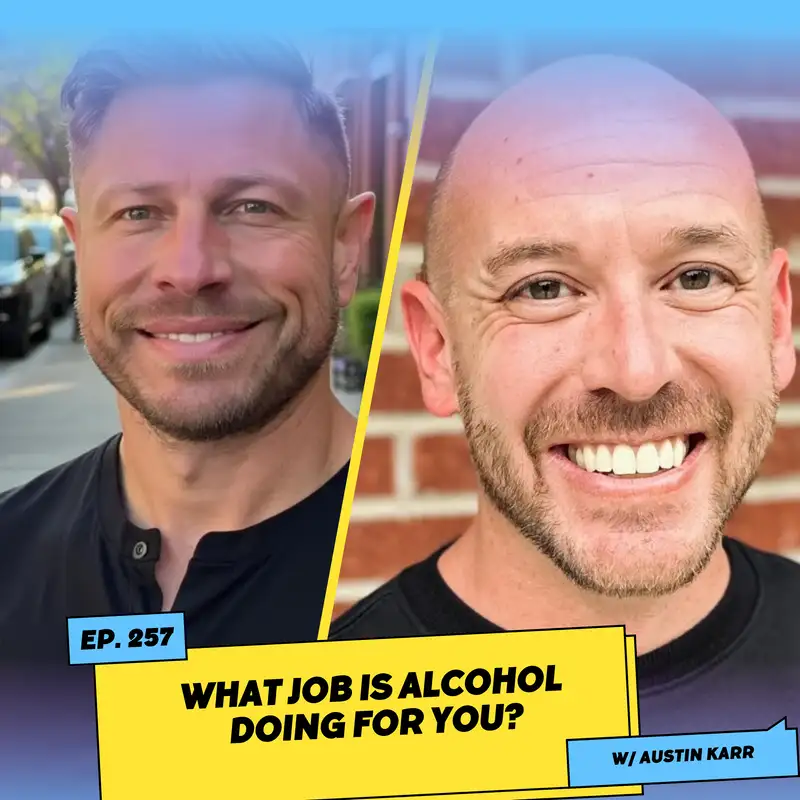
What Job Is Alcohol Doing for You? w/ Austin Karr
A lot of people know alcohol is taking up too much space how long before they do anything about it. It might be the drink after work, the second drink that wasn't planned, the weekend rule that keeps bending, or the feeling that alcohol is doing more emotional work than they want it to. In this episode, I'm joined by alcohol coach Austin Carr, founder of one hundred Days, to talk about one of the most useful questions you can ask about drinking. Not just how much am I drinking, but what job am I asking alcohol to do? We also talk about why people wait years before getting support, why one hundred days can create space for change, and how consistent wins rebuild self trust.
Speaker 1:Austin, thanks for coming on today.
Speaker 2:Glad to be here. Thanks for having me.
Speaker 1:Yeah. We had a great conversation. Before we hit record, we both found out we're probably about thirty minutes from each other. So, you know, I'm looking forward to more conversations off the mic for us to share. But before we get into anything, let's just start with your work.
Speaker 1:And this starts with the idea that people deserve support long before things fall apart. What does that mean to you?
Speaker 2:I thank you for asking me this question. I think that one of the things that I have found in my work, especially revolving around alcohol use, is that people have this idea that there is this tipping point. There's the point at which it's a problem. Right? And everything before that is normal, where I shouldn't question it, shouldn't really look at it.
Speaker 2:We're kind of encouraged sometimes even by the alcohol industry to maybe just not look at our drinking. If it's not a problem, it's not a problem. But I find people are questioning often. They're stepping back, and they're saying, I don't know if I like the way it shows up sometimes. It feels like I over drink sometimes, but not always.
Speaker 2:It takes them more space or more energy, and it just absorbs a little bit more of my life. I don't love that. The most common question I get is, I drink this much. Is that a problem? Like, everyone's looking for that.
Speaker 2:Like, what's the line? What's the problem? Where is it shift from normal to problematic drinking? And I tell people always to just take that step back and say, do I like the way alcohol shows up in my life? And if I don't, then I can do something about it.
Speaker 2:And that do something about it can mean so many things, but I just find people are waiting for too long to really look at their drinking. And I think there's so many reasons for that. I'll say that the interesting thing is that most people recognize they have a problem with drinking or that they have consequences from their drinking long before they take action. And the average is eight to ten years between the time someone sees a problem with their drinking to the time that they take action, seek help, talk to someone about it. And that lost decade is something I went through in my life, and I watched so many other people do it.
Speaker 2:And I just feel drawn to help people step in sooner.
Speaker 1:That one really hits home because that is exactly what I went through about probably eight to ten years, somewhere around there. And it's really hard to look back and think and not think, boy, I did it all wrong or maybe something's wrong with me. And I'm vocalizing all kinds of internal thought, not just my own, but other people that that, you know, I screwed up. Why is it taking me this long? And I think that that is why you and I are talking here because we've gone through that.
Speaker 1:We want people to realize that, like, you don't have to wait so long for you to start questioning this change. And, like, the other day, I actually was talking to my neighbor. He obviously doesn't have what you call a problem with alcohol, but he's still questioning maybe his relationship, what that looks like. I know he took an extended break. Now he, he decided he was gonna have a drink on when he went to Mexico or something like that.
Speaker 1:That is not what somebody would call a problem. In fact, if he was talking to a friend, they might dismiss it. But this is, like, a conversation I think is becoming more mainstream whereas before it was pushed off. And what I wanna ask you here where I'm going with this is one thing that you mentioned there was, like, is this too much? Is this an is this a problem?
Speaker 1:And it always goes down to quantity. And I think that this is a really relevant question here for people at Sunnyside that are thinking about, okay. This is where my baseline is. This is the number. This is where I wanna get to.
Speaker 1:And maybe they get to that and they feel success, but maybe they're not fulfilled. And so how do we or how would you have this conversation with somebody when they bring it to the numbers and instead pull back and say, let's look at it in a different way?
Speaker 2:This is why I always encourage people to let go of this, like, what is the number? Because taking a step back for just a second, we know that there are problematic levels of drinking that impact our mental and emotional health, our physical health, our relationships. And so quantity is part of the conversation, obviously, and you just mentioned that with Sunnyside that that's part of the goal, right, of the app and the texting and everything is to support that process of change. What I find for a lot of people is that they're able to make some changes in their drinking, but often it kinda hangs around a little bit. Like, it just goes into the background or it's not a problem.
Speaker 2:And so they still they go back to that number. What's the number? Where where would I tip over again? I this is why I encourage people to think about the job that they're asking alcohol to do. And and this is part of my work, and it's what I've developed and worked with my clients on every day is this idea that alcohol does jobs for us.
Speaker 2:It's an employee. I always think of my life, like, with this. I encourage my clients to think about as a CEO, you're running this business, and your life is busy, and then you hire somebody to take care of something for you. We hire alcohol to take care of it. And so you've asked this drink to take care of something for you.
Speaker 2:How many of those things do you have? How many jobs have you outsourced? How often do they show up? And then are they really doing the job you hired them for? Because sometimes we hire alcohol to do stuff and does it a little bit, but not that well.
Speaker 2:Or so taking that step back and looking at where are all the places in my life that I'm outsourcing responsibility or tasks, rewards, celebration, stress? Am I not doing those things myself? Then I might wanna start bringing some of those things back in house.
Speaker 1:Yeah. When you break it down as a job and start viewing it in different ways like that, I love this concept, and we're gonna get into that in more depth in a little bit here. But first, I wanna go back a little bit in time to your story when you were 24. So you went to AA because you knew alcohol really wasn't helping or working for you at that time. But this idea that many here listening can identify with that this idea of forever felt impossible.
Speaker 1:Can you take us back to that moment?
Speaker 2:Yeah. It's really fresh in my mind twenty plus years ago, amazingly enough. I knew I I think like a lot of people, I immediately started outsourcing to alcohol, and so I wanted to change that relationship. I recognized that it was kind of a problem in my life. It was impacting my my work and my relationship with my my wife and I had just gotten married, and it's like, I think this is a problem I need to to take care of.
Speaker 2:I I walked into AA, and here's the thing I recognized immediately. My story was not the story I was hearing. I didn't fit in in that space. I didn't have a lot of the things that people were struggling with. I was young.
Speaker 2:I was a professional. I was new in my career. And, also, the idea that if I say that I have a problem, the expectation is I'm sober for the rest of my life at 24 years old. And that seemed ridiculous and impossible and all of the things. And so what I walked out with was the idea that I didn't have a problem that looked like that, one that required that intervention, that process, but I didn't have anything to walk into.
Speaker 2:I didn't have any support. It was just either that or nothing. And that began my lost decade from '24 to '34, and I just found no support at any point in that journey of even when I was questioning. I either had to do it on my own. I kept it a secret.
Speaker 2:I struggled, but I just couldn't find the right fit for me. And I spent my decade kind of frustrated with my drinking.
Speaker 1:I can relate because I have a similar story. So when I was 18, I got a minor in possession, and I was required, to do a 100 AA meetings at 18. And I had taken a gap year between high school and college, so I did it that summer. And I did I actually participated. I didn't I felt the same things you did.
Speaker 1:I didn't I felt way younger than anybody there. I obviously, I didn't have the same history. I didn't have any of the things, so there was a big disconnect. But at the same time, I thought, well, I was at my parents' house waiting for college to start. Why don't I just do this thing?
Speaker 1:So, you know, I got to the ninety days or whatever, and then I left for college. In the first couple of weeks, actually, in college, I thought about going through college without drinking at all. But then I also kinda felt like this is extreme. I'm 18 years old. I'm at this college experience.
Speaker 1:Do I re like, it really I wouldn't land there because it was some serious problem. I was landed there because I had to. And so I come back to that point in my life a lot. You know? Like, maybe I could have skipped over some things long term that would have worked out.
Speaker 1:Who knows how it would have worked out? I could have pulled that pendulum to one side and held it there for several years and then just swung way back the other way. Who knows how history would have played out? But nonetheless, at the time, I think the both of us felt this being underserved by what options we had at the time. It was either one extreme or it was just, again, in that category of, I'm just gonna treat this like I'm normal.
Speaker 2:Kind of hope that you're normal. Hope that you like, it'll sort itself out somehow. Like and for some people, it does. I mean, that's the amazing thing. For some people, like, I had a traditional, like, small state college experience like a lot of people do.
Speaker 2:And a lot of my friends drank like me in college, and when they left, they their lives kind of went normal. Yeah. A lot of people age out of it.
Speaker 1:You know? They they kinda just age out of it naturally. Boy, that would be nice.
Speaker 2:It's really it's the most common. Like, people just kind of, like, at some point, like, I don't want this. Their life changes. That was not the path for me. But, like like you, I think that one of the things I think is great about where we're at today is that there are more options for people to step in, to get support for that.
Speaker 2:I'm questioning, but I don't wanna quit. Or if I questioned I wasn't successful, now what? Right? That progression is really helpful, but there are still so many people that I meet on a daily basis. I I met somebody two days ago, and they're like, I don't like AA, but it but now what?
Speaker 2:I don't there's nothing else. Like, in their mind, that was the only thing. And I think that I can't go back and change my life. It's not possible to go backwards. But if I can talk to one person and say, hey.
Speaker 2:There are other options for you. I I have the opportunity to help them. And, that's pretty amazing that we get that chance now.
Speaker 1:Yeah. Well, not only is my only option AA, but my only option in many people's minds and probably your yours and I's included was stop completely at the moment that you wanna make a change. And for a lot of people, the goal would be to stop completely, but not everybody is ready to make that decision when they are considering a change for themselves. What do you think people are lacking support in that way? Is it just a matter of being educated that, hey.
Speaker 1:There's different ways to get to that goal.
Speaker 2:It's a little of two things, I think. Probably a little of 500 things, but I'm gonna narrow it down to two for our conversation. One is that there is still very little education around the options that are available. I'm always amazed when I talk to people that don't know about all of the support that's out there. Right?
Speaker 2:Whether it's apps or programs, online or in person, they just they aren't aware that there are hundreds of support programs out there for all levels of change. And so that's part of it. Like, the education piece, I think, is really helpful, and I advocate for that every day. I share every day the resources, not only the ones that I have, but other free resources and online resources and colleagues that I know that they can reach out to. Or I'm not the right fit, but I know somebody who might be.
Speaker 2:I think that that's part of it. I think the other part of it, though, and maybe the the bigger part, the more challenging part, we as a culture and this goes back to our earlier conversation about when I'm questioning. There is a default in our culture that if you ever question your drinking, you really should quit and be sober for the rest of your life. And it's that's why people often don't talk about it even when they're questioning because it changes every relationship that I have, every conversation that I have, decisions that I make, people whom I might surround with. And so that idea that I'm gonna say I'm questioning my relationship with alcohol, and I'm not going to quit run Stowe counter to culture that it feels really uncomfortable.
Speaker 2:And I think that that also causes people to wait. When in reality, what we know is that people often will try on sobriety and then go back to moderation and be successful for periods of time, maybe struggle, go back to sobriety. This moving back and forth is actually really common, but we don't hear about it because those people don't talk about it. I mean, we just they don't talk about that part of their journey because often they're not at that rock bottom moment or the part where they have to say out loud they're sober. They're just people that you are surrounded with every day who are trying on sobriety some days and moderating some days and overdrinking some days and the back and forth.
Speaker 2:That's the that's really, really common. We're just not seeing it. And I would love for that to be shared more, that kind of, I think, nontraditional, although really traditional means of change.
Speaker 1:Yeah. A 100%. And, you know, nothing gets me more triggered sometimes than that thing you just said. Like, if you're thinking about it or considering it, and then to take it a step further to say, well, you know, I think I don't think that's the case, but I do think that I'd like to make a change. The the typical response in some circles would be, well, you're just in denial, and we'll see you in a little bit when you're really ready to come to terms.
Speaker 2:And it That sends me over the edge. Unreasonable. No. Reasonably angry.
Speaker 1:Yeah. Yeah. Exactly. I mean, I I'll tell a little story is that I remember when I was first initially wanting to do this. And, I mean, I was taken to Google looking for other ways, and I took one of those tests, you know, that tells you that you that tells everyone that they're an alcoholic because I really wanted to change.
Speaker 1:My wife thought I was being hypercritical on myself, and it was probably a mix of both things. And so she took the test, and she's like, looks like I'm an alcoholic too even though she clearly did not have any sort of issues with alcohol.
Speaker 2:We love to just lump people into big groups and be like I think there's this phrase. Right? You probably heard it. If you question your drinking, you have a problem. Like, lots of people question their drinking for lots of different reasons.
Speaker 2:And just asking the question doesn't mean you have a problem. It's just that you're asking a question. It's like, do I overeat cupcakes? I do. Do I need to quit cupcakes forever?
Speaker 2:B. But it doesn't mean that I have to go around telling people that I quit cupcakes all the time. It doesn't mean that I have to change everything about my life. I could use a tool to help me cut back and questioning my relationship and, you know, step in and make changes, but it doesn't have to be this change for the rest of your life. Now some people, that's the choice that they make.
Speaker 2:Right? I think that that's important to hold up and say, there are some people that really benefit from abstinence. I have chosen abstinence for myself, but I work with people every day who are cutting back or taking a break because I think that there's a real advantage to the broader concept of change.
Speaker 1:Yeah. Yeah. Well, I like the cupcake one because they constantly go into, well, if you're having problems with cravings or whatever, it's it's serious. Well, look look at the market for GLP ones and for food. Those people are not, by and large, major addicts in food, like, gorging them.
Speaker 1:They just they need a little bit of help, and that doesn't mean that they're in this category that's on the extreme side. And even though I didn't really put that eloquently, that that is, I think, very much in the same category in some ways except for we're we're not necessarily talking about deep addiction where immediate intervention is needed. We're talking about people that are doing fine. They think they could do much better. And where alcohol sits in that relationship and within their life is the question because they think that might be part of the reason that they're not where they wanna be.
Speaker 2:Yes. Holding them back. I I often talk to my clients. I was talking to somebody this morning about this. Like, feels like we're walking in mud.
Speaker 2:It's just it's life's harder Yeah. Than it needs to be. Do I wanna keep choosing that, or would I like to at least get halfway out of the mud? Right? Like, I don't know if I can imagine getting all the way out, but I'd like it to I'd like to not spend so much energy taking one step.
Speaker 1:I So wanna get into your story a little bit more because we actually share a few things here. It's surprising but not surprising because sometimes I have these overlaps. But after you had given a run at AA, you did a hundred day experiment. And, what did you say that what would you say that, you noticed in that? Why did you think that you wanted to or noticed in you at that time, why did that feel more like a door that you could walk through versus before?
Speaker 2:I love telling this story because it sounds so amazing in hindsight. This is one of those stories where you're like, this is the, like, the origin story, but at the time, it was not the origin story. My family came to me and said my extended family, my nuclear family, my wife, and said, hey. You like, this is there's a problem here, and you need to do something about it. And at that moment, I was kind of in agreement that, yep, those things are not going great.
Speaker 2:Like, the the being in the mud was an understatement. And so I came up with this genius plan of taking a hundred days off. I'll stay sober for a hundred days. I will do everything that you ask me to do. And on day 101, I will make a decision about what I'm doing next.
Speaker 2:And I had a predetermined decision already, and that was I was gonna drink on day 101. This was gonna be like a turn it off and turn it back on kind of scenario. Do a hard reset and get back at it. And I so that was my goal. I was just like, I'm gonna do a hundred days.
Speaker 2:I don't know where this idea even came from. I think I spent the first, like, twenty days researching moderation, like, figuring out how it was gonna work after I quit. On day 25, I got fired from my job. And I think that was one of those, like, in hindsight, one of those turning points where I was like, if I was gonna point to I hate the term rock bottom. If I was gonna point to a change moment, I think mine came after my last drink where it was suddenly Well Became clearer to me that a longer term change is necessary for me.
Speaker 2:And my life I just say my life didn't, like, become perfect. I mean, I got fired from my job. That was kind of a problem. I my life just got easier. It just got enough easier that it was like, when my wife asked me on day 101, what are you gonna do?
Speaker 2:I said, I'm gonna do another hundred days. And I've I kind of do a little bit of, like, not a big celebration, but I do recognize still often. I miss quite a few of them now. At the beginning, I was really pretty keen on celebrating hundred days, even just a little bit of, like, pat on the back. But I still recognize a hundred days, and, that's primarily why a lot of the the work that I do is centered around the idea of a hundred days.
Speaker 2:Like, if you just take a hundred days and focus in on this, whatever it is, you'll be shocked to what you can accomplish in your life in a hundred days.
Speaker 1:I am a big believer in the extended break, especially if you've tried other things and it hasn't worked. Because I tried all the rules that we always do. You know? Not in the house, you know, only on the weekends, all the other typical things. And I had done thirty day breaks here and there, always going right back pretty much to where it was or getting there quickly.
Speaker 1:And I so I did thirty days, and I I decided, oh, I'm gonna do I'm gonna do 60. I've never done 60. I feel really good. I'm gonna do 60, and I did 60. And I remember sitting there.
Speaker 1:I was pumping gas, outside of Scottsdale, getting ready to go mountain biking, and I was thinking looking inside. I'm like, this is day, you know, day 60. I could go in and get a six pack of beer for tonight, and that'd be nice. I just thought, I feel so great. Why don't I try 90?
Speaker 1:You know? And then I got to 90, and it and that progression got easier and easier. I don't know what your your experience was, but the first 30 was the toughest. First couple weeks was the toughest. First 30 was harder.
Speaker 1:60 was easier. 90, I was feeling like I was a little bit more on autopilot. And I got to 90, and I was just, like, totally changed guy. You know? Like and I did not really miss anything.
Speaker 1:And in fact, I went just just under a year. But then I started questioning how am I being too extreme? Can I, you know, have a drink occasionally and not a big deal? And I do remember we were in Chicago. We were on the riverfront.
Speaker 1:I had been thinking about this for a couple weeks. Maybe I just wanna I ran this experiment. Let's run another experiment. And if it goes bad, I go right back to where I am right now. So I I do remember having that drink that I had been thinking about on the riverfront.
Speaker 1:I got a Moscow mule, which uncharacteristic, but it seemed like something nice on a hot day. And I had that drink, and I remember thinking, this is it? This is this is this is all that I was thinking about. It's really not that great. And that kind of affirmed that, okay.
Speaker 1:I I think that this is something that if I want it, I can have it. I need to keep guardrails on it. I need to keep a close full eye, but I didn't go back to rules or whatever. I just kinda went back to living and extended, and I wasn't really counting again. And, and that would is what led me to write my book because everything before that didn't work.
Speaker 1:And so I really identify and also endorse that hundred day originally, I thought sixty when I wrote my book or 66 based on, you know, atomic habits and some of the other studies. And but I really think it's more like ninety or a hundred days is is much more universal for a complex habit like alcohol that's been around for decades for some people.
Speaker 2:Yeah. I think I think a lot of times that we're trying to make this change even if it's even if it hasn't been problematic or troubling drinking for that long, it's it's been part of your life. Right? Like you said, like, being on the riverfront, Downtown Chicago, I know exactly. I'm, like, in my head right there with you on a nice merde.
Speaker 2:Right? That's cultural. It's expected. We're we're doing a wine pairing. So even if it's not problematic, we just have all of this built in, like, schema, this key these cues to drink.
Speaker 2:I love a hundred days for another reason, I will tell you, is that it's it's nebulous if you're gonna tell somebody else that you're doing a hundred days of not drinking. They have no idea when you started, and they don't know when it ends. And I love a thirty day goal. I mean, a thirty day goal can change a lot of people's lives, right, or sixty days, but we tend to tie it to a month. And so it's like, I'm doing dry June.
Speaker 2:Right? Or and then your friends are like, oh, June's almost over. Right? And they're encouraging you to have a drink. Or you're thinking the month's over is over.
Speaker 2:Whereas a hundred days, like, when did you start your hundred days? Oh, like, on February 10? Like, what's one hundred days from February 10? I have to literally calculate it out. It's easier that one hundred days is a little bit more flexible in that way.
Speaker 2:And I love that. And I think so many people are kind of used to, like, 75 hard or those other kinds of things that you could just I tell people, just frame it like a challenge. I'm just you know, I'm trying something different for a hundred days. I'll, you know, I'll see what happens on day 101. I'm not thinking about that one right now.
Speaker 2:And I think that those are these kinds of things are really helpful. Sometimes we just need to carve out a little bit of space for ourselves. And I think people are becoming more flexible around drinking, and there were a lot more options with drinking. There was when I quit eleven years ago. But now there's there's so many options, and, you can fit in kind of anywhere.
Speaker 2:People don't question it as much as they used to, but it's still there's still a lot of stigma around quitting drinking.
Speaker 1:Yeah. I think that the the fortunate thing that I'm seeing over and over again is that when people say they're taking a break, it doesn't have to come with because it's just I'm taking a break and people don't go, oh, you know, so and so has might have a problem or whatever. So I think that, fortunately, things are coming around in that way. What do you say to people? Because many people think that a thirty day break, oh, how am I gonna give them for thirty days?
Speaker 1:How do you explain a hundred days and the benefit to get them over that hurdle? I don't foresee you as somebody that's gonna try and convince somebody, but probably shift their perspective on what that hundred could look like.
Speaker 2:Yeah. I think the fur you laid it out so nicely when we first started this part of the conversation. The first thirty days can be a real challenge. And so often, we kinda feel like we're missing out, and maybe we're just feeling a little off. We often kinda start sometimes we start a little restless and then get pretty tired.
Speaker 1:And the sleep thing, you might have to get over the sleep thing. But once you settle in, that gets a lot better.
Speaker 2:Yeah. Exactly. So I think the first thirty days is kinda like finding your footing a little bit, and that's about the time that most people are like, okay. Now I can finally have a drink. The next thirty days, I think often what we start to find is a little bit of, like, calming.
Speaker 2:Our energy starts to come back a little bit. We, we maybe feel a little bit more comfortable in not drinking. The next thirty days, I think when you get into that 90 and the next ten, we start to see growth. So you feel more comfortable with your emotions or managing stress or just dealing with day to day life. You feel like it's less necessary.
Speaker 2:You've done some things too. You've gone to a baseball game, a friend's backyard barbecue. You know, you've had people over to the house or whatever, and you've done those things. So it's, like, becoming more normalized. And so by the time you were making that decision on day 100, which is what I encourage people to do.
Speaker 2:The last I wrote a journal when I first started doing this. In the last ten days, it was about making this decision. What are the pros and cons to staying sober and going back to drinking? What are the things that I would like to accomplish? What do I wanna take with me that I'd like to have that I learned in this hundred days and carry it forward regardless?
Speaker 2:And so this, like, real intense awareness about what I want to do next, and that was based on my journey. Right? Like, I need to make a decision. I didn't wanna just go into the next part of my life and roll into that. I wanted to choose, and I found that to be really important.
Speaker 2:So I always encourage people that last is you're closing in on that hundred days that you really take that opportunity to to do some introspection. The other thing I will say, having a drink on day 10, if that's what happens, sometimes we have a drink. Right? And it's just a drink. It was a drink or two and or sometimes more.
Speaker 2:And we get a chance to learn from that. So just because you didn't do the hundred day I have some clients who are like, I didn't do the hundred days perfectly. I'm like, let's go over everything you learned. How much did you cut back to if you are a daily drinker, even if it's just a glass of wine after work, and you go thirty days, if you go fifteen days of not drinking and then have a glass of wine, that is amazing. When was the last time you went fifteen days without having a drink?
Speaker 2:And so I am a firm believer in in always celebrate the success regardless of of what is in between.
Speaker 1:A 100%. It's all about consistency, first of all. It's a hundred days of consistent effort towards this goal. Nobody's perfect. So I a 100% agree.
Speaker 1:Like, that hundred day experiment, even if it didn't go perfect, I really hated the concept that you have to start all over as in none of it counted if your consecutive days, of whatever it is. For some reason, we hold the this really high standard when it comes to alcohol that has to be consecutive, and that's been drilled in, I think, in a lot of ways. And, but in that period, also, I think that a lot of people realize thirty days, they might feel like they got a little live a little bit like a monk. But as they come out to sixty days and ninety days, they build confidence. They start maybe they went to a party and had an nonalcoholic beer, and they were like, it wasn't the same, but I still had a good time, and I stuck to my commitment.
Speaker 1:And then they do maybe they get up one morning and go for a hike or go to a farmer's market that they normally wouldn't. Like, they start to build these micro, benefits into their and it just builds into confidence. And I think that that's where the real change happens. And one more thing I'll say is that I've I've read in the studies, and you probably have too, that one, I guess we'll call it a slip up right now or breaking of a commitment in a long series of of trying to build a new habit has been has been studied and shown to have no effect on the general outcome over a certain amount of time.
Speaker 2:Yeah. I I love when we get to talk about this. This is something I am super passionate about, that just because you struggled does not mean it's a failure or you're starting over. I always say to people, did you find a time machine? Because if you did, I would like to borrow it.
Speaker 2:Like, did you go back in time somehow to thirty days ago? No. You are carrying all of that with you today. You have all the information about your time off, about the times you drank, and now you're carrying that new information into the future. So you you can't it is impossible to start over.
Speaker 2:That is beyond what we're capable of as humans to start over. And I think that, you know, it's so important to just celebrate that progress that we've made. And I totally agree with you by the on this, by the way, that we start to build these, like, micro wins of, like, a Saturday morning when you're like, feel really good this morning. Like, okay. I could get behind this for a little bit.
Speaker 2:And you go to a friend's house. How many times have I talked to somebody who, like, I'm terrified of going and having drinks with my coworkers? Right? And the next day, they call me, and they're like, no one cared. Like, literally, no one even mentioned it.
Speaker 2:I had club soda. Everyone else had a drink, and no one said anything to me about it. And they were so like, they spent weeks worried about it, and then they were actually a little bit disappointed because nobody noticed. And, like, you have these wins, and you're like, okay. This feels a little bit more possible now.
Speaker 2:And I you know, getting back out doing things, finding this whatever this new path for you is, I think, is so important. And I think that's again, if you commit to if you committed to a hundred days of going to the gym and you did ninety days of going to the gym, there is massive benefit that you're gonna see from that. If you said, I'm gonna do nine a hundred days of meditation, and you did eighty nine days of meditation, you're gonna see massive benefit from that. And so just even focusing your life around something like that for a short period, it's a hundred days actually pretty short in the grand scheme of our lives.
Speaker 1:It really is. It can feel monumental, but it really is, and so much can happen in a hundred days. I'm even thinking right now, my kids have been skateboarding a lot, so I pulled out a skateboard and put it together that they had in the garage, and I started skating around. I'm terrible. But I guess if if I start skating for a hundred days, I'll probably be pretty good at the end of it or or good enough to not be laughed at by my kids.
Speaker 2:Right. Exactly. Yeah. Or at least a little bit more confident in your ability.
Speaker 1:Yeah. Exactly. Alright. So I wanna go back
Speaker 2:to a tick flip or, you know, dropping in, but at least you can
Speaker 1:Yeah. We'll see
Speaker 2:what comes out.
Speaker 1:We'll see. We'll see. Yeah. Alright. I wanna go back to this concept around the jobs that alcohol does because I know this is integrated into a lot of your work.
Speaker 1:What are the jobs that you see alcohol doing for most of the people that you work with?
Speaker 2:Yeah. I think we kind of think often the job is escaping. Right? That's, like, the classic. Just escape your life.
Speaker 2:So you ask me why they drink. I encourage people just on this job assignment to be put a really fine point on it. It is not why you drink. This is a mistake that a lot of us make. I drink because.
Speaker 2:If I hear that statement, I'm like, okay. Let's pause for a second. Because the drink you have on Tuesday night after a stressful day at work and the drink you have on Friday night with your friends have two different jobs. One is to relax, to calm down, to turn your mind off. The other one is to make your life bigger, more exciting, to feel connected.
Speaker 2:Right? So different drinks, different jobs. So that's the first thing. I find a lot of people stress is probably the biggest one. We do not deal with our stress well as a society, as a culture, as a whole, as an individual.
Speaker 2:So stress often, I don't know how else to cope. And the alcohol industry has really been good at, like, this helps you feel more calm and relaxed. Right? The other one is celebration and reward. Lots of people drink for celebration and reward.
Speaker 2:The marker of a great week, accomplishing something in my life. Romance, creativity, energy, relaxation, so many things that people drink for. And this is why I encourage people to do drink by drink. What does this drink have the job of? Because the second one might have a different job.
Speaker 2:So the first one might be to turn my mind off after a busy day. The second one might be to give me a little energy through the evening, patience with my kids, Feel like I can do bedtime and routine. Might be the first one didn't do the job. And the second one is supposed to do it better. Right now, we're outsourcing again.
Speaker 2:So I really encourage people to do this drink by drink. The other thing I think I see with a lot of people that sometimes we don't give enough credit for is reconnecting with myself. So there's a part of me that feels closed off. There's a part of me that feels inaccessible, and alcohol takes that wall down, and so I can be more of me, more outgoing, more confident, more creative. I can express my feelings that feel like they're kinda closed off a little bit.
Speaker 2:Maybe I can finally say the thing to my spouse that I've been wanting to say, but it's just been kinda stuck
Speaker 1:in me.
Speaker 2:And so I think that that's a big part of it too. Sometimes it is just reconnecting or finding this part that feels closed off or inaccessible. I I'm amazed. I have a list that I keep, and I say most people have at least 10 jobs. I think that you could easily have 50 in the course of a year because there are so many things that you're asking alcohol to do.
Speaker 2:And sometimes just one at a time, and sometimes it's, like, a chronic like, I I've never been able to do this, or I always outsource this.
Speaker 1:Yeah. As you're talking, I'm thinking about all the jobs that it has done. And and, you know, some jobs it's created, more jobs for me, but, in a negative way. But, you know, I think do you help people think through where are the jobs that are being done that you want to keep in your life, and where are the jobs that you want that you recognize that you wanna remove that and replace it with something else?
Speaker 2:Yeah. Absolutely. I think this is a really important point because if you're making a decision about how you want alcohol to show up in your life, how you want it to be a part of your life, and you're not like, I'm quitting, but you're like, I want to be able to drink occasionally. So what are those things that it feels okay for or feels acceptable for? Thinking through that and understanding it is really helpful.
Speaker 2:I think that anytime somebody says, I always outsource it. I don't know how to do this. Like, if I were to say, I want you to go to a baseball game and not drink. Oh, I can't do that. Okay.
Speaker 2:Great. That's where we should start. Right? Because that is a job that you lost track of. So we all know how to do a lot of these jobs.
Speaker 2:Have fun, hang out with our friends, do all these things when we're at least younger. Depending on when you started drinking, you started to outsource. Right? And over time, sometimes we outsource it so frequently that we just lose track completely of how to do it. And so the idea of how to, when I say, okay.
Speaker 2:Let's try and take that job back. Like, I I don't even know where to start. I mean, I couldn't come up with one thing that would do 1% of that. And that's the point at which you're like, okay. Let's really work on honing in on these things.
Speaker 2:I said earlier that some people are able to kinda take some jobs back in, but they're not able to others. I see this with a lot of people, that they figure out how to deal with stress, for example, but they don't know how to do celebration. And so they're like they're they've cut their drinking way back because they've brought stress back in house, stress management, understanding my feelings, how to step in. But if I go with friends or if I go with my spouse or if I go to a baseball game or a party, that's when I drink when I don't want to or over drink or I just don't feel like I can. And so then we start to work on those things.
Speaker 2:So, anytime, you know, when alcohol shows up uninvited, usually a pretty good sign that you don't know how to do the job.
Speaker 1:Let's talk about that because I think that it's pretty straightforward how to manage stress. I mean, pretty straightforward as far as teaching somebody. Like, I talk on the podcast a lot. Like, thing jobs for me, for example, was shutting down for the day, being able to say, hey. Work's over.
Speaker 1:I'm transitioning into relaxed mode. It was doing that job every single night for me. Less so with stress. I didn't find myself saying, oh, I'm so stressed. I need a drink.
Speaker 1:But but that definitely happens. But I think that that's more teaching stress techniques, teaching, finding alternatives to get into, you know, evening mode, watching a movie, putting on PJs, going for a walk, making dinner. Like, these things are pretty straightforward. But I I do think that it's way more complex as far as celebration because they don't people don't know how to be or maybe they actually, the answer is, I just wanna have a drink, and then they can't even identify the job it's doing. So how do you approach some of those things?
Speaker 1:Because I'll tell you, there's probably no job other than instruction that'll ever have me dancing unless I have a drink, to be honest. But how do you help people with on the celebration side of things?
Speaker 2:Some of it's practice. Right? A little thing. Go to dinner with your spouse after a busy week, right, and order something that feels special. Sometimes we just don't allow ourselves a reward.
Speaker 2:Right? We get the shoulds. So I go out to dinner, and I really wanna have that dessert because that's gonna feel like a reward, but I don't because I shouldn't. Right? I would have had two glasses of wine, but I'm not gonna have that cheesecake because that's I'm not supposed to do that.
Speaker 2:Where the cue to the reward to shutting down the week and celebrating was the wine, and we've taken that away. So we'd never get that kind of relief, I guess. So part of it's practice. Part of it's allowing yourself to do these things. I will say the other thing that's crazy.
Speaker 2:And when you're talking about stress management, like, you know how to manage stress, and I've learned how to manage stress. But if you talk to a lot of people, like, what do you do for stress management when you're feeling overwhelmed? They have no idea. They wouldn't even know the first thing to do. Like, I'm like, have you tried a breathing exercise?
Speaker 2:I lay down the floor, put my arms out. Like, I try and do all kinds of things. Right? They don't know. Here's what I love about the job assignment, though.
Speaker 2:Instead of googling how do I quit drinking or how do I cut back on my drinking, these really tired and exhausting Google searches that a lot of us do at some point, now I'm searching for how do I celebrate at the end of the week? How do I calm my nervous system? How do I reconnect with my spouse? I'm less worried about the drinking, and I'm more worried about what the jobs I need to bring back are. And that changes how you view your life.
Speaker 2:I'm not working on not drinking. I'm working on building a life that I feel comfortable in, that I feel in control of, that I feel like I can live. And so I just even that simple thing of stop searching how to quit drinking and start searching how to relax. And so that that in of itself is a huge change. I I encourage people when they're struggling with, like, what the job is sometimes, I ask them what they wanna feel like after they have their drink.
Speaker 2:So I'm right now feeling a way that I don't know because I'm not tapped into my body, right, for whatever reason. And I have a drink, and on the other side of it, I wanna feel calm. That's the job you're giving alcohol. I wanna feel energized. Right?
Speaker 2:I wanna feel connected. I wanna feel less lonely. So sometimes it's easier to think, after I have this drink, how do I wanna feel? And that can be another way of doing the same thing.
Speaker 1:Yeah. I like that. I haven't thought about it in that direct way. Some of the ways that I put it is kinda like, you know, like that proverbial, I need a drink. Yeah.
Speaker 1:But what do you really need? Like, I need to chill out. I need to stop thinking about this thing. I need to, take a minute to myself. I need to be in relaxed mode or whatever it is.
Speaker 1:You know? Like, or not throw something through through the the window or something. You know what I mean? Yeah. So That I think that so strong to I was gonna say,
Speaker 2:at the root of this, it really is the question, what do you need? But that is not a question we're used to answering as adults. That might be if you just went to somebody that you met and you're like, what do you need right now? The work that goes into that, understanding what's happening in my body, in my brain, the way I feel, what's happening around me, what my stress load is, it's actually really complicated. Yeah.
Speaker 2:And so when you ask what do you need, they're like, you did not ask me that question. That's what I need. So
Speaker 1:Yeah. Yeah. Yeah. I might I might slap you for that question too.
Speaker 2:Right. I
Speaker 1:just told you what I need. I need a drink. Right. So this has been awesome. Like, I wanna ask you one thing about, you know, a lot of people lose self trust, in themselves and starting over.
Speaker 1:And I think that you've gone through this and I've gone through this. We tried all different kinds of things, and you've we both sort of found a breakthrough with an extended break. That works for a lot of people. It doesn't work for every single person. But, how do you help people maybe build self trust and knowing that perfection is not the goal?
Speaker 2:Oh my gosh. I love this question. You probably get that a lot. People say, that's a great question. Building self trust is like, we have really eroded self trust often in this process of getting to where we are right now.
Speaker 2:I two things. One, don't set up your goal that's gonna set up success as sobriety for the rest of your life. That's the first one. If you wanna set like, you get to set the goal. So my goal is to drink less days this month.
Speaker 2:My goal is to drink fewer glasses of wine or cocktails this month. Right? I don't know what your goal is, but you get to set the goal. That's step one. So it's a lot easier to achieve the goal that you've created instead of one that you've dreamt up or someone else has told you.
Speaker 2:You're also more likely to stay engaged in the process if your goal matches what your goals are instead of, like, I should do this. I should be sober. So that's that's one thing. I use a framework called the ten and ten. I love this idea.
Speaker 2:I don't know if you know John Acuff. I read his book recently, and he mentions this idea that if you tell someone your goal and they are amazed by it, that is the wrong goal. If you tell someone your goal and it is underwhelming and almost seems meaningless, that's the one you're gonna keep. And I love this idea that it's the next smallest thing. So I encourage my clients to take ten minutes.
Speaker 2:So you're thinking about having a drink. You're gonna take ten minutes, and you're gonna try and do 10% of the job that you were gonna assign that drink. So if it is relaxation, I'm gonna put some music on. I'm gonna sit down, put my phone down for a minute. I'm gonna take ten minutes to just try and calm myself a little bit.
Speaker 2:And then I check-in with myself after that. How do I feel? Do I feel a little bit more calm? Do I still wanna have a drink? If I do, I can.
Speaker 2:I at least go through the process of checking back in with myself. Right? Do I wanna do the job assignment again? Did the job change? Right?
Speaker 2:Is there something different I need now? And so this idea that I'm gonna take ten minutes and do 10% of the job allows you to just do the next smallest thing. And if you do that, you've built some self efficacy. You've built some self trust. You've built a little more confidence.
Speaker 2:Hey. I can take ten minutes. This is great. I can do ten minutes. Fantastic.
Speaker 2:And sometimes we actually end up doing a 100% of the job by accident. We feel a lot better, and we're like, I'm gonna wait an hour. Let's see how I feel at six instead of five. And so even just that little step can make a huge difference. One of the other things I love is you have to take a little bit of work to figure out.
Speaker 2:A lot of my clients are like, don't even know what like, what 10%? What would 10% even be? They have to work through it a little bit, and so that's even a little bit of a some cognitive work and some restructuring and understanding. I had a client recently who was like, if I take five minutes and meditate, that's way more than 10% of the job. That's, like, 50% of the job.
Speaker 2:Like, yeah. You know, isn't this isn't, like, rocket science. I can do one small thing. So that's the way I encourage people. Stop setting the goal up as perfection.
Speaker 2:Start setting up as achievable in just a very, very small step. Because if you can do ten minutes and you can do 10%, you just had a win. And that when was the last time you had a win against a glass of wine? It's probably been a while.
Speaker 1:Taking action on manageable goals, at least especially to get started. It's so good and gives anybody listening here some action to go and try something. Make sure that that math number 10% is exact or not. But, Austin, this has been incredible. But before we go, if anybody wants to reach out, learn more, or if there's any projects that you're working on you'd like to share, please do tell us.
Speaker 2:Absolutely. I appreciate that. My website, austinjcarr.com. It's karr. You'll find a lot of information about me and what I do there.
Speaker 2:I'm really fortunate that I get to host, a community and membership. We have five live meetings a week. We have a supportive community resources and tools. One of the biggest things for me is that you have a way of connecting to this community that isn't live. So if your life changes, if work changes, life gets busy, you can watch recordings.
Speaker 2:You can access the tools offline. There's lots of ways to connect. And then we have a foundational part of that as well called a 100 that is a chance to jump in and do group coaching and get lessons. The same lessons I work on with my one on one clients, we've taken and put it into a course. So you can access that, and you can choose how to engage in that process.
Speaker 2:But I've so enjoyed this conversation. I always love talking about this, especially to somebody who understands that we don't have to adopt this all or nothing idea. We can take small achievable steps, and that so many people succeed that way, and we we can stand up and shout it.
Speaker 1:Yes. I I couldn't agree more. What a great conversation. Yeah. I had so much fun today.
Speaker 1:We saw see eye to eye, and I foresee a lot more conversations in the future. So thank you so much for coming on and sharing today.
Speaker 2:Thank you for having me. I appreciate it.
Creators and Guests