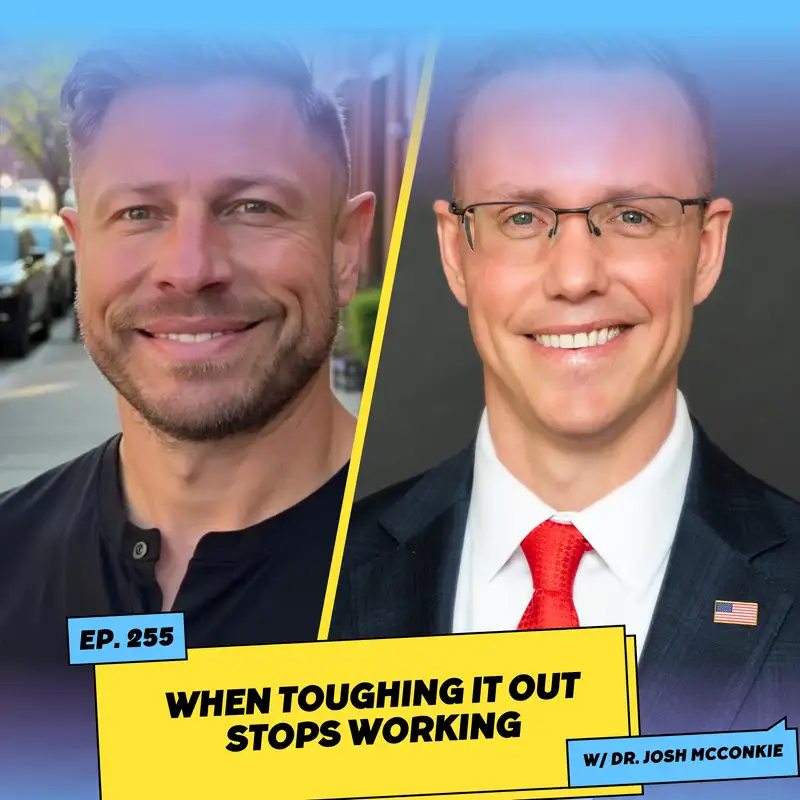
When Toughing It Out Stops Working w/ Dr. Josh McConkie
My guest today is Doctor. Josh McConkie. He's an emergency physician and a military veteran who flew medevac missions in Iraq. We get into the moment when Toughing It Out stopped working for him and what it was like to come home after that. We also talk about why alcohol becomes the go to coping mechanism for so many high performers and why shame keeps people stuck while ownership moves them forward.
Speaker 1:This one ranges a little wider than usual, but you've ever told yourself, I can handle it, this episode is for you. You have a really rich background and history that's very unique, and I wanna jump in to the first thing because you have a nickname, MacGyver Doc. So where does that nickname actually come from?
Speaker 2:Well, it comes from a mix of twenty five years of military service. Was I I flew medevac in Iraq. I've been a critical care air transport doctor, and I've been in the emergency department for about twenty five years as well. And you deal with anything and everything you can possibly imagine, and then you throw in there the surprise name and nominated author and started a nonprofit organization. I stay pretty busy, but I pride myself on being able to deal with absolutely anything you could possibly throw my way.
Speaker 1:I'd love to know what those environments teach you about how humans actually behave under pressure.
Speaker 2:Well, that's definitely something that a lot of combat vets have some experience in, and you learn a lot about yourself when you get put in those pressure situations. Myself, the first time I found myself in combat, this was 2007. It was part of the surge. So president Bush had called in 10,000 additional troops. I was straight out of residency.
Speaker 2:I was super green, a captain. I was the army national guard, and then they're like, hey. We need some docs out here. We need I was EMS fellowship boarded as well. So I do a lot of EMS pre hospital teaching.
Speaker 2:And so I found myself as medical director for Medevac. And the day I landed in theater, the day I stepped I stepped foot in Iraq, they shot down one of our helicopters. And this was a two week span where they shot down eight helicopters in a two week span. I was scared out of my mind because I was quite sure I was going to be number nine. And they killed the flight surgeon a couple weeks before I got there, and it was Colonel Allgood.
Speaker 2:And it just it just puts you in that pressure situation where you really kinda find what you're made of. It it was an adjustment. It really took a couple of weeks because I was writing some some letters home, and I finally called my cousin Zach, who's a special operator. And he's an 18 delta. He's like, man, you're you're in it now.
Speaker 2:You can cry and whine about it, or you can just just strap in for the best adrenaline rush of your life. And if you get shot down in a medevac helicopter, you're going out to save lives. I mean, there there's really no better way to go. So between my my cousin's words of wisdom and had a really great relationship that I developed with our chaplain, Jim Higgins, that you really kinda hand hand your your life over to God and just that faith. Because if you're just running around scared of dying all the time, it's hard to get things done in those high pressure situations.
Speaker 2:So a lot of people lean on faith in difficult times like that. That was the first time when I was really tested and put under that kind of pressure.
Speaker 1:Well, today, we're gonna talk about dealing with stress and high pressure and just difficult times, and we talk about that a lot here, personal stresses, going through, just life is difficult. That is is as real and as raw and as extreme as it can get. But what I'd love to know is because on the other side of this, I think that you learned a lot about yourself, a lot about how others can react in these situations, and how to kinda come out the other side of this. And was there a moment in going through all this where just, like, just tough it out, that sort of approach stopped working?
Speaker 2:Well, I I realized very quickly how precious life is. You're you're taking care of men and women that are just laying it all out there for the country. I mean, I carried body bags. I saved as many people as I could, and unfortunately, you just can't save them all. All of those things are are difficult to deal with.
Speaker 2:And I hit the gym. I definitely got in fantastic shape. But really, it was after that probably two or three weeks where just just toughing it out just clearly isn't gonna work anymore. You just it's it's almost like a mental breakdown. You have difficulty sleeping every time you try to call home.
Speaker 2:I mean, you're just you're you're crowning. I mean, once you have that realization that you are very likely going to die here, faith was certainly helpful, like friends, colleagues. For me, working out was really important. And it's it's this really compression, decompression where a lot of veterans can get into that mindset quickly because it's it's it's fight or flight. I mean, these are just basic instincts.
Speaker 2:Do wanna live or do you wanna die? And so you figure it out. But when you come home, that's why it's so hard. I mean, to come back from that and then try to reintegrate yourself back into society. I had a a very, very difficult time.
Speaker 2:I know a lot of people find drugs and alcohol, and I I ended up just moving to New Zealand for a year and had met my wife now also who's amazing, and she just saw how I was struggling a little bit. Just I tell people just some big just basic stories where when you're in a combat zone and you're taking care of people just taking bullets for the country, they say you you get a trauma. And there's an individual that had their legs blown off and they're they're near dying in death, and you just talk with them and say, hey. What's your pain? It's like a four out of four four or five out of 10, and their only questions really are, like, is my is my still there, and is my buddy alive?
Speaker 2:And then when you come back to The United States, there really wasn't much time to decompress. It was literally two weeks, and then I'm working a shift in the emergency department, and you just people's perceptions of of their pain and what was happening to them were just so vastly different than what I was experiencing in Iraq. I had a there was a 14 year old kid who had an ingrown toenail. It's two or three in the morning. And him and his mom had been waiting for a while because we were running a pediatric code, a two week baby that died.
Speaker 2:And we walk out of the room after being there for an hour or so, and we're all crying, and the nursing staff were pretty destroyed. I mean, this is your worst nightmare watching having a baby die. And this lady jumps out of a room just accosts us and screaming at us. Why are we waiting so long? And I was like, listen.
Speaker 2:This baby just died and we need a little bit of time. And she said, I don't care. We were here first. And I lost it. And I I Oh, yeah.
Speaker 2:I threw out of the emergency department. She's like, you can't do that. I'm like, security, throw this woman on my ER right now. And I just realized at that moment, like, man, I don't I don't know if I'm ready to be back here quite yet. And so we had moved to New Zealand, and I played soccer at Roto Roar United, and then a little emergency department at Roto Roar.
Speaker 2:I really, really helped me kinda that that decompression, and then obviously got back into the military when I came to The US. But it's it's coming back that's really hard.
Speaker 1:Yeah. Well, it it strikes home or hits home very closely to me. I grew up in a household where my father was a disabled Vietnam veteran with PTSD all his life. So this is something that I'm very familiar with that, yeah, that just tough it out. It might get you through that moment, but it's gonna come back in other ways until Oh, yeah.
Speaker 1:You find ways to to literally address it or get through it. And, even I find myself these days just everyday life with my kids, those expressions that we grew up with, just suck it up, just walk it off. I I catch myself not saying those because even in little things, it's programming our kids and to grow up to just stuff it down and just not address things.
Speaker 2:Yeah. Just ignore their feelings, bottle it up, and then it just blows up later monumentally, or they they cope, like, with with with mechanisms that aren't as healthy, drugs, alcohol. It it it finds its way out. I promise you.
Speaker 1:I I wanna move the conversation a little bit about your insights that you've learned through all your experiences to a little bit on more on the nose for the topic of the podcast, which is around alcohol
Speaker 2:Yeah.
Speaker 1:Specifically around stress and high performers. When does someone under that much pressure for long enough when does alcohol start kinda showing up as part of the picture? I'm sure that you've thought about this in regard to veterans, but also first responders. And
Speaker 2:Yeah. Yeah. Yeah. Veterans, first responders. Like, I was a special forces medical director for combat search and rescue, pararescue.
Speaker 2:The the the pilot the pilot and the weapon system officer that just rescued in Iran, they were the ones that do that rescue. So when you work with those types of individuals and then just high performers in in business and in medicine, it it begins very early. And so you'll see that in professional schools under high stress, like law school, medical school, special operations training. When they get a night out, there tends to be more alcohol involved than there should be, and it's easy to fall into that trap. And people use alcohol as that crutch, and the more and more you use it, it just conditions your body and your brain to not really deal with the stress effectively.
Speaker 2:So you're just basically supplanting normal coping mechanisms. However it is, like for me, like for now, I've learned a lot after almost fifty years on planet Earth, I'll be 50 next year. I work out every day, I run, I find if I just exhaust myself, and it's kinda hard to be hard to be stressed out. Not everybody can do that, of course, But the alcohol just kinda turns into that cycle even though you maybe feel better at the time and, you know, these days, the anxiety falls away. I mean, you pound a couple of whiskeys.
Speaker 2:Gosh. I feel so much better. You don't sleep as well. Your body your your your mind rebounds, but then it just heads in the opposite direction, and then you chase that the next night or the next time. And that that's how it comes become very very more habit forming and and the addiction component, and and then you're just kinda chasing You're just chasing it at that point.
Speaker 2:And so once you condition your mind to not be able to deal with it, like in a healthy way, that that becomes your coping mechanism. And that's I see so much of that in the emergency department as well. I worked at the VA hospital, just so many veterans. And, boy, it's been twenty five years I've seen lots and lots of alcohol issues.
Speaker 1:Specific industries really can take it first responders, like you said, high performers executives. I mean, we see it a lot in the service industry. It's high stress, high pressure, access to alcohol all the time. There's so many different things that kinda come into play.
Speaker 2:So the different chemicals in the brain, it it basically kinda mimics some of the GABA receptors, and it it it it's it's a it's a depressant. So it kinda just shuts down that area of the brain. You feel more relaxed. You you feel that as a stress reduction, but in reality, it's always gonna rebound. It hit the opposite direction.
Speaker 2:So you have a couple of drinks. Gosh. I feel like I get to sleep so much faster. My mind gets off of what I was worried about or stressing about, but it's but it's only temporary. It comes back with a vengeance that the brain has this rebound.
Speaker 2:And then once you have enough of it, you actually get that that physical addiction where you can't function without it. And and I see lots of late stage alcoholism, like like end stage and liver failure and just like just a true addiction where you just can't function without it, and then you go into both those withdrawals. So it actually, the regulation of those receptors in your brain and your body, it gets to a point where if you stop drinking, I mean, could literally die, right? Delirium tremens and seizure. That I deal with lots of that as an emergency doctor.
Speaker 2:There's the mental illness population has a there's a lot of alcohol related issues, homelessness, veterans. I mean, I I see it almost on a nightly basis.
Speaker 1:Yeah. I mean, it's unfortunate. So I would think that of all the people, there are different reasons that people get an unhealthy relationship with alcohol. Some people, it's related to work and, like, wanting to fit in. Some people enjoy it, and they use it as a crutch also, but there's also trauma, and there's also anxiety and using it in some capacity for self medication.
Speaker 2:Self self like, kinda just treating yourself, And then there's a genetic component to that as well. Right. So for me, I I I was very cognizant of that. And my father, I just remember just telling me straighten by my grandfather. He he he died relatively early from esophageal cancer, and he was a very heavy drinker for a lot of his life.
Speaker 2:And so he kind of, he warned me, he's like, there's some alcoholism in his family, you gotta be careful. And so it's something that I've tried to be cognizant of. In college and medical school, probably drank more than I should have. I I I think, honestly, most medical students, law students, if you've ever been to any of their parties, there's there's may maybe rugby players drink more. I'm not sure.
Speaker 1:So and of all those groups that you interact with and have also lived within, is there, like, a pattern that you tend to see? Is it harder for them to realize that it's become a problem than maybe another category, or do you think that they're problem aware but not really maybe solution aware?
Speaker 2:Well and that's where you see in the in those high performers in particular, like, like, military, the first responders, or some some police officers, like, physicians. They they're they're really kinda at at at the top of their field. Right? And they they they tend to have some pretty big egos. And, hey.
Speaker 2:I can handle this. I can deal with this. It's not a problem. I can turn it on. I can turn it off.
Speaker 2:I cannot I cannot drink for a few days and hammer this test or get this military exercise done, but I'm fine. I got it. I got it. And until you don't. Yeah.
Speaker 2:And then I actually had a very I had a very good friend of mine that had drank an insane excessive amount in college to the point where he could literally only get drunk drinking Everclear. I mean, clearly, it was an issue, but brilliant individual and very, very good friend. And in medical school, it it it finally caught up to him. And we went to treatment. I had to take a year or so out of school and then did fantastic.
Speaker 2:Doing great now. But watching that with a with a very close friend that I'd known for for years and years by just brilliant individuals. They've got they got it until they don't. And it's and it's pretty big crash too.
Speaker 1:Yeah. So I can identify that because at times questioning, okay. Well, if it was really that bad, then I wouldn't be getting up and going for a run, getting all my work done, showing up to every single thing that's expected. But I'm also somebody that also is very aware of his flaws and always is trying to do better. So at that point, it wasn't a very long negotiation with myself where I said, I can do better than this.
Speaker 1:But I can absolutely see how you can very easily convince yourself to keep going forward as this is just part of dealing with life. This is part of sucking it up.
Speaker 2:I've got a great story. So this I don't want won't drop any names here, but there's a professional golfer in his caddy. So I've got some friends that are big time into golf. We've had some conversations, and they actually went on a trip and and and met some of the caddies for some very famous golfers, people that you know. And this and this caddy, basically, just some monster drinking problem.
Speaker 2:He he was absolutely brilliant and had actually interviewed with with one of these golfers for a job, and they they they made a comment like, hey. I I kinda hear you have an alcohol problem. He's like, I don't have an alcohol problem. I could I I I basically can can still do this, this, and this. I I just when I go home, I just choose to drink.
Speaker 2:It doesn't affect my job. He was so brilliant and was so good at his craft and being the cabbie like it's it's not a problem. He was a raging alcoholic, but for him, it's it's not a problem. You know? Until he was recognizing it was a problem and he just just refused to recognize it.
Speaker 2:He could still function, do his job, and just even at that level, which was very, very impressive. So the the guy is a genius. Like, I can't imagine what he would be doing if he wasn't a raging alcoholic most of the time. But, hey, he was still functioning and still performing.
Speaker 1:It works until it doesn't. Whether that's a hard crash or just one day you realize this just isn't working either way. But sometimes you have to come into that. And along with that saying, I need to make these changes can also be coupled with shame. And I love you to know your viewpoint around shame and why shame almost always backfires.
Speaker 1:Oh, yeah.
Speaker 2:Wait. That's the difference between that ownership and and beating yourself up about it. Right? So when you beat yourself up, it's it's just negative energy. It's very destructive.
Speaker 2:It becomes your identity. Oh, I'm I'm I'm an idiot. Fine. But I'm just just and it becomes excuses, and there's the kind of the victim mentality and just it it's it's very destructive. It doesn't help.
Speaker 2:It's it's it's very negative energy, and emotionally, it's it's just a spiral. Yeah. And then it just becomes your identity. On the ownership side, it's just like, hey. Listen.
Speaker 2:I messed up. I own this, and I'm gonna do something about it, and then you make some changes. Right? On the the other side of that is it just becomes that vicious circle at a cycle over and over because you just tell yourself an idiot. You just blame yourself and beat yourself up, and then you just keep doing the same thing over and over versus, like, ownership.
Speaker 2:As in once you take ownership of that, you do something about it and you make changes. And those behavioral changes is that's very positive. That's a very healthy thing when you make mistakes. Be a man about it. Be a professional.
Speaker 2:Hey. I messed up. I'm on that. And then you do something about it. If you keep making the mistakes, then you start blaming yourself.
Speaker 2:Not healthy.
Speaker 1:Yeah. It feeds the cycle. The shame can cause the same thing that you're trying to avoid. It's probably the most difficult thing for me to get for people to get over in doing the show and the feedback that I get, but also in my own life. I could even give the advice of don't carry shame around this because it's not gonna help.
Speaker 1:And while I'm not carrying shame when it comes to alcohol, there are other things in life that you can carry shame around, and I have to catch myself even today to say this isn't helpful. It's okay to make mistakes. We're all doing the best we can. Take ownership for it and move on. But, yeah, that the shame is the hardest part, I think, for most people.
Speaker 2:Yeah. Because that that's life. I mean, nobody is just born in life with all of this information and all the answers and all this wisdom. Like, life is the only it it's it's the only test. It's the only test.
Speaker 2:Like, where you you have to take the test first, and then you you you learn, like, what the correct answers were later.
Speaker 1:Right.
Speaker 2:Right? Yeah. It's like, you can't get the wisdom without experience. You can't get the experience without generally making a lot of mistakes, to be honest. Like, no nobody's perfect.
Speaker 2:I mean, you learn from mistakes. Oh, well, didn't go well. And it's it's just like the opposite where, you know, you get to study for a test and hopefully you do well, but there's no really studying for life. I mean, you just think things happen or you make bad decisions and you learn and then, oh, okay. Well well, that was the right answer.
Speaker 2:That would have been helpful four or five years ago.
Speaker 1:Yeah. No. Failure isn't. And and it is, like, not beating yourself up because if beating ourselves up worked, then everybody that had any kind of issues would come out the other side immediately because we're all really good at doing that. It takes more discipline to really pull yourself away from that and move into a mind space that if versus implosive and destructive.
Speaker 1:Let me ask you this. So if somebody's listening right now and they're realizing I've been using alcohol to cope, what would be the first shift that you'd want them to make? First off,
Speaker 2:you have to recognize that there's the problem. Right? Because nobody can tell you. I mean, your your parents, your friends, your spouse, like, I mean, you'll hear it over and over and over, like, every day when I'm in the emergency department with people. I can tell they recognize it's a problem, it is not gonna get better.
Speaker 2:There's always excuses. You're always rationalizing. So you have to make that jump yourself, like, in your mind like, listen. This is a problem. And that's and that that's a big step.
Speaker 2:And that's the most healthy step because once you recognize it yourself and you take ownership of it, it's not the blaming thing anymore. It's not the beating yourself. It's like, I have a problem. I need help. You're you're not alone.
Speaker 2:My goodness. I mean, some of the most famous people on planet Earth have they have had drug and alcohol addictions. And, I mean, the people that I work with and see on a daily basis, you're like, wow. I I never would have known and never would have thought that somebody in that position could still have these problems. Everybody.
Speaker 2:Special operators, like seal team six, tier one operators. I mean, like, the the the hardest charging, toughest mental and physical people on planet Earth still have these issues. They still have drug and alcohol problems. They still have suicides and mental health issues. I it's nobody's immune from this.
Speaker 2:You So just make that realization yourself and then go get those resources. Like, that's where taking ownership of it is like, great. What can I do? And people if they don't know and you say say you've burned all your bridges and you feel like you're alone and you're finally recognized that this is a problem and everyone else has bailed on you because you've just, like, just shit on them all. Go to your emergency department.
Speaker 2:Like, I'm literally I'm there waiting for you. I have mental health resources. I can get you in touch with psychiatrists and treatment specialists and social workers and whatever resources you need. I I'm very proud to be that safety net for America. A lot of people don't realize that they can go to your emergency department for things like that, and we can get you those resources.
Speaker 2:So you have to recognize that there's a problem and then find those resources. Hopefully, you've got some people still behind you that wait behind your spear that you can lean on. But, you know, some people have burned all those bridges, and they feel like they're alone. Come on into your ear. We gotcha.
Speaker 1:Yeah. I think that, fortunately, everyone that's listening to this is actually taking steps to better themselves. So I love that we don't have to get over that for most people, but I do I think one of the challenges is and I've heard this recently in an email that wrote me is, like, I should already have this figured out. I've done all these different things in my life. I'm successful in this part, and I'm disciplined in this part, and people feel continuously let down by themselves as in I should have figured this out by now.
Speaker 1:But I love how that ties in to just say, it doesn't matter at what level you are or what age you are. It's a difficult thing for everybody. The levels of difficulty, the nuances where you come from, how you approach things in the support network, of course, are all gonna be different. But it's nonetheless, no one should feel bad for finding it challenging.
Speaker 2:Yeah. Because if it was super easy, that wouldn't be a problem for anybody. Right? It's, I mean, this this this has plagued mankind for hundreds and hundreds of years since there's even been alcohol. Like, this it's it it is very difficult.
Speaker 2:But once you make that decision yourself, then you take that ownership, and then you head in the right direction.
Speaker 1:I love that. For somebody trying to show up better for the family, what does that actually look like in everyday life?
Speaker 2:So you can start very simple. Right? Where you just physically make that time. And this younger generation, if there's parents at homes and people with families, the digital world that we live in right now has not been great for mental health. It has not been great for the younger generations of Americans.
Speaker 2:They they were raised on social media and iPads and iPhones. You know? Buddy, like, basically, the iPhone generation, of Gen Z, you have to get involved face to face. So social media is not gonna do it. It's not gonna be TikTok videos and YouTube.
Speaker 2:You have to you have to be there in person. So volunteer. Coach little league, basketball, soccer, go to that animal shelter. Just just be a volunteer in a church or a school, but be that mentor. They had to physically see it, that face to face mentoring and interaction because their whole world is digital, so it has to be face to face.
Speaker 2:And, like, everyone's got that unique set of skills. Like, it it's super important. Did you get out there? Everyone's got a different set of skills. So there are so many organizations in your community from soup kitchens and volunteering and coaching sports and athletics, ambush shelter discussion.
Speaker 2:There's just there's millions of organizations out there that that need your help. Tons of nonprofit organizations that just need volunteers. So getting out there and doing it face to face is the most important part.
Speaker 1:I a 100% agree with that. I mean, we're we're of the same age group that we know the Internet. We grew up with some digital, but we still remember payphones. We still remember going out and meeting friends at a parking lot at 08:00 on a Friday night or whatever like that. And, also, nothing's ever gonna replace that face to face interaction.
Speaker 1:So I think that it's just such such strong advice that people these days really need to be pushed at times. But once you get out there, you'll see the difference. You feel the difference. And in fact, if it ties into the topic today, it replaces a lot of the needs that maybe alcohol or other coping mechanisms that aren't healthy in a constructive way that gives back. Well, I want to say thank you for your work.
Speaker 1:And anybody here that wants to learn more, potentially reach out, or any projects that you have going on, I'd love to hear about that for you to share.
Speaker 2:Absolutely. If you go to eatbehindthespear.com, weight. Wait behindthespear.com. You follow on on x McConkie double o seven. On Instagram, it's Josh McConkie MD.
Speaker 1:Thank you so much for coming on today.
Speaker 2:Thank you very much. I appreciate it.
Creators and Guests