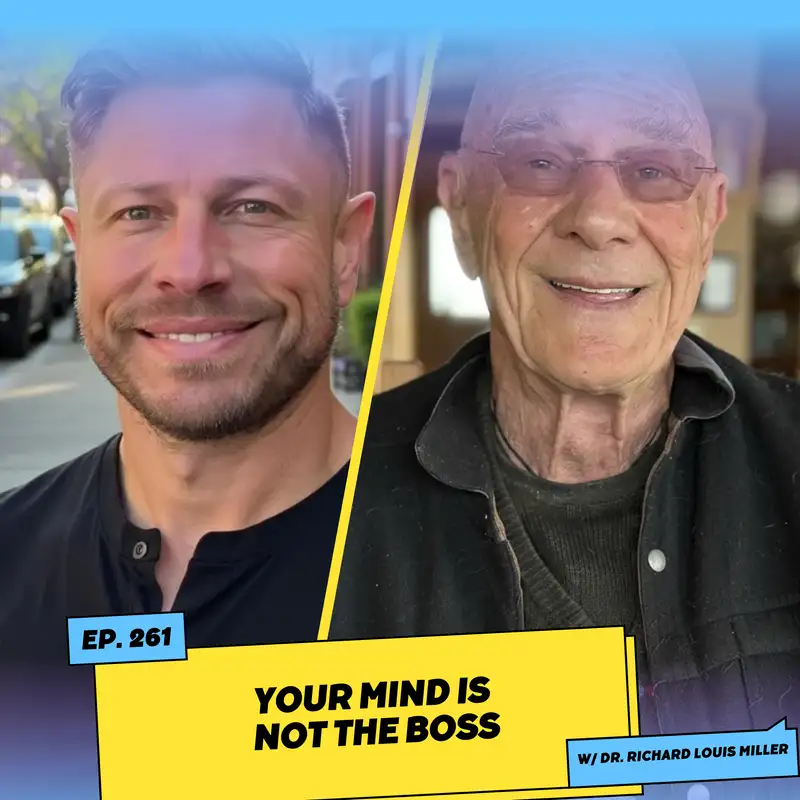
Your Mind is Not the Boss w/ Dr. Richard Louis Miller
Doctor. Richard Louis Miller has spent more than sixty five years helping people understand the mind, the body, and why we do the things we do. In this episode, he shares a simple but powerful idea. Your thoughts, cravings, and feelings may be loud, but they do not have to be in charge. We talk about how easy it is to get pulled into automatic patterns, why alcohol can become a shortcut for relief, and the question that can create just enough space to choose differently.
Speaker 1:Richard, thanks so much for coming on today.
Speaker 2:You're welcome. It's lovely to be here with you.
Speaker 1:Well, Well, it's a privilege to have this conversation because I rarely get to talk to somebody with the depth of experience that you have along with very unique and pioneering ideas. And so I'm really interested to get into that today. But, yeah, thank you so much for coming on to share your what is it? Sixty five years in clinical practice?
Speaker 2:Yeah. About sixty five years, Michael.
Speaker 1:Incredible. Alright. So this is undoubtedly gonna be a great episode. Okay. So you often say in your work that the mind is a tool, not your boss.
Speaker 1:What are the core principles behind that idea?
Speaker 2:Well, we grow up believing that everything that we hear in our heads is something that we're meant to hear as if it has almost a divine or magical purpose, sort of like, well, I wouldn't be hearing it if it wasn't important, so I better listen to what my mind says. And I am questioning that entire notion. What I'm saying is the mind is a tool just like the computer, and the computer doesn't tell us what to do, and the mind isn't made to tell us what to do. However, where the mind is different from the computer is that the computer, if we don't type or talk into it, it stays quiet. The mind is similar in that it has an accumulation of a huge amount of information plus feelings and emotions.
Speaker 2:However, it does not stay quiet. It is a self generating machine, so it will generate ideas, thoughts, pictures, movies, music, colors. You name it, the mind can generate it, and it will. Just like when we go to sleep, we do not know how, most of us, to throw a switch and say, dream, or throw another switch and say, no dreaming tonight. We don't know how to do that.
Speaker 2:But what I have learned, and I'm passing on, is that there are switches to throw to turn the mind off. And that is why I'm talking part of why I'm talking about the mind as a tool. We not only can learn how to turn it off, Michael, we can direct it to think about exactly what we want it to think about. It takes practice. Practice.
Speaker 2:Practice. It's a skill. And over time, we can learn to change the channel. We can learn to put the program on that we want, we can learn to direct it to think about topics that we wanna think about, and we can learn to turn it off. That's why I say the mind is our tool to use, but it's not the boss.
Speaker 2:It wants to be the boss. It does, but it's not.
Speaker 1:Makes total sense. So take me back to this concept that you felt called to, that you needed to define, that you needed to give switches for people to know when to turn it off and when to turn it on. What were you seeing around you that made you think that I need to define this so that people can get better results than maybe they are currently?
Speaker 2:In 1968, I was sitting in a seminar with doctor Fritz Perls, Frederick Perls, the founder of something called Gestalt therapy. And Fritz was already experimenting using closed circuit video. And I was in a group therapy with him at the Esselen Institute in Big Sur, California, and I watched the video. And when I saw myself on the video, I realized that I was what's called caught up in thought. I was so involved with my thinking that I was not paying attention to what was going on in the room.
Speaker 2:We have all had that experience, and some of us have even had the experience of thinking so intensely that we've missed turns when we're driving. In fact, I was driving one time and thinking so intensely that I missed the turn off to Tahoe to go skiing, and before I realized where I was, I was forty five minutes down the road at Reno, Nevada. So that was an intense think. I see you shaking your head, so you know what I'm talking about, how you can think so much that you lose sight of what's in front of you.
Speaker 1:Well, I reached for the the salt instead of the sugar yesterday morning and almost poured it in as I was going through things in my head. So yeah.
Speaker 2:Okay. You know exactly what I'm talking about. And and that's something that many people can relate to because it happens so commonly. It's our job if we want to live a graceful life with what's called agency, us being in charge of our thoughts and our feelings and our feelings, then we have to learn the skill that it can be taught in grammar school to begin with. But it's something, Michael, that I never learned in eleven years of college.
Speaker 2:I was never taught how to control my mind, how to turn the dial, how to turn it on and off, and how to direct it to do what I wanted to do. Eleven years of college. So there I was in that seminar and answering your question. I looked at the video. I realized what was going on, that I was, quote, lost in thought, and really what I was was lost.
Speaker 2:And so that was the beginning of me studying methods for taking control and designing techniques and tactics that the average person could do with a reasonable amount of practice. There's no point in coming up with something if you have to practice five hours a week. You're not gonna get the people to to practice five hours a week. Just like you're not gonna get most people to meditate five hours a week. It's not gonna happen.
Speaker 2:That's just not the way we're built. It's not the way the civilization and the culture is. So what I've come up with is learning how to practice skills of mind and emotion mastery in very small segments, thirty, sixty, and ninety second repetitive segments as ways of controlling. So anyway, that's why you asked the question, how did I begin all this? I began by watching myself on a video in a in a psychotherapy seminar.
Speaker 1:I love the story, so I can't I mean, you I want you to pull out any stories that you have like that as we go. So
Speaker 2:Your story is your story is I was going for the salt, and I almost put the sugar in until I realized I was lost in thought.
Speaker 1:Oh, I I mean, it's like, that's on loop in the mornings. I'm so in my head that I'm not even paying attention, to be honest. But, also, the I pass things in the car all the time, so I can relate. So, you know, I think that a lot of this it's like one of those things that it's obvious and in front of you, but maybe you don't grab it and pull it in and examine it. And it sounds like you have.
Speaker 1:So I wanna sorta, like, focus some of the work a little bit more narrow to the podcast here. So for example, like, when people are reaching for relief, whether it's through alcohol, another habit, or just feeling stuck inside habits that they wanna change, what and I you said thirty, sixty, 90. What does that self talk usually sound like? How do they begin to maybe change that inner dialogue to then be begin to change themselves?
Speaker 2:To begin with, we have to observe ourselves and be aware of ourselves if we want options to change ourselves. We cannot change what's outside of our awareness. So if I've been biting my nails fortunately, that's not one of my habits. But if I've been biting my nails for weeks or months or years and I'm not aware of when I'm sitting there and biting my nails, I'm I don't have any option. I'm not aware that I'm doing it.
Speaker 2:And days, weeks, and months, and years are going by, and I'm chewing on my nails. I see the results, but I'm not aware of it. It's similar, you could say, to not being aware that you're, quote, lost in thought. You're driving down the street and you're thinking so hard, you missed your street, and you could even miss a red light. It could be dangerous.
Speaker 2:First, you have to take the time to become aware of what it is that you're doing. You can't change what you don't know. So for example, I've got a bottle of booze in front of me. I've got the option to reach out and grab it and take a slug. I also have the option to pause.
Speaker 2:But in order to pause, I have to be aware that I'm about to reach for that bottle. I've gotta let myself be aware of it. Then if I'm aware of it, I might even ask myself the question, what am I asking this drink to do for me? In other words, what purpose does it serve in my life? If I reach for a glass of water, I'm thirsty, I know I need to hydrate.
Speaker 2:The purpose of drinking the glass of water is to hydrate my system, which is made up of mostly water and it needs more water. Very clear. If I have a headache and I reach for two aspirins, I'm saying to those aspirins, I have pain in my head and I want you to go in there and reduce the pain. Everything that we ingest, we ingest because there's a reason behind it. We don't just blindly lay on the ground, open our mouths, and everything that comes in, we swallow.
Speaker 2:There's our eating is purposeful. Now some of it is because we naturally are hungry, and the body knows it needs fuel. So when we're doing that kind of eating, we're saying, I need fuel. I'm eating you. You go in there and provide fuel for me.
Speaker 2:When you're wanting more of a gastronomical meal, you're combining fuel with sensuality that we call taste. So we're enjoying the fuel as it's coming in. When we're reaching for mind altering substances, such as alcohol, we are making a very specific request. It's not the same request every time, and it's not the same request for all people. Some people may be drinking because they want to numb themselves because they have internal pain.
Speaker 2:Somebody else may be drinking to loosen their inhibitions because they know they, quote, loosen up with alcohol. Some people drink alcohol because they think that it gives them more energy for a certain period of time, the sugar. So there are different reasons for drinking, and each time we reach for the drink, we're making a request, and each time it could be for a different reason. However, there's a little slogan in life that I go by that is relevant here, and the slogan is a little something over time is a lot of something. A little something over time is a lot of something.
Speaker 2:And here's my favorite little story about that slogan. If you keep everything else constant, what you eat, how you sleep, the amount of food you eat, the exercise, everything is the same, and you change one thing. You have one beer every day or one bottle of soda pop every day. Everything else is the same. At the end of three years, you've gained over 40 pounds.
Speaker 2:Why? Because that little 100 to a 150 calories every single day adds up to how many calories a month, How many calories a year? How many calories in four year three years? And when you divide that big number by 3,500 calories per pound, you've gained over 40 pounds just from that one little drink. Oh, one little drink.
Speaker 2:It's not gonna bother me. No. That one little drink isn't, but that one little drink every day for three years is gonna put 45 or 40 on you, almost 45. So when people start experimenting with mind altering substances as well as other things, They easily forget that doing a little of it over time becomes a lot of it, number one. And number two, what they easily forget is that many of these substances, alcohol is one of them, turns out to bring something with it that I call the creep.
Speaker 2:Namely, if you start drinking one drink every single day, a beer, a glass of wine, a highball, whatever it is, you don't stay with that one for weeks, months, and years. It just doesn't happen. You either drink less or you drink more. That person did not have a bad childhood. That person isn't dealing with post traumatic stress disorder.
Speaker 2:That person isn't dealing with all kinds of I need to numb myself from the pain. That person is simply dealing with a habit that dealt up over time, a little something over a long time, and it became what you might call institutionalized in that person's culture. That person is now a person who, when he goes out on a date or she, let's have a few drinks. That's a person who, when they're single, let's go to the bar. What do you do at the bar?
Speaker 2:You drink. So that person has now incorporated drinking into their very lifestyle. Now I could take it to the other extreme of a person who started drinking when they were 12 or 13 because they had such terrible abuse in the family. They're gonna get to the same place as the other person, namely over drinking, or if it happens to be Coke mixed in or heroin, it can be one of those, and it might be a prescription medicine such as the oxycontin, hydrocodone, etcetera. We're talking here about over time not asking the question, what am I asking this mind altering substance to do for me, but instead robotically getting into a habit pattern because of doing a little something over time.
Speaker 2:I have treated thousands of alcoholics, literally. I've never met one alcoholic who started drinking by grabbing a bottle of vodka and downing it. It's not how it starts. It's if it is, it's extremely rare. People start, quote, with a drink.
Speaker 2:People start with one shot. People don't just like, I've never drunk before in my life. I think I'll have eight highballs. That's Right. It might happen, but it's it's very rare.
Speaker 2:It's very rare.
Speaker 1:I mean, it's it's true. A little bit adds up to a lot. Death by a thousand paper cuts since we're talking more on the moderation harm reduction approach that there probably won't be a rock bottom. Sometimes it just it never gets bad enough, so it's it's a lot of self regulation to get in there and realize, I need to make these changes, and I think you nailed it. You gotta identify what job is this substance that I'm reaching for doing right now.
Speaker 1:I wanna zero in on another side of it because you've thought about this on both sides. So not just on the side of how do I change this habit and how do I look at it and how do I stop myself or pause and make sure that I'm making a choice consciously. What about on the self trust side of things? So a lot of people will say, it's not even about the drinking that bothers me the most. It's that I told myself I would, let's just say, I'd only drink one night a week.
Speaker 1:Now I'm breaking my promises. How do people start to trust themselves again? How do you approach that?
Speaker 2:When my daughter, Eva Cheska, was five years old, She came home from school one day. This is a kid who grew up hanging out in group therapy, literally walking into sessions. And she came home from school one day and she said, dad, here's what I noticed at school today. Kids find something that they're unhappy about inside themselves, and they start looking around the room to see what caused it. That sums it up.
Speaker 2:They've already been taught by the time they're five years old that when some feeling is going on inside that's not comfortable, they should look around outside to see what the cause is rather than close their eyes and look inside to see how they're creating that discomfort. And therein lies the source of a great deal of our problems and our anxieties because we're taught from that early age to look around outside to deal with stuff that's going on inside. There's pressure, but not like alcohol. Drive down the street, big signs, big posters, magazines, you name it. Everywhere you look, drink, drink, drink.
Speaker 2:So the people who are involved with alcohol have that cross to bear. But the people like myself whose basic out of control area is eating, we have it the worst because you can't you can't go cold turkey. You have to eat to live. They're really not getting inside and finding out what that food is doing for them. Right?
Speaker 2:What it's doing for them. Yeah. What's what's my food, what it's doing for me, instead of taking the time to reduce my emotional state by sitting and breathing and using all the skills I have, it's easier to grab the icebox and stuff something in my mouth, and that's what I'm dealing with. And so those of us who have this issue in terms of your question, we can always trust ourselves that we may reach for something that's gonna hurt us. And so once we have this issue, we must be hypervigilant for the rest of our lives.
Speaker 2:That's just the name of the game. We need to be vigilant, if not hypervigilant. That might be too strong. We need to be vigilant for the rest of our lives. That's how it is.
Speaker 2:If you have a certain part of your body that's vulnerable, you injured your right elbow, you have to learn for the rest of your life not to bang your right elbow. Because if you do, it's gonna hurt like all hell, and that's gonna be with you forever. These things are the same. If you have an income impulse control disorder, that means you're doing things outside to change your inside. You're gonna have to be vigilant.
Speaker 2:By vigilant, I mean awake, aware, watching what you're doing, noticing. It's not a strenuous activity, but it's an all the time activity because otherwise, we're liable to reach in terms of the drinker. We're liable to reach for that bottle rather than deal with our emotions in a different way. And, of course, part of what I teach in my work is how to deal with those emotions in other ways. In other words, if I'm asking the bottle of alcohol to do x, y, and z, emotional pain, trauma, forget memories, take away the fact that I'm scared about my job, whatever it is, Then I ask the question, how can we solve the same issue in three other ways instead of drinking, coking, heroining, or whatever?
Speaker 2:In other words, what are the sober alternatives that we can have a great life having and not feel that we're being cheated because we're not getting our drug of choice? Like, you know, people feel, oh, you know, you're taking away my my fun or my painkiller or my whatever it is. You're taking something from me. And I believe if you take something from somebody, you should give them something back in return to fill the space, and that's what the tools are.
Speaker 1:Yes. Absolutely. When one door shuts, another one opens, you just have to look for it and open it up. Absolutely. And, otherwise, you'll just be constantly looking to fill that void that you perceive as a void even if it actually isn't.
Speaker 1:You know, I I wanna ask you before we get going here because I know you've mentioned Marcus Aurelius. And, what do the stoke stoke philosophy teach us about not being ruled by the next feelings?
Speaker 2:Marcus Aurelius, two thousand years ago, philosopher, emperor of all of Rome, He said, our feelings our feelings are ours to create, and they are not guided by external events. What that means is we can choose to feel feel on a feeling basis. Actually feel. I'm not talking about thinking now. I'm talking about sensations in our body, what we call emotions, we can choose to feel what we want to feel and how we feel regardless of what's going on around us, because this is this is our agency.
Speaker 2:This is our sovereign being. And that if you really think about what I just said, that's a really big task. That's a really big task. That's the task that when my health retreat that I the health sanctuary at Wilbur Hot Springs, which I created in 1972, and in 2013, when I stood there and watched it burn and watched my my work of almost fifty years burning, that was how and it was on my birthday. On my birthday, that was how after I made sure that every single guest was safe, I had all the guests stand in a circle while the building was still burning and sing happy birthday to me.
Speaker 2:I did not let losing uninsured, no no fire insurance. I did not let the fire ruin my birthday. I had the joy of standing knowing that every single one of my guests was safe, and that was more important than anything else. Nobody had a scratch on their body, And so I gave gratitude for that, and I stayed in the present, and they sang happy birthday to me. And that's a way of demonstrating to oneself that our inner feelings do not have to be in any way pushed down or diminished by external events.
Speaker 2:And I can give you other examples in my life as well where I practiced what I learned from Marcus Aurelius. It's a it's a big it's a really big ask. It's a big ask when you think about it and really sit with it. What I feel inside is determined by me and not by external events of what's around me.
Speaker 1:I find that the most challenging of any of the stoic literature is putting it into practice. The sensical nature of it is obvious or, oh, that makes sense. But to hear your own story, I'll then pass on. I have presence and gratitude for the conversation that we're having here and that you've come to share today. So thank you so much, Richard, for sharing.
Speaker 1:If anybody listening wants to find out more about you, listen to your own podcast, find out more about your work, where's a good place for them to connect with you?
Speaker 2:Oh, thank you for asking that, Michael. They can do one of several things. They can go to my podcast. It's called mind body health and politics. Mindbodyhealthandpolitics.org with emphasis on all the words, including politics.
Speaker 2:Mind, body, health, and politics. They can go to my own website, doctorrichardlouismiller.com. Doctorrichardlouismiller.com. You can go to Amazon, and all my seven books are on Amazon, and you can learn about me there because they have reviews of me and, you know, who I am and stuff like that. And then there's social media.
Speaker 2:As I mentioned before, I'm an influencer on social media, and I give away free health tips. And, you can follow me on Instagram or YouTube or TikTok. You know, I'm out there giving out health information. Thanks for asking.
Speaker 1:Well, thanks, Richard, so much. This has been a great conversation.
Speaker 2:Well, thank you so much
Speaker 1:for
Speaker 2:having me.
Creators and Guests